Here's my final map prediction for tomorrow:
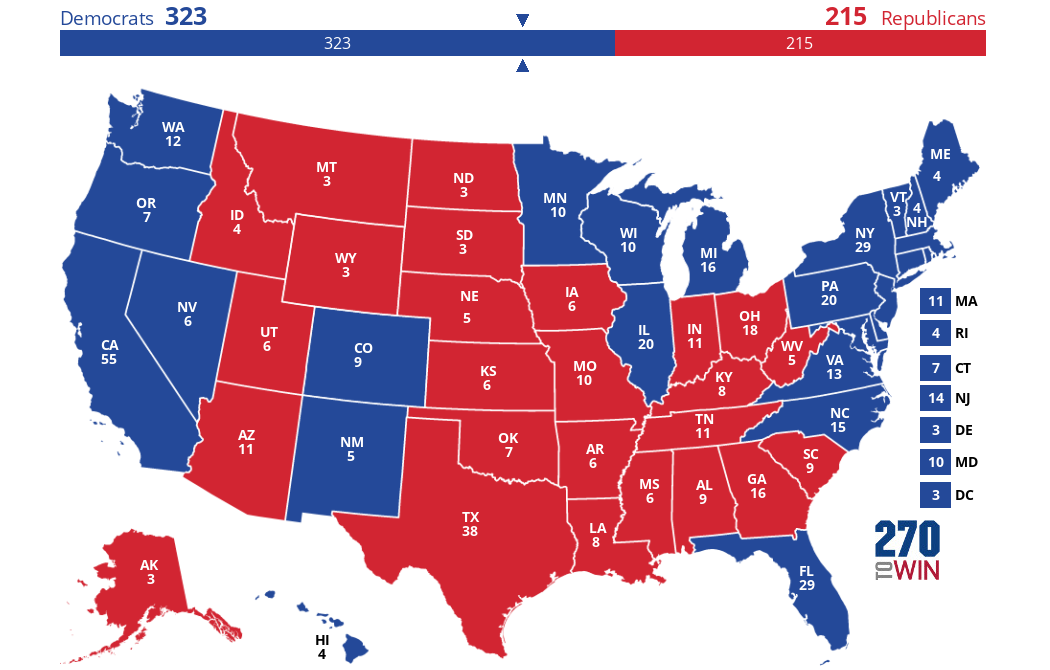
323-215 to Secretary Clinton, Trump takes Iowa and Ohio, but loses all the other swing states: FL, OH, NC, PA, VA, CO, NH and NV.
326-212 if you switch Ohio and NC. I would be pleasantly surprised if the Buckeye State didn't disappoint me. It's possible Florida could go either way too but I have to hang my hat on something, and that's going to be the huge Latino early voter turnout in FL and NV.
Trump has no viable path to 270 if he loses both, he'd have to run the table on all the other swing states I named except for New Hampshire, and he's just not going to break the Virgnia/Colorado/Pennsylvania Clinton firewall and still lose Florida. If he does, he wins outright and will win. Bigly, even.
Still, sticking with the above map, which is Obama 2012 minus OH and IA, but plus NC.
What about the Senate?
I think Dems are going to get pickups in PA, WI, and IL for sure and defend Harry Reid's seat in NV, meaning they have to get at least one win in Missouri, Indiana, NC or NH. I think they'll get all but NH in this scenario, so 52-48 Dems.
Please vote tomorrow if you have not voted already.
Monday, November 7, 2016
 Click the map to create your own at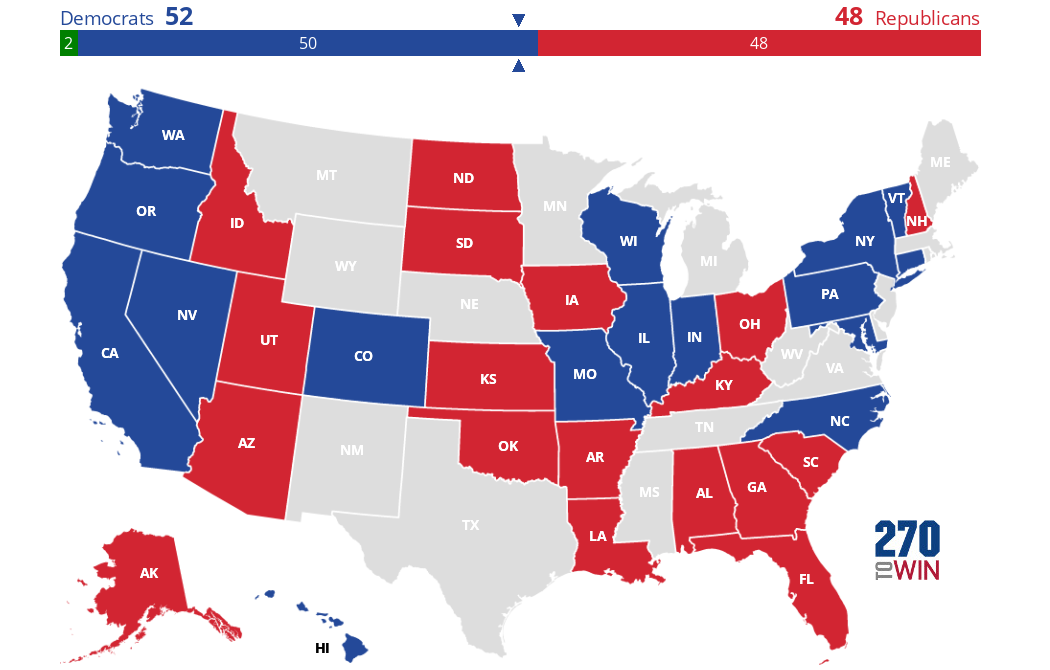


The Big Winner Tomorrow Is...
...Angry Racist White Guys, according to the NY Times. Gosh, when has America somehow not belonged to Angry Racist White Guys?
And that ladies and gentlemen, is the true legacy of Trump and the GOP in 2016: Making Racism Acceptable Again. Acceptable enough that 60 million people are going to vote for the guy tomorrow, minimum.
Not that it ever wasn't acceptable, mind you. But Obama winning made them tired of covering for it, and that's why Trump won the primaries.
Pretty awesome, huh.
“I never thought I’d see the day where illegal immigration was included in a presidential candidate’s top three issues,” Mr. Gilchrist, a supporter of Donald J. Trump, said. “For me personally, my mission has been accomplished.”
While Mr. Trump seems likely to lose the election, many of his most extreme supporters say they believe that they have already won. Whether the subject is immigration, military intervention, the news media or federal government corruption — and even the entire democratic process — their views, long thought to be well outside the political mainstream, have been given a voice inside it. And that voice belongs to the presidential nominee of a major political party.
Of course, Mr. Trump’s populist candidacy has energized ordinary Americans across the country who previously felt alienated from the political system, but it has also emboldened extremist groups that say he has validated their agendas.
It is unclear how much legitimacy these organizations can realistically expect to gain, given the extreme nature of their views to most Americans. But if they are able to maintain even a measure of influence on the right after the election, this could be Mr. Trump’s most enduring legacy.
“Trump has shown that our message is healthy, normal and organic — and millions of Americans agree with us,” said Matthew M. Heimbach, a co-founder of the Traditionalist Youth Network, a white nationalist group that claims to support the interests of working-class whites. It also advocates the separation of the races.
Whatever happens on Nov. 8, Mr. Trump’s candidacy has brought groups like Mr. Heimbach’s out of the shadows, and they say they have no intention of returning.
“For racists in this country, this campaign has been a complete affirmation of their fears, worries, dreams and hopes,” said Ryan Lenz, the editor of the Hatewatch blog at the Southern Poverty Law Center, which tracks such groups from its headquarters in Montgomery, Ala. “Most things they believe have been legitimized, or have been given the stamp of approval, by mainstream American politics to the point now where it’s no longer shameful to be a racist.”
And that ladies and gentlemen, is the true legacy of Trump and the GOP in 2016: Making Racism Acceptable Again. Acceptable enough that 60 million people are going to vote for the guy tomorrow, minimum.
Not that it ever wasn't acceptable, mind you. But Obama winning made them tired of covering for it, and that's why Trump won the primaries.
Pretty awesome, huh.
Mad Don: The Road Warrior
Remember the joke that anti-government Libertarians sure love to use public highways to drive to those rallies? And you know, it gets even funnier because Libertarians have zero sense of humor and always respond with "Well, maybe if we had more toll roads and bridges, at least they would be paid for." Sure, that would essentially be a massive, regressive tax on the poorest Americans especially in places without public transportation, but it's not like anyone's actually going to do that to the federal highway system, right?
So do we want to take a guess at what Donald Trump's big infrastructure plan is?
Trump, as you might have noticed during this long, emotionally torturous campaign, likes to wax poetic about America's collapsing bridges and “third-world” airports, and he has vowed to fix up the country by doubling Hillary Clinton's proposed spending on infrastructure. At the same time, he’s also promised to pass gargantuan tax cuts while limiting the budget deficit.
This has all raised an obvious question: How, exactly, does America’s angriest clementine plan to pay for all of this building? I mean, Mexico isn't going to cover the wall and repairs to I-95, is it?
Thankfully, we now have an answer from two of Trump's chief economic advisers. In a report from Oct. 27, University of California–Irvine professor Peter Navarro and private equity honcho Wilbur Ross outlined how the candidate would transform about $167 billion of federal tax credits into $1 trillion of infrastructure spending. Factor in the effects of economic growth, they argued, and the cost to taxpayers would amount to zero, zilch, nada. Or, as they put it, the whole thing would be “budget neutral.”
Of course, it‘s not really free. Americans would just end up paying for the construction a bit later on.
Under Trump's plan—at least as it's written (more on that in a minute)—the federal government would offer tax credits to private investors interested in funding large infrastructure projects, who would put down some of their own money up front, then borrow the rest on the private bond markets. They would eventually earn their profits on the back end from usage fees, such as highway and bridge tolls (if they built a highway or bridge) or higher water rates (if they fixed up some water mains). So instead of paying for their new roads at tax time, Americans would pay for them during their daily commute. And of course, all these private developers would earn a nice return at the end of the day.
One of the big fights here in Cincinnati is over the Brent Spence bridge, which carries I-71/75 traffic across the Ohio River and is one of the busiest trucking bridges in the country. Republicans really, really want to turn it into a private toll bridge because it would be a massive profit generator for whoever got the bid. Voters really, really want to throw out whoever votes for such a plan in either northern Kentucky or southwest Ohio.
Trump vowed to fix the bridge with this plan on Friday at his rally in Ohio.
Republican presidential candidate Donald Trump rallied in Clinton County Friday, announcing he'd replace the Brent Spence Bridge if he is elected.
Trump spoke at 4:30 p.m. Friday at Airborne Airpark, vowing to bring jobs back to America, rebuild inner cities and to keep the country safe from terrorism.
“We’re going to fix and invest in our inner cities, we’re going to bring jobs back to the inner cities,” Trump said.
Trump did not announce how he planned to replace the Brent Spence or what he would do to cover those costs.
Of course not. Those plans come later, after you've already fallen for the scam.
StupidiNews!
- Former US Attorney General Janet Reno has died at the age of 78, she was the nation's first female top cop, serving 8 years under Bill Clinton.
- FBI Director James Comey says emails discovered on former Congressman Anthony Weiner's laptop do not contain new information and that the FBI is still not recommending prosecution.
- UK PM Theresa May says that in light of last week's British High Court ruling requiring Parliament to approve leaving the EU, legislation is now being drafted to do just that.
- China has officially announced a new Finance Minister, barred two Hong Kong activists from seeking office, and a new "Great Firewall of China" cybersecurity law all in one day.
- Environmental officials are gathering in Marrakesh as a follow-up to last year's UN Paris climate accords, but a new UN report finds the world is essentially out of time to start action.
Sunday, November 6, 2016
Last Call For Echoes Of A Dark Past
Trump's "closing argument" ad out today is awful, and as Josh Marshall notes, it's a direct appeal to America's anti-Semites to vote for Trump.
From a technical and thematic perspective it's a well made ad. It's also packed with anti-Semitic dog whistles, anti-Semitic tropes and anti-Semitic vocabulary. I'm not even sure whether it makes sense to call them dog whistles. The four readily identifiable American bad guys in the ad are Hillary Clinton, George Soros (Jewish financier), Janet Yellen (Jewish Fed Chair) and Lloyd Blankfein (Jewish Goldman Sachs CEO).
The Trump narration immediately preceding Soros and Yellin proceeds as follows: "The establishment has trillions of dollars at stake in this election. For those who control the levers of power in Washington [start Soros] and for the global [start Yellen] special interests [stop Yellen]. They partner with these people [start Clinton] who don't have your good in mind."
For Blankfein: "It's a global power structure that is responsible for the economic decisions that have robbed our working class, stripped our country of its wealth and put that money into the [start Blankein] pockets of a handful of large corporations [stop Blankfein] and political entities."
These are standard anti-Semitic themes and storylines, using established anti-Semitic vocabulary lined up with high profile Jews as the only Americans other than Clinton who are apparently relevant to the story. As you can see by my transcription, the Jews come up to punctuate specific key phrases. Soros: "those who control the levers of power in Washington"; Yellen "global special interests"; Blankfein "put money into the pockets of handful of large corporations."
This is an anti-Semitic ad every bit as much as the infamous Jesse Helms 'white hands' ad or the Willie Horton ad were anti-African-American racist ads. Which is to say, really anti-Semitic. You could even argue that it's more so, given certain linguistic similarities with anti-Semitic propaganda from the 1930s. But it's not a contest. This is an ad intended to appeal to anti-Semites and spread anti-Semitic ideas. That's the only standard that really matters.
Nobody, I repeat, nobody should be at all surprised by this. This is who Trump is, this is who his supporters are, and always have been.
This is intentional and by design. It is no accident.
Trump has electrified anti-Semites and racist groups across the country. His own campaign has repeatedly found itself speaking to anti-Semites, tweeting their anti-Semitic memes, retweeting anti-Semites. His campaign manager, Steven Bannon, is an anti-Semite. The Breitbart News site he ran and will continue running after the campaign has become increasingly open in the last year with anti-Semitic attacks and politics.
Beyond that, this shouldn't surprise us for a broader reason. Authoritarian, xenophobic political movements, which the Trump campaign unquestionably is, are driven by tribalism and 'us vs them' exclusion of outsiders. This may begin with other groups - Mexican immigrants, African-Americans, Muslims. It almost always comes around to Jews.
You can add women and LGBTQ Americans to that list too. We have a white nationalist running for president, and he's going to get 40% of the vote minimum.
Just another reminder that Wednesday morning these assholes are still going to be here.
The Late, Great, Early Voting Movement
In states that are controlled by Republicans in 2017, I fully expect to see efforts to completely end early voting altogether, and Nevada is going to be the reason why.
Michael McDonald, the chair of the Nevada Republican Party, complained at a rally on Saturday that “certain people” had the opportunity to vote. According to CNN, McDonald “was referring to a polling location in Clark County, which is 30% Hispanic and the county in which Las Vegas is located.”
Video of McDonald’s remarks were captured by Correct the Record, a group which supports Hillary Clinton’s presidential candidacy.
In the video, McDonald complains that “in Clark County, they kept a poll open ’til 10 o’clock at night so a certain group could vote,” even though “the polls are supposed to close at 7.” It is, indeed, true that polling places were kept open past the stated 7pm closing time, but not for the nefarious reason that McDonald suggests.
It is a standard practice during elections to allow anyone who was in line prior to closing time to cast a ballot, so that no one is disenfranchised because they failed to anticipate their neighbors’ interest in the election. In Nevada, Latino turnout is unusually high — an ominous sign for Republican candidate Donald Trump, who has campaigned on his overt racism towards people of Mexican descent. This has led to long lines at some polling places with large numbers of Latino voters.
On Friday night, for example, hundreds of voters were still in line at 9pm at a Mexican grocery store which served as a polling place in Las Vegas. So long as these voters took their spot in line before 7pm, however, they were allowed to vote.
Mr. Trump, for his part, attributed the later closing times to some kind of conspiracy during a rally in Reno. “It’s being reported that certain key Democratic polling locations in Clark County,” the Republican candidate claimed, “were kept for hours and hour beyond closing time to bus and bring and [SIC] Democratic voters in.”
Whether Clinton wins Nevada on Tuesday (and I think she'll win handily) expect Republicans to stop with the subtle dog whistles and get out the Trump bullhorns starting Wednesday to equate early voting with voting fraud. Hell, don't be surprised by a push for federal legislation to set "common sense national voting standards" either. National voter ID/end early voting laws will be the new rallying point in 2018 midterms.
Watch. When it becomes clear that Republicans were done in for the third presidential election in a row by early voting, they will seek to eliminate it completely as "saving an undue burden on taxpayers", especially when it becomes clear that the Latino voters the GOP were courting have utterly turned against them.
It will be time to punish Clinton supporters, just as the last eight years have been a concerted GOP effort to punish Obama supporters.
Spooked A Man In Reno Just To See Him Flee
Things got ugly at a Trump rally last night in Nevada as somebody yelled "He's got a gun" in the crowd, a fist fight broke out, and Donald Trump was rushed off stage all over a man with a "Republicans against Trump" sign.
During Trump's speech, scenes of chaos broke out near the front of the stage after a scuffle involving a protester, when an unidentified individual yelled "gun," the Secret Service said in a statement.
A man was escorted out of the crowd by agents, but, "upon a thorough search of the subject and the surrounding area, no weapon was found," the Secret Service said. "A thorough investigation is ongoing at this time by the U.S. Secret Service and the Reno Police Department."
Two Nevada Republican sources who spoke with multiple attendees who witnessed the incident at the Reno-Sparks Convention Center said a scuffle broke out when a man appeared to raise a sign in protest of Trump.
Moments before, the Republican presidential nominee had predicted he would have “tremendous” support from Hispanic voters on Election Day when he spotted the protester.
“We have one of those guys from the Hillary Clinton campaign,” Trump said. “How much are you being paid? $1500? Out. Take him out,” Trump continued, as the crowed roared.
Less than 30 seconds later, Trump was stopped mid-sentence when two Secret Service agents rushed him off stage to safety behind a curtain. An announcer alerted the crowd that Trump would return soon.
The Republican nominee appeared unharmed back on stage several minutes later, finishing his speech.
"Nobody said it was going to be easy for us, but we will never be stopped. I wanna thank the Secret Service. They don't get enough credit. They're amazing. So let's get back," Trump said on his return to the stage.
More than anyone I respect the US Secret Service for keeping President Obama safe for these last eight years, a Herculean task. Yes, they've had problems but they've done the job. Having said that, the Donald Trump fear and paranoia playbook has real consequences, and we saw that last night.
We have to vote on Tuesday. We have to stop this madness, and then continue to fight against it starting Wednesday morning.
Sunday Long Read: Coming (Back) To America
New York Times Magazine writer Jim Yardley has spent more than a dozen years as a foreign correspondent and editor, living in and covering Beijing, New Delhi, and Rome. This summer he came back to the United States to cover the 2016 election as one of America's wayward sons, a man who decidedly no longer recognized the country or the people he left more than a decade ago.
I had forgotten how big the people are, how big the cars are, how much fried food can be stacked onto a single plate. Everything seemed larger than I remembered, even the night sky. Driving along the 610 Loop in Houston, I saw a cigar shop named SERIOUS CIGARS that was easily triple the size of my grocery in Rome.
“This country is huge,” Tomás said one day. “It is like 50 countries all together.”
Tomás, a Chilean, has traveled the world, but this was his first long tour across the United States. On seeing one rural road sign, he asked what it meant to “adopt a highway.” Another day, another road sign: “Hitchhikers May Be Escaping Inmates.” Tomás was startled by how thoroughly so many American cities emptied out at night. In Colorado Springs, we attended a rodeo where the announcer made a long soliloquy praising our military for defending our freedom at home. Tomás had embedded many times with American forces in Afghanistan. He liked the soldiers, but he didn’t understand how sending troops to other countries, particularly Iraq, kept Americans free at home.
Before the rodeo, I met two ranchers, Rob Alexander and Bill Craig. The air smelled faintly of horse manure as we sat on a plastic cooler drinking Coors. Alexander, 53, explained that the rodeo was a fund-raiser for ranch hands, who often lacked health insurance or a safety net to help out in emergencies. Ranching families had taken a hit in the past two decades, in part because trade agreements led to the consolidation of many cattle operations and an increase in imported beef from South America. Craig, 35, is a fourth-generation rancher, but he said land is now so expensive and profit so meager that he could never afford to start a ranch from scratch today. They talked like men whose lifestyles and values were endangered.
“Something is wrong,” Craig said. “Watch the TV. The moral compass is so far out of whack in our country right now.”
At the University of Texas at Austin, I met Lisa Moore, a professor of English and women’s studies who is one of three plaintiffs suing to overturn a new state law allowing students to carry concealed handguns on campus. Born in Canada but a resident of Texas for 27 years, Moore is a naturalized American citizen who is still a bit baffled by her new country. “That is the weirdness of the United States to me: Everybody is always talking about their rights,” she said, while identity in Canada derives from the idea of the social compact.
Moore is a gay, married mother of two children who teaches courses on L.G.B.T. literature. “Campus carry” infringes on free speech, she argues, by inhibiting her ability to provide a safe learning environment. What if a student becomes enraged by the subject matter and pulls out a Glock?
American gun manufacturers produced 3.3 million guns the year I left for China, according to the Bureau of Alcohol, Tobacco, Firearms and Explosives. By 2014, the number was nine million (supplemented by 3.6 million guns imported into the country). According to some recent estimates, there are now roughly as many guns as people in the United States, maybe even more. To many foreigners, the American infatuation with guns is an inexplicable, if defining, national trait. On a taxi ride in Beijing once, the driver, upon discovering I was American, shaped his hand like a pistol and began shooting imaginary bullets.
At a firing range outside Austin, I met six guys shooting semiautomatic rifles. Several of them worked for Defense Distributed, the open-source organization in Austin that came up with a plastic handgun whose design can be downloaded from the web and produced with a 3-D printer. The State Department ordered the company to remove the design code, but the company is challenging that order in court. For Benjamin Denio, at the time a 36-year-old who worked in desktop support and did product testing at Defense Distributed, being able to produce your own plastic gun is a safeguard against the tyranny of the state. “The term I would use to describe the level of vitriol in the country,” Denio said, “is that it is the ‘cold civil war.’ ”
A "cold civil war" seems about right. America is broken, having been largely rendered ungovernable and unmanageable by political forces on the right that decided an America they could no longer fully control was going to slowly burn to the ground instead. History says we've gotten repeatedly lucky to avoid the fascist moment, although even a cursory glance at our history shows many such moments and systems that took decades and centuries to be dismantled, and some that very much remain.
We're at one of those nexus points now, where we choose whether or not we're going to continue down the road of this country's decidedly darker and awful days, or the brighter ones where we work to correct our many mistakes.
Only 150 years ago these states were disunited. We're closer to that moment again now than we've been in some time. Maybe we just need a little perspective from somebody who has been away for a while.
Saturday, November 5, 2016
Kathmandu Has Really Great Wi-Fi If You Know Where To Look
Time for another Marvel movie review, true believers, and this time we've got Doctor Strange on deck starring Benedict Cumberbatch as the titular Sorcerer Supreme.

Marvel Studios being willing to take a chance on its lesser-known heroes paid off in spades with both Guardians of the Galaxy and Ant-Man doing well enough to get high-profile sequels, and I think Doc is no different here. We'll definitely see more of him.
The story starts off with world renowned NYC neurosurgeon Dr. Stephen Strange showing off that his skills can indeed pay the bills, even impressing his former lover Dr. Christine Palmer (Rachel McAdams) with a casual display of medical brilliance, on top the world and about to receive yet another prestigious award when a rainy night car accident changes everything in an instant.
Strange comes to with the lifeblood of his trade, his hands, irreparable, knowing full well that the only scalpel slinger gifted enough to have saved him was himself. Becoming increasingly desperate, he turns to a former spinal injury victim who was saved by Nepalese mystics, and thus begins one amazing adventure as he meets The Ancient One (a bald Tilda Swinton) and her students Mordo (Chiwetel Eijofor) and Wong (Benedict Wong) and learns that science can't explain everything.
The bad guy is the scene-chewing Kaecilius (the marvelous Mads Mikkelsen) and when I say the scenery chews in this film I mean it quite literally, apparently mystical arts fights involve a mirror dimension that makes the visual tricks in Inception look like a low budget student film as space folds in on itself in a kaleidoscope of gears and moving parts.
Visually this is Marvel's most striking film to date, even putting the effects in Guardians to shame. It's worth the price of admission just for the fight scenes alone but everything about this film and ILM's outstanding effects work stands out. See this film on the biggest screen you can.
I really enjoyed this one, as with most Marvel films the plot is bit threadbare but the acting and writing come through, Cumberbatch is as good of a Stephen Strange (both before and after his accident) as Robert Downey Jr. is Tony Stark or more recently, Chadwick Boseman is as T'Challa in the Marvel cinematic universe.
As always, stick around for the end credit scenes and enjoy the continuity to previous MCU films, as I'm looking forward to Guardians 2 in May, Spidey in July, and Thor: Ragnarok this time next year. It's a good flick to take your mind off the You Know What on Tuesday.
Hopefully we'll make some magic in a few days.
Marvel Studios being willing to take a chance on its lesser-known heroes paid off in spades with both Guardians of the Galaxy and Ant-Man doing well enough to get high-profile sequels, and I think Doc is no different here. We'll definitely see more of him.
The story starts off with world renowned NYC neurosurgeon Dr. Stephen Strange showing off that his skills can indeed pay the bills, even impressing his former lover Dr. Christine Palmer (Rachel McAdams) with a casual display of medical brilliance, on top the world and about to receive yet another prestigious award when a rainy night car accident changes everything in an instant.
Strange comes to with the lifeblood of his trade, his hands, irreparable, knowing full well that the only scalpel slinger gifted enough to have saved him was himself. Becoming increasingly desperate, he turns to a former spinal injury victim who was saved by Nepalese mystics, and thus begins one amazing adventure as he meets The Ancient One (a bald Tilda Swinton) and her students Mordo (Chiwetel Eijofor) and Wong (Benedict Wong) and learns that science can't explain everything.
The bad guy is the scene-chewing Kaecilius (the marvelous Mads Mikkelsen) and when I say the scenery chews in this film I mean it quite literally, apparently mystical arts fights involve a mirror dimension that makes the visual tricks in Inception look like a low budget student film as space folds in on itself in a kaleidoscope of gears and moving parts.
Visually this is Marvel's most striking film to date, even putting the effects in Guardians to shame. It's worth the price of admission just for the fight scenes alone but everything about this film and ILM's outstanding effects work stands out. See this film on the biggest screen you can.
I really enjoyed this one, as with most Marvel films the plot is bit threadbare but the acting and writing come through, Cumberbatch is as good of a Stephen Strange (both before and after his accident) as Robert Downey Jr. is Tony Stark or more recently, Chadwick Boseman is as T'Challa in the Marvel cinematic universe.
As always, stick around for the end credit scenes and enjoy the continuity to previous MCU films, as I'm looking forward to Guardians 2 in May, Spidey in July, and Thor: Ragnarok this time next year. It's a good flick to take your mind off the You Know What on Tuesday.
Hopefully we'll make some magic in a few days.
It's About Turnout Now
There's now enough evidence in the early voting numbers to suggest that Republican efforts to suppress voters of color in a post Voting Rights Act-era are working exactly as intended.
In the figure below, we present each group’s share of the early vote compared to their size of the overall CVAP. This tells us whether a group is “overperforming” or “underperforming” in early voting relative to their presence in a state’s population. For instance, if Latinos make up 15 percent of eligible voters but only 10 percent of the early voting population, they are underperforming in the early vote by 5 points.
Using this perspective, there is only marginal evidence that the surge in Latino turnout in 2016 is resulting in an outsize Latino electorate. Florida is the only state where Latino early voting is outpacing both population growth and growth in the early vote for non-Latinos.
Even there, the growth in participation is relatively small, and Latinos still make up a smaller proportion of early voters than they do of the eligible electorate. So far in 2016, the Latino share of early vote in Florida is 5.1 percentage points lower than the Latino share of the eligible electorate.
In two other states with large Hispanic populations — Texas and Nevada — Latinos are underperforming relative to population growth and steady or increasing early voting by whites. Although many of these white voters may be Democrats, this suggests a more nuanced story about the likelihood that high Latino early voting alone will reshape the electoral landscape.
At the same time, early voting among African Americans is lagging behind their share of the eligible electorate, often in dramatic ways.
In 2012, African Americans overperformed in states such as North Carolina and Texas. But this year, black voting rates are trailing other groups relative to their size of the electorate, with some swings on the order of 5 to 10 percentage points.
Even in North Carolina, where the black share of the early vote is on par with their share of the eligible electorate (and similar to white voters), the pattern is a departure from 2012, when African Americans made up 5.8 points more of the early vote than their population share.
Meanwhile, white voters constitute a larger share of the early vote than in the past two election cycles. For example, in North Carolina and Florida, whites were underperforming in the early vote a week before the 2012 election. But they are now overperforming — and substantially so in Florida.
Of course, it is not entirely clear what this suggests for Tuesday’s outcome.

It does suggest that overall turnout in early voting states is up. That's a good sign for Democrats. But in all six of the above states, it's white voters who are turning out at a higher percentage. That's better news for the GOP. If these white voters are college-educated voters that Clinton would be winning for the first time in decades, then it's good news for her. If these are disaffected white Trump voters driven to the polls by anger, who never really bothered to vote before, then it's big for him.
Either way these are the votes that the polling models and turnout scenarios have missed in the past.
We'll see what happens here in the final week.
Not The Best Comparison
Kentucky is at this point considered a pretty reliable state for Trump, polls have shown him with a more than 20-point lead earlier this year, and this week a poll from Western Kentucky University had him up by 17 points, 54-37% (and Rand Paul, also expected to win easily in that same poll 55-39%). GOP Gov. Matt Bevin is comfortable enough with those numbers to openly brag that Trump is following his path to victory in Kentucky and will win on Tuesday.
In early October, Gov. Matt Bevin stood in the Capitol Rotunda, a few short steps from his office, and recorded a video because he had caught wind of a Democratic press conference that would call his record on education funding into question.
“They’re going to come in here and hypocritically lie to you about the focus of education and that of this administration for education,” Bevin said, staring unflinchingly at the camera.
Earlier, Attorney General Andy Beshear released a text that Bevin had sent him, calling Besear’s office “an embarrassment to the commonwealth.”
It was a wild day by Frankfort standards, but in the grand scheme of 2016, it was nothing out of the ordinary. For more than a year, the national press had been following another unorthodox politician vowing to shake up the system: Donald Trump.
“These guys are not in the system and they don’t care about what the political rules are about,” said Les Fugate, a Republican lobbyist and senior vice president of RunSwitch Public Relations. “They will forge their own path.”
For Bevin and Trump, that path has been similar in many ways.
Both were educated in the private school system before becoming wealthy businessmen. Both ran for office as political outsiders promising to disrupt the establishment and rallying the support of those who felt left behind by their government. Both overcame long odds in a vicious primary full of personal attacks to become the major nominee of their party.
Bevin was elected despite trailing in pre-election polls. Now, as the presidential race grows tighter in swing states, the question lingers: can Trump pull a Bevin-like upset on Tuesday?
“I think he’s going to win,” Bevin told WHAS radio in Louisville on Tuesday. “I think he’s losing in the same way I was supposedly losing a year ago at this time.”
The problem with Bevin's theory is that most American voters are smarter than the ones in Kentucky. I know that's not saying much, after all I live here and get to witness just what a populace that elected Matt Bevin is capable of in the first place, but if there's one state where it's totally cool to say that not only that you think Trump will win but is following your game plan, it's here.
Sadly, here in coal country, the growing economy isn't growing very much in the Appalachian counties, and there's a whole hell of a lot of "economic anxiety". The folks here blame the Clintons the way most people blame broken mirrors or black cats crossing their path. They have been taught to hate pretty effectively, and Clinton has about as much chance of winning here as I do breaking a four-minute mile running backwards.
Bevin thinks he's Trump before Trump was cool? Sure man, keep that up.
Friday, November 4, 2016
Russian To Judgment (Day)
Newsweek's Kurt Eichenwald has been the go-to reporter on Trump's Russian connections, and delivers a staggering election eve case against the Republican candidate in his latest piece this week. The bottom line is our NATO allies in Europe firmly believe that a Trump administration would abandon Europe to Vladimir Putin's machinations.
There's a ridiculous amount of circumstantial evidence that strongly suggests Putin has a pretty thick dossier on Trump based on his business dealings in Moscow over the last decade or two. The Russian term for such intel service blackmail files is a fitting one borrowed from English: kompromat. And pretty much everything I've read on Trump-Putin screams to me that Putin has the goods on Trump.
Of course, it could be that Trump just really likes the guy and sees the Russians as natural allies. Certainly if Putin does have something bad on Trump, he doesn't have to lord it over the guy for him to want to work with Moscow.
What makes me believe that there's an alliance is the fact that conservatives (and the useful idiot Double G section of the "left") are both saying that these accusations are nothing more than red-baiting "neo-McCarthyism", arguably the dumbest thing I've heard this campaign given Putin's background in intelligence services.
Hit dogs holler the loudest, and these dogs are barking so loudly that it's deafening.
In phone calls, meetings and cables, America’s European allies have expressed alarm to one another about Donald Trump’s public statements denying Moscow’s role in cyberattacks designed to interfere with the U.S. election. They fear the Republican nominee for presidenthas emboldened the Kremlin in its unprecedented cybercampaign to disrupt elections in multiple countries in hopes of weakening Western alliances, according to intelligence, law enforcement and other government officials in the United States and Europe.
While American intelligence officers have privately briefed Trump about Russia’s attempts to influence the U.S. election, he has publicly dismissed that information as unreliable, instead saying this hacking of incredible sophistication and technical complexity could have been done by some 400-pound “guy sitting on their bed” or even a child.
Officials from two European countries tell Newsweek that Trump’s comments about Russia’s hacking have alarmed several NATO partners because it suggests he either does not believe the information he receives in intelligence briefings, does not pay attention to it, does not understand it or is misleading the American public for unknown reasons. One British official says members of that government who are aware of the scope of Russia’s cyberattacks both in Western Europe and America found Trump’s comments “quite disturbing” because they fear that, if elected, the Republican presidential nominee would continue to ignore information gathered by intelligence services in the formulation of U.S. foreign policy.
Trump’s behavior, however, has at times concerned the Russians, leading them to revise their hacking and disinformation strategy. For example, when Trump launched into an inexplicable attack on the parents of a Muslim-American soldier who died in combat, the Kremlin assumed the Republican nominee was showing himself psychologically unfit to be president and would be forced by his party to withdraw from the race. As a result, Moscow put its hacking campaign temporarily on hold, ending the distribution of documents until Trump stabilized, both personally and in the polls, according to reports provided to Western intelligence.
America’s European partners are also troubled by the actions of several people close to Trump’s campaign and company. Trump has been surrounded by advisers and associates with economic and familial links to Russia. The publicized connections and contacts between former campaign manager Paul Manafort with Ukraine have raised concerns. Former Trump adviser Carter Page is being probed by American and European intelligence on allegations that he engaged in back-channel discussions with Russian government officials over the summer. Page did travel to Moscow, but he denies any inappropriate contact with Russian officials. The allies are also uneasy about retired Lieutenant General Michael Flynn, a Trump adviser who was reportedly considered a possible running mate for the GOP nominee. Last December, Flynn attended a dinner at the Metropol Hotel in honor of the 10th anniversary of RT, a Russian news agency that has been publicly identified by American intelligence as a primary outlet for Moscow’s disinformation campaigns. Flynn, who was two seats away from Russian President Vladimir Putin at the dinner, has frequently appeared on RT, despite public warnings by American intelligence that the news agency is used for Russian propaganda.
Western intelligence has also obtained reports that a Trump associate met with a pro-Putin member of Russian parliament at a building in Eastern Europe maintained by Rossotrudnichestvo, an agency under the Ministry of Foreign Affairs that is charged with administering language, education and support programs for civilians. While the purpose of that meeting is unclear, and there is no evidence that Trump was aware it took place, it has become another fact that has alarmed officials from at least one NATO ally. Finally, Trump’s repeated glowing statements about Putin throughout the campaign—and his shocking comment that the Russians were not in Crimea—have perplexed some foreign officials, who fear that under a Trump presidency, the United States would no longer stand with Western Europe in regard to Moscow.
There's a ridiculous amount of circumstantial evidence that strongly suggests Putin has a pretty thick dossier on Trump based on his business dealings in Moscow over the last decade or two. The Russian term for such intel service blackmail files is a fitting one borrowed from English: kompromat. And pretty much everything I've read on Trump-Putin screams to me that Putin has the goods on Trump.
Of course, it could be that Trump just really likes the guy and sees the Russians as natural allies. Certainly if Putin does have something bad on Trump, he doesn't have to lord it over the guy for him to want to work with Moscow.
What makes me believe that there's an alliance is the fact that conservatives (and the useful idiot Double G section of the "left") are both saying that these accusations are nothing more than red-baiting "neo-McCarthyism", arguably the dumbest thing I've heard this campaign given Putin's background in intelligence services.
Hit dogs holler the loudest, and these dogs are barking so loudly that it's deafening.
BridgeGate Over Troubled Water, Con't
NJ GOP Gov. Chris Christie, former presidential candidate, Trump's first choice for running mate, and current Trump transition team head, just got the November Surprise of his life.
So by using Clinton email coverage rules, how doomed is Donald Trump's campaign now by association? And he's still planning on hitting the campaign trail?
For who, Hillary?
Bye Chris. Enjoy your impending impeachment trial.
Two former Chris Christie allies were convicted Friday on all counts in the lane-closure plot known as "Bridgegate."
The New Jersey governor's former deputy chief of staff, Bridget Kelly, and his former top Port Authority official Bill Baroni were found guilty in the plot, a use of George Washington Bridge traffic as a means of political retribution. They are convicted of working with David Wildstein, a former Christie ally who has already pleaded guilty, to get retribution on the Democratic mayor of Fort Lee, who did not endorse Christie in his re-election.
The verdict comes after more than a month of proceedings and an attempt by the defense to declare a mistrial. Sentencing is set for Feb. 21, 2017.
Christie has denied having any knowledge of the 2013 incident, in which some of the George Washington Bridge was blocked, until after it happened. But some of the testimony in the case implied Christie was aware of the plan before it took place.
Wildstein served as a star witness for the prosecution.
Christie, who previously had presidential ambitions, heads Republican presidential candidate Donald Trump's transition team. He plans to campaign for Trump in New Hampshire and Pennsylvania this weekend.
So by using Clinton email coverage rules, how doomed is Donald Trump's campaign now by association? And he's still planning on hitting the campaign trail?
For who, Hillary?
Bye Chris. Enjoy your impending impeachment trial.
The Most Important Jobs Report In Four Years
...and it may not actually matter one bit to voters in 2016. Needless to say, it's a good report: October saw 161K new jobs and the unemployment rate down to 4.9%, but voters really don't seem to care at all about jobs (despite saying they do.)
So 205K total new jobs with the upward revisions, but we're still in real danger of giving the country away to a walking orange bankruptcy (both moral and financial) because Obama failed us with 80 straight months of job growth and Clinton's a real bitch or something.
God we're going to miss the man.
U.S. jobs continued to gain at a steady pace in October and wage gains accelerated, signs that the labor market and economy made steady progress at the start of the fourth quarter.
Payrolls climbed by 161,000 last month following a 191,000 gain in September that was larger than previously estimated, a Labor Department report showed Friday. The median forecast in a Bloomberg survey called for 173,000. The jobless rate fell to 4.9 percent, while wages rose from a year earlier by the most since 2009.
The figures are likely to keep the Federal Reserve on track to raise borrowing costs next month for the first time in 2016. Underlying the steady gains in employment is a balance between hiring managers’ need to keep up with stable domestic demand and the struggle to match more limited labor to skilled-job vacancies.
“As it continues to tighten up, firms are going to have to resort more and more to more attractive pay to draw people in,” Stephen Stanley, chief economist at Amherst Pierpont Securities LLC in New York, said before the report. “We’re pretty close to full employment.”
Workers have been in short supply for 13 straight months, according to the Institute for Supply Management survey of service-industry companies, which make up almost 90 percent of the economy.
The median forecast in a Bloomberg survey called for a 173,000 advance in payrolls. Estimates in the Bloomberg survey ranged from gains of 105,000 to 208,000 after a previously reported 156,000 September increase.
Revisions added a total of 44,000 jobs to payrolls in the previous two months.
So 205K total new jobs with the upward revisions, but we're still in real danger of giving the country away to a walking orange bankruptcy (both moral and financial) because Obama failed us with 80 straight months of job growth and Clinton's a real bitch or something.
God we're going to miss the man.
StupidiNews!
- Thousands of protestors took to the street in Jakarta, Indonesia to demand the resignation of the city's governor after charges of blasphemy against Islam in a political speech.
- A new CBS/NY Times poll finds more than 80% of voters are disgusted with the state of American politics in 2016, majorities find both major presidential candidates to be dishonest.
- Iraqi military forces have taken control at least six districts of the embattled city of Mosul from Islamic State militants as coalition forces seek to reach the Tigris River.
- A new study finds that despite the number of uninsured Americans at a record low, two in five adults on Obamacare plans say they still cannot afford to use their insurance.
- Wearable health tracker company Fitbit saw a third of its stock value vanish Thursday as the company announced a major miss on third quarter profits due to increased competition.
Subscribe to:
Posts (Atom)


 Posts
Posts


