Tuesday, August 18, 2020

Last Call For Black Lives Still Matter, Con't

As Virginia Democrats are on the verge of passing new state legislation in a special session to reform police departments across the commonwealth, the state Senate's most powerful Black Democrat is suddenly facing felony charges for her role in allegedly damaging a Confederate statue during a June protest.

A Virginia state senator has been charged with damaging a Confederate monument in Portsmouth during protests that also led to a demonstrator being critically injured when a statue was torn down, authorities said Monday. 
Sen. Louise Lucas faces charges of conspiracy to commit a felony and injury to a monument in excess of $1,000, Portsmouth Police Chief Angela Greene said during a news conference. The protest occurred in June. 
Lucas is a longtime Democratic legislator and a key power broker in the state Senate, joining the chamber in 1992. The charges were filed the same week Virginia lawmakers are taking up dozens of criminal justice reforms during a special legislative session.
The reaction from some of her fellow Democrats was swift. 
“It’s deeply troubling that on the verge of Virginia passing long-overdue police reform, the first Black woman to serve as our Senate Pro Tempore is suddenly facing highly unusual charges,” Gov. Ralph Northam, a Democrat, tweeted on Monday evening. 
The American Civil Liberties Union of Virginia called for the charges against Lucas and several others to be dropped. The ACLU said the charges constitute a stark overreach by police because they were not approved by the local prosecutor's office. 
Lucas did not respond to an email and phone call seeking comment. Her attorney, Don Scott, told WAVY-TV that Lucas will “vigorously” fight the case and be vindicated. 
Lucas is being charged at a time when many memorials to the Confederacy are being taken down, whether by demonstrators opposed to racial injustice or by authorities seeking to dismantle them through official channels. The monuments have long been viewed by many as symbols of white supremacy. But they've drawn increasing attention following the death of George Floyd, a Black man who died in Minneapolis police custody. 
The monument in Portsmouth consists of a large obelisk and statues of four Confederate military personnel. During protests that drew hundreds of people in June, heads were ripped off some of the statues while one was pulled down, critically injuring a demonstrator.

Greene, the Portsmouth police chief, said that “several individuals conspired and organized to destroy the monument as well as summon hundreds of people to join in felonious acts.” 
Greene said those acts “not only resulted in hundreds of thousands of dollars in damage to the monument, but also permanent injury to an individual.” 
Greene did not detail exactly what Lucas or several other people are accused of doing did to merit the charges that have been filed against them. 
Other people facing charges include members of the local NAACP chapter, a local school board member and members of the public defenders office, the police chief said.

This is straight up retaliation, like something out of a Klan Jim Crow playbook. Then again, Jim Crow never really ended in America, did it? It certainly didn't end in Virginia.

And of course, state Senate Republicans are calling for Lucas to turn herself in and face charges, and to suspend the special session.

Black Lives Still Matter.

Convention Connection, Day 1

Michelle Obama's keynote speech last night at the Democratic National Convention was impressive, and sorely reminds of of what we missed about her and her husband, in a night of great speeches making the case as to why Joe Biden and Kamala Harris are the way forward.

But the best part of the speech was the end.

Joe Biden wants all of our kids to go to a good school, see a doctor when they’re sick, live on a healthy planet. And he’s got plans to make all of that happen. Joe Biden wants all of our kids, no matter what they look like, to be able to walk out the door without worrying about being harassed or arrested or killed. He wants all of our kids to be able to go to a movie or a math class without being afraid of getting shot. He wants all our kids to grow up with leaders who won’t just serve themselves and their wealthy peers but will provide a safety net for people facing hard times.

And if we want a chance to pursue any of these goals, any of these most basic requirements for a functioning society, we have to vote for Joe Biden in numbers that cannot be ignored. Because right now, folks who know they cannot win fair and square at the ballot box are doing everything they can to stop us from voting. They’re closing down polling places in minority neighborhoods. They’re purging voter rolls. They’re sending people out to intimidate voters, and they’re lying about the security of our ballots. These tactics are not new.

But this is not the time to withhold our votes in protest or play games with candidates who have no chance of winning. We have got to vote like we did in 2008 and 2012.
We’ve got to show up with the same level of passion and hope for Joe Biden. We’ve got to vote early, in person if we can. We’ve got to request our mail-in ballots right now, tonight, and send them back immediately and follow-up to make sure they’re received. And then, make sure our friends and families do the same.

We have got to grab our comfortable shoes, put on our masks, pack a brown bag dinner and maybe breakfast too, because we’ve got to be willing to stand in line all night if we have to.

Look, we have already sacrificed so much this year. So many of you are already going that extra mile. Even when you’re exhausted, you’re mustering up unimaginable courage to put on those scrubs and give our loved ones a fighting chance. Even when you’re anxious, you’re delivering those packages, stocking those shelves, and doing all that essential work so that all of us can keep moving forward.

Even when it all feels so overwhelming, working parents are somehow piecing it all together without child care. Teachers are getting creative so that our kids can still learn and grow. Our young people are desperately fighting to pursue their dreams.

And when the horrors of systemic racism shook our country and our consciences, millions of Americans of every age, every background rose up to march for each other, crying out for justice and progress.

This is who we still are: compassionate, resilient, decent people whose fortunes are bound up with one another. And it is well past time for our leaders to once again reflect our truth.

So, it is up to us to add our voices and our votes to the course of history, echoing heroes like John Lewis who said, “When you see something that is not right, you must say something. You must do something.” That is the truest form of empathy: not just feeling, but doing; not just for ourselves or our kids, but for everyone, for all our kids.

And if we want to keep the possibility of progress alive in our time, if we want to be able to look our children in the eye after this election, we have got to reassert our place in American history. And we have got to do everything we can to elect my friend, Joe Biden, as the next president of the United States.

Thank you all. God bless.

This was good stuff, folks.  I'm glad to see it.

Graham Cracked-up

Over at Cook Political Report, Jessica Taylor moves Sen. Lindsey Graham's race from Likely Republican to Lean Republican as Democratic challenger and former state party chair Jamie Harrison is closing the gap in South Carolina.

Ever since he launched his underdog bid against veteran GOP Sen. Lindsey Graham, former South Carolina Democratic Party Chairman Jaime Harrison has needed a lot of things to go right to be genuinely competitive in a place as heavily Republican as the Palmetto State.

One of those was proving he could match the three-term incumbent from a fundraising standpoint. Harrison has now outraised Graham for two consecutive quarters. He has pulled nearly even with Graham for amount raised throughout the cycle, with $30.9 million brought in by Graham and $29 million total raised by Harrison through the end of June.

The second was a more favorable electoral climate that could help the Democratic challenger boost African-American turnout and woo white, college educated suburban voters to his side; now, the uncertainty and anger amidst the COVID pandemic — including a surge last month in South Carolina — has done just that
. Racial injustice protests that swept the nation in early June also give Harrison, who is Black, further motivation for turning out African-American voters in the state. Were Harrison to upset Graham, South Carolina — the first state to secede from the Union in 1860 — would become the first state in history to have two Black senators serving at the same time, joining Republican Sen. Tim Scott.

Polling shows that possibility is no longer a long-shot, though the race fundamentals still give Graham an advantage. A Quinnipiac University poll conducted from July 30-August 3 showed the race tied at 44 percent a piece. Graham’s job approval was also narrowly underwater (47 percent disapproving and 43 percent approving), and he was losing independents by 10 points to Harrison. The Democratic nominee is also winning women by 5 points, but that slim advantage seems to be driven by Black women, since Graham is still winning white women by 26 points. Republicans also argue that the poll undersampled GOP voters and said their own polling shows a more sizable lead for Graham.

Two Democratic surveys last month also suggested the race was tightening, and private Democratic pollings shows the same thing. An internal survey from Cornell Belcher at brilliant corners Research & Strategies (conducted July 13-19) for Harrison’s campaign showed Graham with a 43 to 41 percent lead in a four-way race (including a Libertarian and a Constitution Party candidate), and also noted that Harrison was leading by 19 points among college-educated women and 7 points among suburban voters. An Anzalone Liszt Grove survey (conducted July 5-20) for the Lindsey Must Go super PAC showed Graham with a 49%-45% edge, underscoring still why it is much easier for a Republican than a Democrat to come close to 50% in the state. However, Democrats hope that with third-party choices on the ballot, that threshold will drop, but Republicans say they aren’t worried about such a scenario.

Presidential polling shows a much closer race than President Trump’s 14 point win over Hillary Clinton four years ago. Those same Senate surveys show Trump’s lead is now between just 5 and 7 points, but if the presidential race nationally tightens that margin could widen for Trump, making things more difficult for Harrison. Still, it was South Carolina that gave Joe Biden a decisive primary victory back in February that put him on a glide path to the nomination, and Biden does well with Black voters and is a plausible alternative for moderates as well. Plus, Democrats hope that Biden’s selection of California Sen. Kamala Harris, the first Black woman ever on a presidential ticket, as his running mate will further excite the African-American base, especially Black women that Harrison very much needs to turn out.

Several sources in the state point to one crucial decision by the Harrison campaign that has made him more competitive than Democrats in South Carolina usually are — going up early on TV with positive, biographical ads that were left unanswered by Graham for almost two months, with Harrison beginning ads in early April while Graham went on air in late May. Now, Graham’s latest TV ads tie Harrison to national Democrat and highlight praise he’s had for Hillary Clinton and House Speaker Nancy Pelosi. Harrison’s latest ad contrasts Graham’s travel expenses with the senator saying he would reauthorize COVID unemployment benefits “over our dead bodies,” a remark Democrats highlight as particularly tone-deaf as coronavirus deaths near 170,000 nationwide, including 2,260 in South Carolina as of Sunday.

And even some Republicans in the state are somewhat skeptical that Graham’s efforts to cast Harrison as a far-left candidate will work. One admitted that Harrison is running “a centrist Democratic campaign focused on dinner table issues that has captured a lot of disaffected moderates” and working to capitalize on demographic realignments in the state.

The unsaid difference is that Harrison rising to the station of state party head means he knows how to politic in the Palmetto State. He has run a disciplined, smart campaign, from opening with his biographical ads in the spring to going after Lindsey Graham with his greatest weakness, Previous Footage Of Lindsey Graham Saying The Exact Opposite Of His Current Position.

Compare that to Amy McGrath, who just has the opposite footage of herself problem and has already taken a new campaign manager as of this week.

Amy McGrath, the Democrat challenging Senate Majority Leader Mitch McConnell in Kentucky, is replacing her campaign manager with a little more than 80 days before Election Day.

In a statement, McGrath’s campaign announced that Dan Kanninen will take over for Mark Nickolas as campaign manager. Kanninen, who recently joined the campaign, served as states director on former New York City Mayor Michael Bloomberg’s presidential campaign.

Kanninen ran the North Carolina operation for Hillary Clinton’s campaign in 2016, and also oversaw some state operations during former President Barack Obama’s White House runs in 2008 and 2012, according to his bio. Kanninen is currently CEO of his own consulting firm.


“There is no more destructive force in Washington than Mitch McConnell—he is the architect of the dysfunction that is hurting Kentuckians,” Kanninen said in a statement. “Amy has served her country for more than 20 years, and she will continue to fight for Kentucky as senator. I’m honored to be a part of that fight.”

Nickolas will stay on with the campaign as a senior adviser overseeing paid media.

At least McGrath realized what she's doing is not working. Harrison on the other hand has a plan and is executing it.

If only the two were switched and Harrison was running here...

I'll take Lindsey getting the L though.

StupidiNews!

Monday, August 17, 2020

Last Call For An Orange Man With Mail Pattern Badness, Con't

Looks like Westy was right about Postmaster General Louis DeJoy facing House Democrats next week.

I haven't looked into this, but since the Postal Service is a quasi-autonomous organization (DeJoy isn't directly appointed by the President), it ought to (in theory) be even more illegal for Trump to "block" their testimony - not saying he won't try, but saying that a friendly judge is more likely to rule on an emergency motion to enforce a subpoena if it comes to that, because there's no serious argument that he can't testify.

Looks like Dejoy's lawyer has advised him the same.  Hooray for enlightened self-interest!

Postmaster General Louis DeJoy has agreed to House Democrats’ request for him to testify next week about his controversial Postal Service changes that have raised hackles around the nation, according to two people familiar with the matter.

On Sunday, Democrats moved up a request for DeJoy to testify to Monday, Aug. 24, calling it an “urgent” matter. The Oversight and Reform Committee hearing is likely to be tense, with Democrats loudly objecting to changes that have slowed mail delivery in numerous parts of the country amid President Donald Trump’s calls to restrict the use of mail-in ballots for the November election.

A number of Democrats have called on him to resign, and moderate House member Rep. Jim Cooper (D-Tenn.), even said that he wanted DeJoy, a major Republican Party fundraiser, arrested by the House sergeant at arms if he didn’t agree to testify.

“Over the past several weeks, there have been startling new revelations about the scope and gravity of operational changes you are implementing at hundreds of postal facilities without consulting adequately with Congress, the Postal Regulatory Commission, or the Board of Governors,” House Oversight Chair Carolyn Maloney (D-N.Y.) wrote to DeJoy on Sunday, giving him a deadline of Monday to respond to the testimony invitation.

“Your testimony is particularly urgent given the troubling influx of reports of widespread delays at postal facilities across the country—as well as President Trump’s explicit admission last week that he has been blocking critical coronavirus funding for the Postal Service in order to impair mail-in voting efforts for the upcoming elections in November.”

Maloney also has requested the testimony of Mike Duncan, chairman of the Postal Service’s Board of Governors. Duncan also agreed to testify, according to a person familiar with the matter. Duncan is a former chairman of the Republican National Committee.

A spokesperson for the Postal Service didn’t immediately have a comment.

We'll see what happens on Monday.  It's possible that Trump will move to block the testimony still, but as Westy pointed out, Trump may not be able to. DeJoy's cooperation is probably a very good idea on his part, because the second Trump realizes wrecking the post office in public is hurting him, he'll throw DeJoy under the postal truck.

Should be fun next week.
.

Stream Of Unconsciousness

In a post-COVID world, there's little place for movie theaters, and increasingly, for entire movie studios, as NYT columnist Ben Smith opines on the death of Warner Bros.

For decades, the best thing about being a Hollywood executive, really, was how you got fired. Studio executives would be gradually, gently, even lovingly, nudged aside, given months to shape their own narratives and find new work, or even promoted. When Amy Pascal was pushed out of Sony Pictures in 2015, she got an exit package and production deal worth a reported $40 million
That, of course, was before streaming services arrived, upending everything with a ruthless logic and coldhearted efficiency. 
That was never more clear than on Aug. 7, when WarnerMedia abruptly eliminated the jobs of hundreds of employees, emptying the executive suite at the once-great studio that built Hollywood, and is now the subsidiary of AT&T. In a series of brisk video calls, executives who imagined they were studio eminences were reminded that they work — or used to work — at the video division of a phone company. The chairman of WarnerMedia Entertainment, Bob Greenblatt, learned that he’d been fired the morning of the day the news broke, two people he spoke to told me. Jeffrey Schlesinger, a 37-year company veteran who ran the lucrative international licensing business, complained to friends that he had less than an hour’s notice, two other people told me. 
“We’re in the brutal final scenes of Hollywood as people here knew it, as streaming investment and infrastructure take precedence,” said Janice Min, the former Hollywood Reporter co-president who did a brief stretch as an executive at the streaming platform Quibi. “Politesse and production deal kiss-offs for those at the top, and, more importantly, the financial fire hose to float a bureaucracy, seem to be disappearing. It’s like a club, already shut down by the pandemic, running out of dues to feed all its members.” 
The drama at Warner marked a turning point, in part because of its huge size and the high profile of the iconic companies under its umbrella: Warner Brothers, HBO and CNN among them. And it comes as Hollywood power is conspicuously absent from the national conversation. Washington is consumed by TikTok, the Chinese-owned video-sharing app that’s the most successful new content platform in the world. TikTok has succeeded as Quibi — Hollywood’s premium alternative to user-generated content — struggles to find an audience. The California politician just nominated for the vice presidency comes from San Francisco, and doesn’t particularly advertise her Hollywood ties (though she was all over Hollywood insiders’ Instagram last week). 
The corporate shifts at WarnerMedia and NBCUniversal in recent days signal that the technological shift you’ve been reading about for years is finally taking concrete form, accelerated by the pandemic. The new leaders of the industry want to talk about digital products and subscription marketing. The most interesting profiles of entertainment executives are, literally, obituaries, notably the catalog of victories and vices that marked the career of Viacom’s founder, Sumner Redstone. 
(Like much of his industry, Mr. Redstone, who died last week at age 97, held on far longer than anyone expected. Former Viacom employees recalled that it had been more than six years since, the then- chief executive, Philippe Dauman, asked his aides to draft a stirring eulogy for Mr. Redstone, who was 90 at the time, and to create a website in his memory. But Mr. Dauman was fired four years ago, there are no plans for him to deliver a eulogy and the website remains on some forgotten digital shelf.) 
Much of what’s happening now in Hollywood, too, has that feeling of a death so long anticipated that you half assumed you’d just missed the funeral. At WarnerMedia, the executives’ firings came after the company badly botched the introduction of a streaming service whose name — HBO Go, HBO Now, or HBO Max — nobody could figure out. The service has primarily distinguished itself so far by its energetic and unsuccessful attempts to spin about 4 million people who have actually used the service into a number north of 30 million.

Disney Plus is trying to sell the live action Mulan remake for $29, the price of an adult movie ticket and two kids tickets and no popcorn.

A year from now most movie theaters in the US will be out of business, but they were headed for the graveyard ever since 9/11 and the Aurora shooting made them soft targets in the back of everyone's minds. All COVID did was speed up the desiccation process.

Orange Meltdown, Con't

If the "suburban housewife" revolt against Trump has reached here, Northern Kentucky outside of Cincinnati, then Trump is going to get butchered.

If you search “suburban housewives” on Facebook—between the pages dedicated to gossiping about the Real Housewives reality shows and one called “A group where we pretend to be suburban PTA housewives”—you will now find at least eight groups dedicated to overthrowing Trump. The group descriptions and membership varies, but the message is the same: Trump cannot count on suburban women to pull him over the line this November.

“Donald Trump used sexist language to describe us as ‘suburban housewives,’” one group description reads. “He also said that we’d be voting for him. He’s wrong.”

“A group of ‘suburban housewives’ whose vote Trump does NOT have—despite what he seems to think,” reads another.

Loni Yeary Gentry, a stay-at-home mother of three from Florence, Kentucky, started the group “Suburban Housewives Against Trump” on Wednesday afternoon. The objective, she said, was to create a space for other Trump critics in her conservative community to speak freely. When she went to bed that night, the group had just over 100 members. When she woke the next day, it had more than 300. At the time of publication, it had 6,000.

To Yeary Gentry’s surprise, the group members included several mothers from her children's Catholic private school—women she had assumed were Trump supporters.

"I think people may make assumptions,” she said. “And I think that's something the president has done, unfortunately, is make assumptions that all white women are going to support him. And we're not."

I don't think people fully appreciate what it's like to have the suburban school soccer moms with kids in Covington Catholic (Remember Nick Sandmann?) and schools like it here around the NKY Cincy exurbs to be in an open Facebook group against Trump.  This is a part of the country where an Obama bumper sticker will get your tires slashed, your car keyed, or your vehicle blocked in by two big Dodge Ram 1500 coal rollers covered in MAGA propaganda and Confederate flags.

If the women here are going to vote for Biden, in Kentucky, a state where Trump should win by 25 points, he's in dire trouble elsewhere, in more diverse suburban precincts.

Indeed, a recent NPR/PBS poll found that 66 percent of suburban women said they disapproved of the job Trump is doing overall, and 58 percent said they "strongly" disapproved. According to The New York Times’ Nate Cohn, Trump trails Biden by 25 percentage points with female voters. And in the 2018 midterms, when a historic wave of Democratic women swept into office, 51 percent of married men voted Republican, while just 44 percent of their wives did the same.

Presidential candidates have long considered the suburbs, which now make up about half the electorate, key to winning their elections. Trump took the suburban vote by 5 percentage points in 2016, and voters there drove him over the finish line in battleground states like Michigan and Wisconsin. That’s likely why his campaign dispatched more than a dozen female surrogates to the suburbs starting last summer, and why he has been increasingly courting them with his “law and order “message.

But Mary Hayes, the founder of a Facebook group called “The Real Suburban Housewives for Biden/Harris,” pointed out a flaw in Trump’s logic: The suburbs are not dominated by the white women who so famously supported him in 2016. By trying to appeal to suburban housewives with racist comments, Hayes said, Trump is alienating a large part of the increasingly diverse group.

Trump even acknowledged the growing diversity of the suburbs in a recent press conference, noting that more than 30 percent of suburban residents are minorities. But he also doubled down on his tweet, claiming that allowing low-income housing in the suburbs would create “lots of problems” and would “destroy suburbia.” (The policy in question, the Obama-era Affirmatively Furthering Fair Housing rule, was created to prevent housing discrimination. Biden has pledged to reenact it, but said nothing about Booker being in charge.)

“He might as well have said, ‘The white housewife will be voting for me because I kept the low income [people], or the minorities, or however you want to say it, out of your neighborhoods,’” said Hayes, a Black woman and mother of three from Northern Virginia. “You cannot want to get the vote of somebody and discard certain people in that same community
.”

If Trump's anti-coattails carry over to Senate races, it's 2008 all over again, only this time with a real mandate.

StupidiNews!

Sunday, August 16, 2020

Last Call For Biden, His Time

The selection of Kamala Harris as Joe Biden's running mate has very quickly solidified the Democratic party base behind him heading into this week's Democratic National Convention.

Helped by a party that seems unified behind him, Joe Biden leads in our current estimate of the Electoral College — the only count that will matter — as his nominating convention begins. The CBS News Battleground Tracker model has Biden up in states worth 279 electoral votes, slightly more than the 270 needed to win in November. To be clear, that doesn't mean Biden will win. This is now.

The electoral map has expanded this summer. Multiple Southern states previously in the Republican column now look to be in play, like Arizona, Georgia, and even Texas. Biden currently leads in the three upper-Midwest states that President Trump narrowly flipped in 2016: Michigan, Pennsylvania, and Wisconsin.

All that opens up multiple paths for Biden to reach 270, as we have seen widespread movement toward him, rather than shifts in just a few states. We estimate that states worth 96 electoral votes are toss-ups, including others that Mr, Trump won, like Iowa and Ohio. However, states currently leaning toward Biden could go back to toss-up status or even lean Republican if the race changes down the road.

Biden is helped by strong commitment from key parts of the Democratic base, plus gains among groups such as women, especially White women with college degrees. Our statistical model takes into account voting preferences of all kinds of voters throughout each state and nationally, as well as how many of them there are in each state, and produces estimates for all 50 states.

Biden leads Mr. Trump by 10 points in the preference of likely voters nationwide, as he did in July. Here's a closer look at the landscape and key groups across the country.
Among women, voters under 30, and White voters with college degrees, Biden continues to hold a substantial lead. While Mr. Trump maintains a lead among White voters without college degrees, it's narrower than his margin among the group four years ago. On the other hand, White evangelicals continue to overwhelmingly support him.

Biden now leads Mr. Trump among Black voters 90% to 6%. This is higher than the 72% of Black voters who backed Hillary Clinton heading into her nominating convention in 2016.


Biden also holds a sizable lead among Hispanic voters today, helping keep states like Arizona and Texas competitive, and he's nearly doubled his lead among suburban voters since July — extending a seven-point lead to 13 points today.

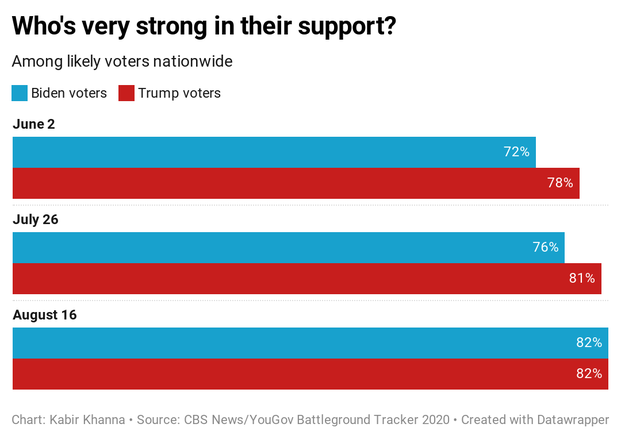
The biggest news is that at least in the CBS polling, Biden has closed the enthusiasm gap.

zuqwe-who-s-very-strong-in-their-support.png

Biden is in a very strong position with 80 days to go.  We'll see if he and Kamala can hold on to or God willing, increase this lead.

An Orange Man With Mail Pattern Badness, Con't

Realizing that House Democrats can't do anything about saving the US Postal Service from home (and also how hideously bad it looks for Dems to be complaining while taking an entire month off) Nancy Pelosi and Steny Hoyer are considering bringing the House back to session early for hearings and oversight.

Speaker Nancy Pelosi and House Democratic leaders are considering cutting short the August recess and bringing the chamber back into session to deal with the unfolding crisis at the U.S. Postal Service, according to Democratic sources.

The House could return to vote with the next two weeks, the Democratic sources suggested. The chamber is currently in recess, with no votes scheduled until the week of Sept. 14.

Pelosi and other top Democrats, including House Majority Leader Steny Hoyer (D-Md.) and House Majority Whip Jim Clyburn (D-S.C.), discussed the possibility of returning early during an emergency leadership call Saturday afternoon.

Democrats are looking to address organizational issues at the Postal Service in the coming weeks, not to provide additional funding at this time, according to sources familiar with the discussion.

One option would be to vote on a modified version of a bill introduced by House Oversight Chair Carolyn Maloney (D-N.Y.) earlier this week that would prohibit USPS from implementing a planned organizational overhaul that critics maintain would handicap mail-in voting.
Other top Democrats also floated addressing other issues, including expired federal unemployment benefits and voting rights. But Democratic sources said the immediate focus — at least for now — is preserving the Postal Service ahead of the election.

On Friday, Pelosi and Senate Minority Leader Chuck Schumer (D-N.Y.) issued a scathing statement accusing President Donald Trump and Republicans of waging an “all-out assault on the Postal Service and its role in ensuring the integrity of the 2020 election.” Their statement came after Trump said he opposes a federal infusion of funds to save the flailing postal service because he doesn’t support mail-in voting.

“The President made plain that he will manipulate the operations of the Post Office to deny eligible voters the ballot in pursuit of his own re-election,” Pelosi and Schumer said. “The President’s own words confirm: he needs to cheat to win.”

Legislation that would never be taken up by the Senate is one thing, but prime time hearings where Postmaster General Louis DeJoy has to defend wrecking the Postal Service live on TV while America watches is what has to happen. And it looks like the House is in fact swinging into action as early as next week.

The House Oversight Committee will hold an emergency hearing on mail delays and concerns about potential White House interference in the U.S. Postal Service, inviting Postmaster General Louis DeJoy and Postal Service board of governors Chairman Robert M. Duncan to testify Aug. 24, top Democrats announced on Sunday.

Democrats have alleged that DeJoy, a former Republican National Committee chairman, is taking steps that are causing dysfunction in the mail system and could wreak havoc in the presidential election. The House had earlier not planned a hearing until September.

“The postmaster general and top Postal Service leadership must answer to the Congress and the American people as to why they are pushing these dangerous new policies that threaten to silence the voices of millions, just months before the election,” House Speaker Nancy Pelosi (D-Calif.), House Oversight Chair Carolyn B. Maloney (D-N.Y.), Senate Minority Leader Charles E. Schumer (D-N.Y.) and Sen. Gary Peters (D-Mich.) said in a statement announcing the hearing.

I fully expect the White House to block DeJoy and Duncan from showing up, saying that neither can be made available for the duration of the "busy election season" and a subpoena will take years to process thanks to the Supreme Court, so that means Pelosi needs to be ready to compel testimony through inherent contempt if necessary.

If DeJoy doesn't show, I expect the Dems will gladly be willing to share the stories of folks not getting their prescriptions, checks, and supplies on national TV for several hours as counter-programming to the Republican convention.

It should make for sobering theater.

Sunday Long Read: Inside The Blast Zone

Our Sunday Long Read is a sobering reminder that given the state of the country right now and the man in the Oval Office, the FBI should be expecting another October Surprise like we had in 2018 when mail bombs showed up at the addresses of Trump critics. Wired Magazine's Garrett Graff takes us through the hunt for the MAGA Bomber in October 2018.

WEIRD THINGS HAPPEN in and around New York City nearly every day, so the appearance of a suspicious package at George Soros' residence in Westchester County didn't initially raise many eyebrows at the FBI's hulking New York field office.

Late on the evening of Monday, October 22, 2018, the office received an alert known as a “nine-liner”—a brief update on an unfolding situation that, in the classic muddle of government communications, is actually 11 lines long. As a routine precautionary response, a team of bomb techs headed to Katonah, New York, to examine the yellow padded envelope. Given the rarity of mail bombs—the US Postal Service encounters about 16 a year, amid plenty of hoaxes—the technicians had good reason to expect it was a false alarm.

But they quickly sent an update when they arrived on the scene: “Boss, we found some energetic material,” an agent on the ground reported by phone to William Sweeney, the FBI assistant director in charge of the New York office. “We have a viable device.”

Sweeney, a 20-year veteran of the bureau, had spent the bulk of his career in the tri-state area and now oversaw the agency's largest, most powerful, and most politically fraught office, comprising more than 2,000 agents, analysts, surveillance specialists, and other personnel, who handled everything from Italian mobsters to Russian spies at the UN. His friendly neighborhood-dad persona belied his role as one of the FBI's most important feudal lords, and he was no stranger to terrorism cases. A year earlier, when a would-be suicide bomber had targeted the Port Authority bus terminal in 2017, the suspect's body was still smoking from his incompletely detonated pipe bomb when Sweeney arrived on the scene. Now, Sweeney knew that the follow-up call from the agents in Katonah would change the night's rhythm dramatically. An actual working bomb? “That starts the machine,” Sweeney says.

Multiple FBI teams were dispatched, including the office's terrorism unit. One investigator's initial theory was that this was an inside job: The package had appeared in a mailbox at the Soros residence that was surveilled by a faulty security camera, which meant there was no record of how it got there. How would anyone but Soros' house staff know that the camera guarding the mailbox was inoperative?

But the next day, the Secret Service discovered a similar package at the nearby residence of Hillary Clinton, addressed to the 2016 presidential candidate. And with that, the “174 case,” FBI code for a bombing investigation, morphed into a “266 case”: an investigation into domestic terrorism.

By Wednesday at 8 am, news of the bomb at the Soros residence made the morning show at CNN; commentator John Avlon ran a segment about how Soros had long been a target of conservative and anti-Semitic conspiracy theories. Then, as CNN anchors Jim Sciutto and Poppy Harlow were anchoring their 9 am show, the alert came that a suspicious device had appeared in CNN's own mail room. (It was intended for former CIA director and TV commentator John Brennan, who was actually a regular fixture on CNN's competitor, MSNBC.)

As the NYPD-FBI bomb squad rushed to the scene, authorities decided to lock down much of Columbus Circle, evacuating the 55-floor Time Warner Center and closing a subway station. Tens of thousands of workers poured out of their offices and shops. Sciutto and Harlow evacuated their studio but continued to report on the unfolding situation from the street, via Skype and cell phones, along with their colleagues. Bomb technicians loaded the device into one of the NYPD's three “total containment vessels”—a specially configured truck with a round, reinforced storage unit able to absorb a bomb's blast—and a six-vehicle convoy of police and fire vehicles hustled the bomb to an NYPD firing range in the Bronx. From the scene, Sweeney called one of his deputies: “Set up the JOC.” It was time to open the crisis command center, the Joint Operations Center, in Chelsea. The country had a serial bomber on its hands.

The hours ahead would see a Herculean mobilization of federal resources and a nationwide manhunt, equaled in the past decade perhaps only by the search for the Boston Marathon bombing suspects. What none of the investigators knew, though, was how much the Hunted Man himself seemed to be enjoying the coverage. As CNN broadcast the breaking news about the unfolding terror campaign, he wandered into a tire store and smiled broadly as he watched the chaos unfold on TV.

The convicted MAGA bomber, Cesar Sayoc, was created by Donald Trump.  Who knows how many more are out there?

I fear we'll find out in the next few months.

Saturday, August 15, 2020

Last Call For A Conspiracy Of Dunces, Con't

As Washington Post columnist Paul Waldman points out, we know exactly what the post-Trumpian GOP looks like. It's the party of dangerous cult conspiracy QAnon, a Christian white supremacist group that promotes lethal terrorist violence against a "global cabal" of Democrats, Hollywood actors, wealthy philanthropists, religious figures and tech business leaders as "pedophiles", who justify deadly attacks on people by saying they have to be put down by any means possible in order to "save children".

Should President Trump lose in November, the Joe Biden presidency will be the target of some kind of angry far-right movement consumed with conspiracy theories. We know this because it’s what always happens when a Democrat gets elected. But how widespread it becomes and how much it affects mainstream politics are uncertain; it could be as influential as the tea party during Barack Obama’s time in office, or as fringe as the militia movement was during Bill Clinton’s.

The leading contender is already taking shape and working its way into the GOP: the lunatic conspiracy theory known as QAnon. It already has its first soon-to-be member of Congress, along with a raft of candidates who have captured Republican nominations for a number of offices, including in the U.S. Senate. And it has establishment Republicans confused and uncertain, aghast at what it represents but too cowardly to purge it from their ranks.

In case you’re not familiar, QAnon began a few years ago with posts on 4chan claiming that an anonymous government insider (“Q") was revealing the hidden forces behind all current events. The theory posits that Trump is a messianic figure at war with an international cabal of satanic, cannabalistic pedophiles; at any moment, the president (who in some tellings was partnering in this effort with special counsel Robert S. Mueller III) will expose his enemies and cart them all off to Guantanamo Bay. The FBI believes QAnon poses a domestic terrorism threat.

At Trump rallies, you could see signs and T-shirts promoting QAnon, and the Trump campaign has courted the movement’s adherents. For a president who is, himself, both a consumer and an advocate of all manner of conspiracy theories, it was an easy fit.

To get some clues about what might happen after the election, we can look at the case of Marjorie Taylor Greene, who this week won a runoff in Georgia’s 14th Congressional District, all but guaranteeing her a seat in Congress.

Greene has a lengthy history of not just promoting QAnon but of posting racist, anti-Semitic and anti-Muslim videos online. When she won the runoff, Trump tweeted his congratulations, calling her a “future Republican Star” and “a real WINNER!” Sen. Kelly Loeffler and Rep. Douglas A. Collins, competing for a Senate seat in Georgia, both applauded Greene’s victory. “It’s clear that we need more outsiders with business sense in Washington,” said Loeffler.


If Greene were alone, it might not be so important. But QAnon followers have won Republican nominations for U.S. Senate in Oregon and for House seats in Arizona, California, Colorado, Illinois, Nevada, New Jersey, Ohio and Texas. Media Matters for America has identified 70 Republican congressional candidates who have promoted QAnon this year.

And how have Republicans in Congress reacted? Only one, Rep. Adam Kinzinger (Ill.), had the courage to say that there is “no place in Congress for these conspiracies.” In response, the Trump campaign attacked him. Politico reported that the House Freedom Caucus, the home of far-right congressional Republicans, is “actively supporting Greene and recruited her to run for the deep red seat instead of a more competitive one.” House Minority Leader Kevin McCarthy (R-Calif.) — who had criticized Greene’s views before — released a statement saying he looked forward to her winning in November.

There are some conservatives condemning Greene and what she represents. But that happened during the early days of the tea party, too.

Greene and the QAnon caucus coming in 2021 will be indicative of the kind of violent backlash Joe Biden and Kamala Harris will be facing should they (hopefully!) win. Make no mistake though, the Biden presidency is most likely going to be marked by waves of deadly white supremacist terrorist violence from the right.

At the very least, it's going to be marked by these conspiracy nutjobs being all over our screens like the Tea Party was ten years ago.


An Orange Man With Mail Pattern Badness

Trump is literally destroying the capacity of the US Postal Service to do its Constitutionally-appointed job by cutting hours, cutting deliveries, and removing mail-sorting machines and destroying them, and the plan to do this has been in the works for months now.

The United States Postal Service proposed removing 20 percent of letter sorting machines it uses around the country before revising the plan weeks later to closer to 15 percent of all machines, meaning 502 will be taken out of service, according to documents obtained by Motherboard outlining the agency’s plans. USPS workers told Motherboard this will slow their ability to sort mail.

One of the documents also suggests these changes were in the works before Louis DeJoy, a top Trump donor and Republican fundraiser, became postmaster general, because it is dated May 15, a month before DeJoy assumed office and only nine days after the Board of Governors announced his selection.

The title of the presentation, as well as language used in the notice to union officials, undermines the Postal Service’s narrative that the organization is simply “mov[ing] equipment around its network” to optimize processing, as spokesperson Dave Partenheimer told Motherboard on Thursday. The May document clearly calls the initiative an “equipment reduction.” It makes no mention of the machines being moved to other facilities. And the notice to union officials repeatedly uses the same phrase. Multiple sources within the postal service told Motherboard they have personally witnessed the machines, which cost millions of dollars, being destroyed or thrown in the dumpster. USPS did not respond to a request for comment.

In May, the USPS planned to remove a total of 969 sorting machines out of the 4,926 it had in operation as of February for all types of letters and flat mail. The vast majority of them—746 out of 3,765 in use—were delivery bar code sorters (DBCS), the type that sort letters, postcards, ballots, marketing mail and other similarly sized pieces. But a subsequent document distributed to union officials in mid-June said 502 of those machines would be removed from facilities.

The May document, titled “Equipment Reduction,” breaks down the exact number of machines the USPS slated to remove by region and facility. Although the document uses terms like “proposed reduction” and “reduction plan” and does not reflect the USPS’s final plan, it provides a general picture of the sweeping changes previously reported by Motherboard about mail sorting machines being removed around the country. It also shows that USPS management is undertaking a broad reduction of the agency’s ability to sort and process all types of mail, except for packages which have been steadily increasing in recent years before booming during the pandemic.

Further, the timeline of the May document did not come to pass. It proposed a plan resulting in the machines being removed by the end of July, but that didn’t happen. Interviews with six postal workers and union officials around the country, who spoke to Motherboard on condition of anonymity because they’re not authorized to speak to the media, revealed these machine removals are still occurring in Michigan, West Virginia, Massachusetts, Maryland, and Texas.

More machine removals are planned in the months ahead. The document sent to union officials in June shows an updated plan to extend the machine removal timeline through the first quarter of 2021.

The Postal Service now says thanks to Trump shooting them in the head on Fifth Avenue, that it can no longer guarantee mail-in ballots can be delivered on time to state voting officials in November.

Anticipating an avalanche of absentee ballots, the U.S. Postal Service recently sent detailed letters to 46 states and D.C. warning that it cannot guarantee all ballots cast by mail for the November election will arrive in time to be counted — adding another layer of uncertainty ahead of the high-stakes presidential contest.

The letters sketch a grim possibility for the tens of millions of Americans eligible for a mail-in ballot this fall: Even if people follow all of their state’s election rules, the pace of Postal Service delivery may disqualify their votes.
The Postal Service’s warnings of potential disenfranchisement came as the agency undergoes a sweeping organizational and policy overhaul amid dire financial conditions. Cost-cutting moves have already delayed mail delivery by as much as a week in some places, and a new decision to decommission 10 percent of the Postal Service’s sorting machines sparked widespread concern the slowdowns will only worsen. Rank-and-file postal workers say the move is ill-timed and could sharply diminish the speedy processing of flat mail, including letters and ballots.

The ballot warnings, issued at the end of July from Thomas J. Marshall, general counsel and executive vice president of the Postal Service, and obtained through a records request by The Washington Post, were planned before the appointment of Louis DeJoy, a former logistics executive and ally of President Trump, as postmaster general in early summer. They go beyond the traditional coordination between the Postal Service and election officials, drafted as fears surrounding the coronavirus pandemic triggered an unprecedented and sudden shift to mail-in voting.
Some states anticipate 10 times the normal volume of election mail. Six states and D.C. received warnings that ballots could be delayed for a narrow set of voters. But the Postal Service gave 40 others — including the key battleground states of Michigan, Pennsylvania and Florida — more-serious warnings that their long-standing deadlines for requesting, returning or counting ballots were “incongruous” with mail service and that voters who send ballots in close to those deadlines may become disenfranchised.

“The Postal Service is asking election officials and voters to realistically consider how the mail works,” Martha Johnson, a spokeswoman for the USPS, said in a statement.

In response to the Postal Service’s warnings, a few states have quickly moved deadlines — forcing voters to request or cast ballots earlier, or deciding to delay tabulating results while waiting for more ballots to arrive.

Pennsylvania election officials cited its letter late Thursday in asking the state’s Supreme Court for permission to count ballots delivered three days after Election Day. But deadlines in many other states have not been or cannot be adjusted with just weeks remaining before the first absentee ballots hit the mail stream. More than 60 lawsuits in at least two dozen states over the mechanics of mail-in voting are wending their way through the courts.

Because the Trump regime is deliberately destroying the US Postal Service, the next several months will now be one huge chaotic binge of voting lawsuits that critically breaks our capacity to hold free and fair elections, with Donald Trump anticipating that he'll be able to steal the election regardless of the outcome with the help of enough GOP state legislatures, Republican US House delegations, and the US Supreme Court.

The Republican party would rather destroy American democracy than allow half the country to vote during a pandemic.

If we do not fight this now, they will destroy it.

Your members of Congress are home for the rest of the month.  It's time to give your Representatives and Senators a call at their home offices and make it clear this isn't going to be allowed to happen without a fight.


Time To Vote In Kentucky

In a major win for democracy and voting rights here in Kentucky, Democratic Gov. Andy Beshear and GOP Secretary of State Michael Adams announced at a joint press conference a deal to allow all Kentuckians concerned about COVID-19 to request ballots to vote by mail as soon at the end of next week.

Kentucky will not be using no-excuse absentee voting by mail for the upcoming Nov. 3 elections, Gov. Andy Beshear and Secretary of State Michael Adams announced Friday.

Unlike with the June 23 primaries, Kentucky's registered voters will have to provide a reason for why they need to vote by absentee ballot in November. Anyone concerned about their own health or compromising another persons' health can request an absentee ballot.

All ballots have to be postmarked by Nov. 3 and received by county clerks by Nov. 6. County clerks will have drop-off boxes for anyone concerned about sending in their ballots by mail.

No-excuse early voting, which was permitted for the first time in June for two weeks leading up to Election Day for the June primaries, is included in Beshear's and Adams' plan for November.

Starting on Oct. 13, registered voters will have the option to cast their ballot early in-person for three weeks heading into Nov. 3. And while polls were open for early in-person voting Monday through Friday in June, this time around, they will also be open on Saturday.

Beshear, a Democrat, praised Adams, a Republican, for "putting ideology on the shelf."

"I don't really think that this was too much of a negotiation going back and forth (on Adams' plan)," Beshear said Friday. "I think we both wanted a successful election where we could protect people's health, and we believe will be one of the larger turnouts we've seen because of there are so many options to vote."

The online portal for requesting ballots should be up by August 21, Beshear said.  And three weeks of early voting, including Saturdays? That's just as amazing.

This is a good deal and I'm shocked by how good it is.
Hey, I fear COVID-19, I have several comorbidity issues, I'm requesting my ballot ASAP and voting and turning it in.

If you can do the same in your state, do it. Get that ballot, mail it in well before November 4th.

The Country Goes Viral, Con't

The real death toll from COVID-19 in the United States is over 200,000 and growing, because states and counties don't have the resources to properly test and autopsy every death anymore thanks to Trump. The number of additional deaths in the US are at least that high above CDC statistics.

Across the United States, at least 200,000 more people have died than usual since March, according to a New York Times analysis of estimates from the Centers for Disease Control and Prevention. This is about 60,000 higher than the number of deaths that have been directly linked to the coronavirus.

As the pandemic has moved south and west from its epicenter in New York City, so have the unusual patterns in deaths from all causes. That suggests that the official death counts may be substantially underestimating the overall effects of the virus, as people die from the virus as well as by other causes linked to the pandemic.

When the coronavirus first took hold in the United States in March, the bulk of deaths above normal levels, or “excess deaths,” were in the Northeast, as New York and New Jersey saw huge surges.

The Northeast still makes up nearly half of all excess deaths in the country, though numbers in the region have drastically declined since the peak in April.

But as the number of hot spots expanded, so has the number of excess deaths across other parts of the country. Many of the recent coronavirus cases and deaths in the South and the West may have been driven largely by reopenings and relaxed social distancing restrictions.

Counting deaths takes time and many states are weeks or months behind in reporting. The estimates from the C.D.C. are adjusted based on how mortality data has lagged in previous years. Even with this adjustment, it’s possible there could be an underestimate of the complete death toll if increased mortality is causing states to lag more than they have in the past or if states have changed their reporting systems.

But comparing recent totals of deaths from all causes can provide a more complete picture of the pandemic’s impact than tracking only deaths of people with confirmed diagnoses.

The numbers are staggering.

When the history of 2020 is written, it will be America's lasting shame for generations.

Well, that is if Biden and Harris win.  If they don't, Trump will write that history.
Related Posts with Thumbnails