
Thank you, MIT. This almost makes up for graduating Tom Massie.
If all printers were determined not to print anything till they were sure it would offend nobody, there would be very little printed. -- Benjamin Franklin
President Obama is now threatened by a similar toxic mix. The disastrous rollout of his health care law not only threatens the rest of his agenda but also raises questions about his competence in the same way that the Bush administration’s botched response to Hurricane Katrina undermined any semblance of Republican efficiency.
As the health law teeters, the stakes are so great because the struggle encapsulates each party’s core argument. It embodies the Democratic belief that society works better when risk is shared—between young and old, healthy and sick—and government intervenes in private markets to try to expand both security and opportunity. The fury of the Republican resistance reflects the party’s insistence that markets work best unfettered, that centralized government programs cannot achieve their goals, and that Democrats are unduly burdening the “makers” to support (and politically mobilize) the “takers.”
If most Americans conclude Republicans are right about the health care law, that judgment would inevitably deepen doubts about other government initiatives. In this world, Democrats could still hold the White House in 2016 around cultural affinity, but they would likely struggle to achieve much if they do. If the president can’t extinguish the flames surrounding Obamacare, this runway explosion could reverberate for years.
We are two Democrats, one of us a baby boomer and the other a millennial. Not only are we of different ages, but we also have vastly different perspectives. Despite this, we hold similar core values. For different reasons, we feel that the Democratic Party has left us. What we are concerned with here is addressing challenges to our core values as a society and redefining what being a Democrat means in today’s circumstances.
A tea party group has launched a campaign to support primary challenges against all 87 Republicans who voted for the deal in late October to reopen the government and raise the debt ceiling.
The Tea Party Leadership Fund, a PAC affiliated with the group TheTeaParty.net, began a fundraising push — dubbed the “Primaries for Traitors Fund” — shortly after the shutdown deal passed in the House, and they are now ramping up efforts to find “credible candidates” in each of the districts, said the fund’s treasurer, Dan Backer.
“From our perspective, we see this as a signature vote. You can’t be a conservative and vote to raise the debt ceiling,” Backer said. “I recognize there are some places where voters may actually think that was the right vote. And there may be places where you have an incumbent who wins with 90% of the vote every time and there’s not a credible challenger. I recognize that, but we’re certainly going to do our best.”
Backer says the group has honed in on a few specific members to start: Illinois Rep. Rodney Davis, New York Rep. Peter King, North Carolina Rep. Robert Pittenger, Louisiana Rep. Charles Boustany, and most importantly, Backer said, House Speaker John Boehner in Ohio.
“Our goal is to keep going one after another after another as our resources allow. To get our feet wet, we’re starting out with a few, but nobody is going to get a pass,” he said.
The enrollment numbers are in, and as expected, they are well short of projections. Around 106,000 enrolled in new plans during October — with approximately 27,000 coming from states where the federal government is running the exchange (with its extensive problems), and another 79,000 coming through the state exchanges. Republicans are gleefully pointing to the numbers as proof Obamacare needs to be scrapped entirely.
That confirms two things we’ve long known to be true: the website is a disaster, and short term enrollment figures are a serious political problem for the White House and Democrats. But to Larry Levitt, a vice president at the nonpartisan Kaiser Family Foundation, another very telling number is this one: over 975,000 have been determined eligible for a marketplace but haven’t yet chosen a plan.
“That’s one of the most telling numbers — a million people have been determined eligible,” Levitt tells me. “That means if the website had been working well, and a million people had gotten to the end of the process, we’d be looking at a very different trajectory now. We heard about the surge in traffic when HealthCare.gov went live. This suggests there is in fact a lot of interest.”
Meanwhile, the 100,000 number is getting a lot of attention, but the report also finds nearly 400,000 were determined eligible for Medicaid. “In total that’s over 500,000 people who signed up for insurance in the midst of a tumultuous launch,” Levitt says. “People make a distinction between the marketplace and Medicaid, but those are both elements of the Affordable Care Act — both are mechanisms to get people insured.”
In one sense what we’re really seeing in these numbers is the first concrete representation of what the de facto GOP health care plan — repeal Obamacare and replace it with nothing, since there’s no GOP consensus on a replacement – looks like. Presuming many of the 106,000 do pay in the end, GOP repeal would entail taking health coverage away from hundreds of thousands of people.
House Speaker John Boehner says he will not allow any House-passed immigration legislation to be blended with the Senate’s sweeping reform bill, further quashing the chances of comprehensive immigration reform legislation being signed into law anytime soon.
“We have no intention of ever going to conference on the Senate bill,” Boehner told reporters Wednesday.
The point here is this. The House GOP leadership will never hold a vote on any comprehensive reform package that includes legalization or citizenship. So the only way forward is if House Republicans pass piecemeal provisions — border security measures, plus some sort of legalization proposal for the 11 million, or barring that, the Kids Act (which gives citizenship only to the DREAMers). That would be a route to comprehensive reform if it provided a way to get to conference.
Boehner doesn’t want anything the House passes to be seen as a vehicle for going to conference, because conservatives will revolt. But here is the rub: House Republicans, on their own, probably can’t pass anything that addresses the 11 million — and may not even be able to pass the KIDS Act — if it is seen as a vehicle for going to conference, since conservatives would resist at all costs. So Democrats would be needed to pass any such proposals. But Democrats will only vote for such proposals with an assurance that we would then go to conference. And so, by ruling out conference, Boehner may have just closed off the last remaining route to getting reform done.
There has been a lot of talk lately about how the GOP establishment is going to wage war on the hard-liners inside the GOP that are forcing unelectable candidates and deeply unpopular positions on the party. Immigration reform, however, is a clear cut case where this vow isn’t mattering in the slightest.
Conservative columnist Charles Krauthammer sees “the collapse of American liberalism” in sight, in no small part because of the troubled rollout of the Affordable Care Act.
“We have not just Obamacare unraveling, not just the Obama administration unraveling, not just the Democratic majority of the Senate [unraveling], but we could be looking at the collapse of American liberalism,” Krauthammer told Bill O’Reilly Tuesday. “Obamacare is the big thing for them. The biggest in a hundred years.”
Krauthammer addressed tensions and tactical disagreements within the Republican Party — particularly related to the government shutdown in October — and said he believes this is an important opportunity for conservatives to unite.
“This is a moment where we have to be calm. We have to understand what holds us together on the right. We have to watch and explain why the failure of the left is happening. And if we do that, we will win,” he said.
The North Carolina Senate race has tightened up quite a bit in the last couple months, with early attacks ads on Kay Hagan and the unpopular rollout of Obamacare taking a toll on her poll numbers. Hagan is now basically tied with her Republican challengers, leading Heather Grant 43/40, Thom Tillis 44/42, and Mark Harris 43/41 while trailing Greg Brannon 44/43.
Over the last two months Hagan's approval rating is pretty consistent. It was 43% in September and it's at 44% now. But her disapproval has spiked from 39% all the way up t0 49% over that period of time. It's no coincidence that the decline in Hagan's approval numbers tracks pretty closely with a big decline in President Obama's popularity over that same period of time. He's gone from having voters in the state pretty evenly divided about him in September at 48/49 to disapproving pretty strongly at 43/53.
It seems likely that the difficulties with the rollout of Obamacare are helping to make life more difficult for Hagan. It's always been unpopular in North Carolina and currently 38% of voters say they approve of it to 48% who disapprove, numbers pretty consistent with what we've found over the years. But what's really hurting Democrats is its being back in the news- 69% of voters say its rollout has been unsuccessful so far to only 25% who deem it a success. 49% say the rollout has been 'very unsuccessful.' Republicans (87%) and independents (75%) are pretty unanimous in their sentiment that the Obamacare launch hasn't gone well but even among Democrats only 41% give it positive ratings to 52% who think it's been problematic.
Over the last two days, Enquirer readers have sent more than 500 emails to Mayor-elect John Cranley using the Enquirer’s ‘talk to your government’ tool. The vast majority contained the same plea: Save the streetcar.
Cranley’s reaction to those emails: “The conversation about the streetcar is over.”
Cranley said he welcomes any advice or input on how to make Cincinnati a bike-friendly city with better mass transit.
“I think, big picture, this was not and never was a question about whether diverse mass transit options, walkable neighborhoods, and non-car commuting options are are critical to our future. They are,” Cranley told the Enquirer.
“The conversation about the streetcar is over. What I would like to do is ask that these folks talk about what we can do that will move us towards the goals I share with them.”
And the city’s continued work on the streetcar? Cranley declared it “very offensive.”
The city needs his political agility. Surround Cranley with opposing points of view, and he’ll wheel and deal until he builds a coalition.
During his nine years on council, he not only reached across party lines, he drove to fellow council members’ homes and sat in their kitchens courting their votes. The next day, on a different issue, he’d find new allies and build an entirely different coalition.
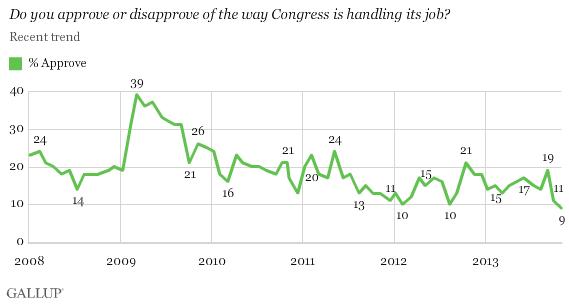
Americans' approval of the way Congress is handling its job has dropped to 9%, the lowest in Gallup's 39-year history of asking the question. The previous low point was 10%, registered twice in 2012.
These results are from a Gallup poll conducted Nov. 7-10.
Congress approval fell to 11% in October, during the U.S. government shutdown. Although the shutdown is now history, Americans' views of Congress have not recovered, but instead have edged lower. By contrast, Americans' confidence in the economy has begun to improve in the last several weeks. The continuing depression in Americans' views of Congress has occurred even though the troubles with the rollout of President Barack Obama's signature Affordable Care Act are now dominating U.S. political news.
The survey data are pretty clear on why Cuccinelli lost. He lost because he was unable to match Romney’s percentages with key demographic groups that almost always vote Republican. Those voters showed up at the polls, but too many Romney voters crossed over to cast ballots for McAuliffe or Libertarian Robert Sarvis.
The Republican nominee for governor won a plurality of male voters (48 percent), but well below the 51 percent that Romney won in the state last year. Cuccinelli would have gained an additional 48,000 votes if he had matched Romney’s percentage, much of which would have come from McAuliffe, thereby completely erasing the Democrat’s 55,100 victory margin. (See Virginia’s total vote here.)
Add in white women (Romney won 59 percent of them in the state in 2012, while Cuccinelli won only 54 percent this year) or wealthy voters (Romney won 51 percent of voters earning at least $100,000 a year in Virginia in 2012, while Cuccinelli drew just 43 percent of them and lost the category to McAuliffe) and the Republican would have had a comfortable victory last week.
And if you don’t want to focus on gender, the marital status numbers tell the same story. Romney won 55 percent of married voters in Virginia last year, while Cuccinelli won only 50 percent of them this year. That’s about 75,400 fewer married voters than a Romney-like Republican gubernatorial nominee should have drawn.
Though you hear a lot about the changing face of the electorate, both nationally and in Virginia, that’s not why Cuccinelli lost last week.
The Virginia election in 2013 was one where the Republican nominee would have won merely by attracting the votes of the same people who voted for Mitt Romney. The party’s candidate for governor did not need to improve his showing among young voters, African-Americans, Hispanics or unmarried women. He just needed to get white guys and their wives.
That conclusion, which is based on an evaluation of all of the data, not on merely cherry-picking one or two variables, ought to be little comfort for Democratic strategists worrying about the makeup of the midterm electorate.
Former President Bill Clinton said in an interview published Tuesday that President Barack Obama should make sure Americans can keep their existing health plans, even if that means tweaking the Affordable Care Act.
"I personally believe, even if it takes a change to the law, the president should honor the commitment the federal government made to those people and let them keep what they got," Clinton told the site OZY in a recent interview.
House Energy and Commerce Chairman Rep. Fred Upton (R-Mich.) has introduced a bill that the House will vote on later this week. It would "grandfather" in all health insurance plans that existed as of Jan. 1, 2013, not March 23, 2010, meaning that insurers could continue to offer a number of plans that they have been forced to cancel under the Affordable Care Act.
Clinton preceded his comments by telling the story of a man he met last week, who he said doesn't qualify for subsidies because he makes more than 400% above the federal poverty level. He has a wife and two children, and Clinton said his policy was canceled and replaced by one that doubled his premium.
"They are the ones who heard the promise, 'If you like what you've got, you can keep it,'" Clinton said.
The tech squeeze is apparently so bad that chief U.S. technology officer Todd Park is too busy to testify before Congress. The House Oversight Committee is probing what went wrong in the development process, but Mr. Park can't attend the Wednesday hearing because he's "occupied full time on the critically important work of improving the website," according to a White House letter rebuffing the invitation.
Is Mr. Park personally rewriting code? Chairman Darrell Issa issued a subpoena compelling him to appear, and maybe he can also address the emerging problem of ObamaCare fraud. That includes the way the law was sold and rolled out, but especially the profusion of identity thieves and scam-artist pages that are now pretending to be Healthcare.gov and are tricking people into divulging sensitive information or buying fake products. Important consumer warning: If an insurance shopping website is usable, it's not the federal government's.




 Posts
Posts


