Monday, October 5, 2015

Last Call For Taking It For Granite

Although rumored for months now as the state fought over the budget, New Hampshire Dem Gov. Maggie Hassan is going after GOP Sen. Kelly Ayotte's seat in 2016.

Senate Democrats got the candidate they wanted in New Hampshire. 
Gov. Maggie Hassan announced Monday she is challenging GOP Sen. Kelly Ayotte for Senate in the Granite State, rather than seek a third term as governor. It’s a move Democrats say gives the party its best shot at picking up a seat that will prove critical to Senate control.

The two-term governor had been mum on her plans as she sparred with the Republican-controlled state legislature over the budget — saying she needed to focus on the job she had rather than make plans for her political future. Republicans in the state were happy to keep Hassan’s focus on the budget for as long as possible, preventing her from publicly deciding whether to run for re-election or challenge Ayotte for Senate. 
But Hassan and the legislature came to a budget agreement, finally freeing Hassan to decide.

This is good news as Ayotte (and her "Third Amigo" to McCain/Graham shtick) is vulnerable as the GOP brand is badly damaged. If the Democrats are going to take back the Senate in 2016, this is one of the seats they'll need to pick up, and Hassan, the state's popular governor, is by far the best candidate to do so.

I've got a good feeling about this race for the Dems about getting rid of nasty corporate Republicans like Ayotte.

Sen. Kelly Ayotte (R-NH) and Sen. Shelley Moore (R-WV) introduced the Student Loan Relief Act of 2015 on Thursday, which would let borrowers refinance their federal student loans in the private market. The senators argue that if their legislation passed, students would be able to benefit from lower interest rates.

Sounds great, right?  Republicans like Ayotte are moderates who care about student loan and debt relief, see?

Although many large banks left the private student loan market after the financial crisis, plenty of politically connected organizations such as state agency lenders and nonprofits have fought to stay in the market. One example is Granite State Management, a New Hampshire nonprofit organization that does student loan servicing. GSM’s primary income is through its student loan servicing, but they would make much more through issuing loans. GSM’s status as a charitable organization was challenged by the City of Concord in 2013 but the court ultimately held up its status, saying that “servicing and administration of loans is not GSMR’s charitable purpose, but a means to achieve” the purpose of its mission to “providing low cost or alternative financial assistance to eligible students and to parents . . . and of supporting the development of higher education and educational opportunities.”

I bet you can see where this is going.

“What they’re trying to do is go back to the bad old days of a bank-based loan system. They want private banks to take over the loan and take none of the risk. So what they’re saying is, ‘Oh, it will be good for students because they will get a lower rate from the private market,'” said Ben Miller, senior director for postsecondary education at the Center for American Progress. “But really what’s going to happen is that the private market is going to get a giant windfall and pass along a tiny slice of it to the students in the form of a lower interest rate … You would hope to do a lot more by spending the exact same amount of money and just cutting their interest rates. There is no value add from the private market.”

That's right, Ayotte's student loan bill is really a way to get Wall Street back into the student loan business.  Shocking, I know.

Can't wait for Hassan to kick her ass.

The Big Trade-Off

After years of negotiations, the Trans-Pacific Partnership trade deal has reached its final leg and just needs approval from individual member countries, just in time to become a major issue in the 2016 presidential race in both parties.

The United States and 11 other Pacific Rim nations on Monday agreed to the largest regional trade accord in history, a potentially precedent-setting model for global commerce and worker standards that would tie together 40 percent of the world’s economy, from Canada and Chile to Japan and Australia. 
The Trans-Pacific Partnership still faces months of debate in Congress and will inject a new flash point into both parties’ presidential contests. 
But the accord — a product of nearly eight years of negotiations, including five days of round-the-clock sessions here — is a potentially legacy-making achievement for President Obama, and the capstone for his foreign policy “pivot” toward closer relations with fast-growing eastern Asia, after years of American preoccupation with the Middle East and North Africa. 
Mr. Obama spent recent days contacting world leaders to seal the deal. Administration officials have repeatedly pressed their contention that the partnership would build a bulwark against China’s economic influence, and allow the United States and its allies — not Beijing — to set the standards for Pacific commerce. 
The Pacific accord would phase out thousands of import tariffs as well as other barriers to international trade. It also would establish uniform rules on corporations’ intellectual property, open the Internet even in communist Vietnam and crack down on wildlife trafficking and environmental abuses. 
Several potentially deal-breaking disputes kept the ministers talking through the weekend and forced them repeatedly to reschedule the promised Sunday announcement of the deal into the evening and beyond. Final compromises covered commercial protections for drug makers’ advanced medicines, more open markets for dairy products and sugar, and a slow phaseout — over two to three decades — of the tariffs on Japan’s autos sold in North America. 
Yet the trade agreement almost certainly will encounter stiff opposition. 
Its full 30-chapter text will not be available for perhaps a month, but labor unions, environmentalists and liberal activists are poised to argue that the agreement favors big business over workers and environmental protection. Donald Trump has repeatedly castigated the Pacific trade accord as “a bad deal,” injecting conservative populism into the debate and emboldening some congressional Republicans who fear for local interests like sugar and rice, and many conservatives who oppose Mr. Obama at every turn. 
Long before an accord was reached, it was being condemned by both Mr. Trump, the Republican presidential front-runner, and Senator Bernie Sanders of Vermont, who is challenging Hillary Rodham Clinton for the Democrats’ nomination. Other candidates also have been critical. Mrs. Clinton, who as secretary of state promoted the trade talks, has expressed enough wariness as she has campaigned among unions and other audiences on the left that her support is now in doubt.

We'll see where the TPP goes, but as with so many other things that this President has accomplished, those who bet against the guy end up losing big when he gets the job done.  I think the TPP will pass and move on.  How good that will be for US workers?

That's far more debatable.

Doing Something About Gunmerica

If Bernie Sanders has a weakness on policy, it's his abysmal record regarding backing the NRA and gun manufacturers in his rural state of Vermont.  Both Hillary Clinton and Martin O'Malley are running hard to the left on Sanders on the issue of gun safety measures.  O'Malley in particular has led on this issue, calling for an outright ban on assault rifles for months now. That pressure has led to Hillary Clinton now calling for a much tougher stance against the NRA.

Democratic presidential candidate Hillary Clinton on Monday will detail new proposals aimed at closing gun sale loopholes and holding accountable those who sell guns for violence committed with those weapons.

Seizing the moment following last week’s mass shooting in Oregon, Clinton will call for the repeal of the Protection of Lawful Commerce in Arms Act, which gives legal protection to gun manufacturers and dealers whose guns are used for criminal activity, said a campaign official, who asked not to be named, previewing the announcement Clinton plans to make on the campaign trail in New Hampshire.

As a senator from New York, Clinton voted against the law in 2005 and, the official said, would lead an effort to repeal it if elected president. Her closest competitor in the Democratic primary, Vermont Senator Bernie Sanders, who served in the U.S. House at the time, voted in favor of it.

Clinton appeared viscerally frustrated as she spoke after Thursday’s shooting at Umpqua Community College, in which authorities say a student killed nine people before turning one of several guns he had with him on himself. “What is wrong with us, that we cannot stand up to the NRA and the gun lobby, and the gun manufacturers they represent?” Clinton said Friday at Broward College in Davie, Florida. “We don’t just need to pray for these people. We need to act.”

In staking out a hardline position on guns, Clinton is capitalizing on an issue where she stands to the left of Sanders. He has a mixed record on gun control—he voted against the Brady Bill in 1993 and for the liability protection law, but also in favor of restrictions on the size of gun magazines—that he attributes to the gun culture of his rural state. He responded to the shootings in Charleston, South Carolina, and in Oregon with promises to implement “sensible gun-control legislation” and to improve mental health services, but has not yet offered specific proposals.

Former Maryland Governor Martin O'Malley, who is trailing Clinton and Sanders in polls, on Sunday in New Hampshire called on his rivals to “join me in building a new consensus” on gun control by supporting his four-point plan, his campaign said.

On Monday, the details Clinton will put behind her pitch include support for closing two sets of loopholes that allow gun purchases without background checks, according to the official.

If Congress does not pass legislation that would deem those who sell significant numbers of guns at gun shows and online to be required to operate under the same laws that apply to gun stores, Clinton would take executive action to do that under her plan. She supports congressional efforts to eliminate what’s being called the “Charleston loophole” after the June shooting at a black church there, which allows gun purchases to go forward if a background check isn’t completed within three days.

Clinton will also say she supports legislation to prohibit all people with histories of domestic abuse from buying or possessing guns, since current laws don’t apply to people in dating relationships or convicted stalkers.

I'm glad to see Clinton's proposals here, and she's definitely ahead of Sanders on this issue.  The ball's in Bernie's court now on gun safety.  We'll see if hes going to bother with specific proposals or just assume he can take a pass on this.

New long overdue tag: Gunmerica.

StupidiNews!

Sunday, October 4, 2015

Last Call For Podcast Versus The Stupid

This week's episode (and we're going to try to go to a weekly schedule on Sunday evenings for now) is These Disunited States Of Gunmerica.

Check Out Blogs Podcasts at Blog Talk Radio with Zandar Versus The Stupid on BlogTalkRadio


Having both grown up in red states and living in them now, Zandar and Bon talk about gun control and American gun culture in the wake of yet another mass shooting in America and find that the US is pretty disunited about the whole thing. Plus more on Springfield's Slut Walk, creepy-ass city councilmen, and more.

Good Ol' Rocket Top, Rocket Top, Gunnessee!

When a tragic, preventable massacre like the mass shooting in Oregon last week happens, as a politician you can choose to respond by asking the American people to do what's necessary in order to prevent another such incident from happening.

For Democrats like President Obama, that means asking the American people to do their duty to push lawmakers to implement real gun safety laws to protect them.  For Republicans like Tennessee Lt. Governor Ron Ramsey, that means asking the American people to do their duty as Christians to start packing heat 24/7.

Responding to a mass shooting at an Oregon community college that left 10 people dead, Tennessee Lt. Gov. Ron Ramsey on Friday encouraged fellow Christians who are serious about their faith to consider getting a gun.

Ramsey, R-Blountville, made those remarks in a Facebook post Friday, one day after a shooting at Umpqua Community College in Roseburg, Ore., left 10 people dead. The suspect, 26-year-old Chris Harper Mercer, reportedly asked victims to name their religious affiliation during the massacre.

In his Facebook post, Ramsey links to a New York Post article with the headline "Oregon gunman singled out Christians during rampage." Ramsey groups the Oregon shooting with other recent mass shootings in the nation. "Whether the perpetrators are motivated by aggressive secularism, jihadist extremism or racial supremacy, their targets remain the same: Christians and defenders of the West," Ramsey said.

"While this is not the time for widespread panic, it is a time to prepare," he later adds. "I would encourage my fellow Christians who are serious about their faith to think about getting a handgun carry permit. I have always believed that it is better to have a gun and not need it than to need a gun and not have it.

"Our enemies are armed. We must do likewise."

Mind you, this is an elected official, the Lieutenant Governor of a state, who sees some of his fellow Americans as "our enemies" and that he is openly encouraging citizens to be willing to use deadly force.

His comments elicited a written statement from Tennessee Rep. John Ray Clemmons, D-Nashville, who said Ramsey's comments "reek of fear-mongering and religious crusading."

"Rather than lead the General Assembly’s bipartisan efforts to improve public safety by removing guns from the hands of criminals and addressing the serious mental health issues confronting many in our state, Senator Ramsey unfortunately chose the road most traveled by the radical right," said Clemmons, who introduced a bill earlier this year that sought to amend the state's "guns-in parks" legislation.

"Senator Ramsey’s inciting statements in the face of a national tragedy are all the more alarming when you consider them in their historical context," he added. "Things have never ended well when any leader has asked people to take up arms in the name of their religious faith. This type of rhetoric is counter-productive to our efforts on so many levels."

I'm glad that Democrats in the state were willing to call Ramsey out, but this "armed Christian militia fantasy" that the right wing has is dangerous as hell. Always more guns, until everyone has a dozen and then, well, why do we need laws anyway when we all have guns, right?

Sunday Long Read: The Odd Couple

They were on the opposite sides of just about every one of Washington's policy debates, he was the rising star of a White House tech advisor and she was the established Hot Air conservative columnist, but of course they were married and had a daughter and were deeply in love.

And then Jake Brewer was killed last month during a charity bike ride for cancer.

In a superficial sense, Jake Brewer and Mary Katharine Ham were a true D.C. anomaly. Bipartisan relationships have always been fairly rare in Washington, where politics are felt so strongly, and Jake and Mary Katharine were far more than Election Day partisans: Their disparate ideologies shaped their increasingly high-profile careers.

But they didn’t see it that way, Mary Katharine recalled at their home in Alexandria recently. Just because politics defined their jobs didn’t mean it defined their lives.

Mary Katharine, 35, leaned back into their sagging brown couch, tucking her feet to support her pregnant belly — their second child, due in December. She was wearing Jake’s cowboy boots, with his wedding band on a chain around her neck.

It was here on this couch that they had their last fight, where she apologized for starting a political spat — she can’t remember now what it was about — when he was just trying to tell her about his day at the office. She scrolled through her phone, looking for that initial e-mail she had ignored back in 2008. “Would be great to have you there,” he had written. “Not only to have a bit of both sides, but mostly just ’cause I think you’d be great to have regardless.”

She laughed: That was so Jake, always eager to hear the other side even while committed to his own. He seemed like a success at anything he tried — triathlons, photography, singing — and found the same ease in the advocacy work that brought him to the District: first environmentalism, and later government transparency and technology, rising to a top job at the petition Web site Change.org. On the side, he co-founded an immigration advocacy organization, Define American.

Mary Katharine came to Washington a few years earlier in 2004, frustrated with a small-town newspaper job that gave her little outlet for expressing the conservative arguments she was craving. She had grown up in the struggling public schools in Durham, N.C., which convinced her that bigger doesn’t mean more efficient in government. A job at the Heritage Foundation led to opinion-writing gigs; her gift for fast-talking rants and punchy comebacks earned her regular TV appearances opposite Bill O’Reilly and the ladies of “The View.”

Their lives, like their careers, could have existed in these two worlds apart, surrounded mostly by people who agree with them. Washington makes that very easy.

Instead, they went on a date to an Indian restaurant, which led to a ping-pong bar and staying up until 4 a.m. talking about the annual Mule Day festival in Jake’s home town of Columbia, Tenn.

They were both almost 30, and it just worked. They had the same level of energy and talent. As one friend would later say, they were magnetized from the start.

But the elephant in the room wasn’t the silent type. Commenters on liberal e-mail groups fretted that the relationship was a bad idea, that she would snoop through his e-mails, do something to hurt the cause.

When Jake called his mother, Lori, to tell her he’d met someone beautiful and smart and funny, he paused to say, “But there’s something you should know. She’s uh . . . she’s . . . uhm . . .”

Lori screeched: “Oh, my God, she’s Republican !”

And yeah, I know.  I find Ham to be depressingly banal, even for a Heritage Foundation flunkie, but these two really did love each other and they had a second child on the way, and sometimes we forget that there are real people behind these pundits and politicians, who are human, flawed, and scared just like us schlubs out here in the cheap seats.

Saturday, October 3, 2015

Doctors Without Borders, Hospitals Without Walls


A U.S. gunship bombed a hospital run by Médecins Sans Frontières / Doctors Without Borders (MSF), early Saturday morning, killing at least 16 people. The Americans had been flying close air support as Afghan government troops continue their effort to re-take the city of Kunduz, which fell to the Taliban last week almost without a shot.

Muhammad Ajami, 35, tells The Daily Beast that he was talking to his 17-year-old brother Jamil on the phone at the time of the airstrike. Earlier in the evening Jamil had been injured during the fighting and admitted to the MSF clinic, the only operational hospital-type facility in the city.

“This was about 2:00 a.m.,” said Muhammad. “Jamil was telling me he wanted me to get him and take him home, there was a lot of bombing and shelling in the city. Then there was a big bang, and my brother dropped his phone. The last words I heard were ‘Move to the basement! Move to the basement! And crying and crying.”

MSF issued a statement “condemning in the strongest possible terms the horrific bombing of its hospital in Kunduz, which was full of staff and patients.” Three MSF staff were confirmed dead and more than 30 unaccounted for after the trauma center “was hit several time during sustained bombing and was every badly damaged.”

MSF has decades of experience working in war zones and had notified “all parties to the conflict, including in Kabul and Washington,” of the precise GPS coordinates of its facilities, including the hospital, guest house, office and an outreach unit in a village northwest of Kunduz. Those coordinates had been communicated repeatedly most recently on September 29, after the Taliban took the city, according to another MSF statement.

A U.S. senior defense official told The Daily Beast in Washington that a U.S.-manned AC-130 gunship “was called in to return fire against a Taliban position that was firing on U.S. Special Forces advising Afghan Special Forces” when the attack began somewhere near the hospital.

But the official could not say how close that fighting position was to the hospital or whether the United States did indeed know the hospital coordinates beforehand. Defense officials also could not say how long the attack took place.  

Let's go over the fact that bombing a hospital is in fact a war crime, not to mention that 14 years after 9/11 we're still bombing goddamn Afghanistan.

Ya'll aren't going to want to hear this, but Obama is responsible for this mess.  We need to get out of Afghanistan fully, no more "support", no more "advisory capacity" no more Special Forces, just out.  Period.

Fourteen friggin years, guys.

And Obama, you screwed this up big time.  You need to answer for it.  Now.

Stuff And Things About Jeb

Jeb Bush really is making a total mess of this campaign, isn't he?

Jeb Bush invited a firestorm on Friday by saying that “stuff happens” in reference to renewed calls for legislative action after tragedies like the mass shooting in Oregon.

“I had this challenge as governor because we had — look, stuff happens,” he said at a forum in South Carolina. “There’s always a crisis and the impulse is always to do something, and it’s not necessarily the right thing to do.”

The inelegant phrase immediately set off a wave of criticism from observers suggesting he was playing down the scourge of gun violence and the tragedy on Thursday, in which a gunman killed nine people at a community college in Roseburg, Ore.

Mr Bush, taking questions from the state’s attorney general, Alan Wilson, was speaking about a pattern of proposing legislative responses that he said did not halt the tragedies they were meant to stop.

Asked afterward about the “stuff happens” comment, Mr. Bush said, “it wasn’t a mistake,” and requested that a reporter point out “what I said wrong.”

“Things happen all the time,” Mr. Bush said. “Things. Is that better
?”

There are three issue here.

First problem is the GOP notion, widely held, that there is nothing that government can do or even should do in order to prevent the mass slaughter of citizens like this.  More than 30,000 people die yearly to firearms in the US and somehow Republicans have not only counseled that the government shouldn't prevents it, but that it can't: it's the blood that waters the tree of liberty, the necessary cost of a free society where firearms "preserve" the Constitution. Indeed, 300 million firearms in the hands of American citizens is good and necessary and there's nothing that we should do in order to curtail that number. By far, this is the biggest issue and the largest debate we need to have, but cannot.

Problem number two is the fact that Jeb Bush, like most Republicans, are running for President (you know, Chief Executive of the Federal Government) in order to specifically not do anything.  Vote for me, I won't solve you problems!  Republicans of course don't think government is the answer (gun deaths, the economy, the environment) unless they do (Sharia law, women's reproductive systems, repealing health insurance).

Finally, Jeb's mealy-mouthed "What's the big deal?" reaction to this just makes him look even more like a privileged creep with all the empathy of Mitt Romney.  It's truly amazing how out of touch the guy is, and incapable of hiding problems one and two from "moderate" voters.

Anyway, add another gaffe to the pile for Jeb, who is self-destructing at the cost of hundreds of millions in donor and super-PAC dollars before our very eyes.

Friday, October 2, 2015

Last Call For Small Ball Rand Paul

You know what, I'm beginning to think Rand Paul might not even make it to the Kentucky GOP caucus he bought.

Struggling to gain traction in the Republican presidential race, Sen. Rand Paul (R-Ky.) this week will turn his attention to fundraising for his Senate reelection efforts.

Paul, who is running for president and reelection to the Senate simultaneously, will attend fundraisers for his Senate campaign on Wednesday and Thursday in Washington, D.C., according to invitations for the events obtained by The Hill. 
One Republican operative with close ties to Kentucky politics warned against reading too much into Paul’s Senate fundraisers, saying it’s not a sign that Paul is giving up on running for president, but rather a necessity of running for two offices at once. 
The operative said it’s a good use of time for Paul to fundraise for the Senate while he’s in Washington. Paul can tap groups that may be friendly to his Senate bid but aren’t inclined to commit to him, or any candidate, while the GOP presidential field remains this large.

Paul, he noted, isn’t going all in yet on fundraising for Senate – he’s not on the ground in Kentucky fighting for resources with the candidates running for statewide office, where elections for governor on down will be held this November.
A spokesperson for Paul’s Senate campaign did not return a request for comment.

Still, one Kentucky Republican operative said the fundraisers will inevitably be viewed through the prism of Paul’s fledgling presidential campaign. 
“Some of this is self-evident,” the Kentucky Republican operative said. “If he thought he’d be the nominee, he wouldn’t spend time hedging his bets and raising money for the Senate race. I think that tells you everything you need to know.”

Nobody at this point believes Rand Paul has a serious shot.  He's been stuck in the single digits nationally and isn't in the running for Iowa or New Hampshire at this point.  I don't know how long he can pretend like he's still a viable candidate, but I hear there's a lot of that going around in the GOP currently.  Right now Rand is trying to win South Carolina, for instance.  I guess that's a plan.

Everyone's waiting on the other guy to drop out so that they can stay in and pick up staffers and donors to live to fight another day, but if even Jeb Bush's donors are demanding that their paid and bough for candidate start producing bu Halloween, the half-dozen other Republicans floating around the 2% mark like Rand here don't have long in this race at all.

Game On In The Queen City

Cincinnati is hosting the area's first major college eSports tourney this weekend, and I'm all for it.

Games at UC's Fifth Third Arena usually involve basketballs or volleyballs. This weekend, however, the play will be with magic spells, swords, and guns, on computers.

The All Midwest Collegiate Invitational is expected to draw about 500 competitors and spectators for games like League of Legends, Super Smash Brothers, and Hearthstone.
Tournaments like this are common on the East and West coasts, but Stelanie Tsirlis says that's inconvenient for game players in the Midwest. 
“They have to travel out there. They have to buy the plane ticket, the ticket to get into the event itself.” 
Tsirlis is a senior at Miami University and a gamer herself. She's also the chief marketing officer for AllMid, which is a collection of game players from her school, UC, Xavier, Ohio State, and others.

Together, they're out to play and to earn some respect for their sport. 
There will be prizes, both cash and game credits. Tsirlis says some of the games pit individuals head-to-head, and others are for teams.

“What I like the most about the invitational this weekend is that our League of Legends tournament on the competitive side has the actual collegiate teams from all the colleges that are participating.” 
Tsirlis says there are even some colleges in the U.S. that are offering scholarships for gamers. 
“There aren’t many,” she admits.

“I know that there are some universities that support eSports as club sports. But to have an actual varsity team is kind of rare.” 
Tsirlis says she hopes this weekend's invitational will show universities that eSports are legitimate and a big deal. 
“People are invested. People are interested. And the eSports industry itself is about to explode. It’s a baby industry. I think it would be smart for any university to hop on that bandwagon and start recognizing any eSport as an actual sport and start supporting those students who play.”

Laugh all you want, but I find eSports to be a better deal to students than exploiting college football or basketball athletes for multi-million dollar programs that they'll never see a dime from, and risking career-ending and even life-threatening injuries to play.  Nobody gets concussions from playing a couple Hearthstone matches.   Nobody buys kids hookers, blow, tattoos and cars to play League of Legends.  Coaches don't get five million a year to scream at kids playing Super Smash Bros. Melee.

It's a hell of a lot less corrupt and more morally acceptable than any major traditional college sports program out there in 2015.  If the point is to let college kids play games, I'm 100% behind the AllMid an other eSports tournaments.

For now, at least.  Once colleges figure out how to market this, they'll start exploiting kids for free labor I'm sure.  But it still won't be as bad as college football.

Bitter Home Alabama, Con't

I've talked before about Alabama pulling the one-two punch of requiring a driver's license in order to vote in 2016 and then closing down 90% of county driver's license offices to "save taxpayer money". If there was still any reasonable doubt as to this being a massive disenfranchisement of thousands of black voters by Republicans, it has been obliterated by the first round of driver's license office closings, nearly all coming in majority black counties. Kyle Whitmire of AL.com:

In 2011, Alabama lawmakers approved the state's voter ID law, making it illegal to vote in Alabama without a government-issued photo ID. 
For most folks, that's a driver's license. 
In those 29 counties you might be able to register at the courthouse, but you won't be able to cast a ballot there unless you have that ID. 
That's not just an inconvenience. That's a problem. 
But it gets worse. 
Look at the list of counties now where you can't get a driver's license. There's Choctaw, Sumter, Hale, Greene, Perry, Wilcox, Lowndes, Butler, Crenshaw, Macon, Bullock ...
If you had to memorize all the Alabama Counties in 9th grade, like I did -- and even if you forgot most of them, like I have -- you can probably guess where we're going with this. 
Depending on which counties you count as being in Alabama's Black Belt, either twelve or fifteen Black Belt counties soon won't have a place to get a driver's license. 
Counties where some of the state's poorest live. 
Counties that are majority African-American. 
Combine that with the federally mandated Star ID taking effect next year, and we're looking at a nightmare.

Or a trial lawyer's dream.

There are eight counties in Alabama where at least 75% of the population is black.  Every one of those counties is losing its drivers license office.  This is such a blatantly obvious attempt at voter suppression that civil rights lawsuits will be filed by the truckload, and I don't see how the state can defend its actions...but if the courts somehow decide this is constitutional (and with this SCOTUS it all depends on whether or not Justice Kennedy wants to see America's dark past)  expect a whole lot of driver's license office closures in a lot of red states.

We'll see where this goes, but I remind you that at least for now, Alabama Republicans are definitely getting away with this at the moment.  And I'm not sure if that will ever be changed.

StupidiNews!

Thursday, October 1, 2015

Last Call For The Cycle Of Tragedy

Another hideous mass shooting, this time at a community college in Oregon, where 14 people died including the gunman who opened fire on students in class. President Obama once again addressed the nation as mourner-in-chief, but this time around he expressed significant frustration at Congress for failing to act yet again on gun control.

During a brief televised statement delivered at the White House , the president lashed out at those who oppose gun limits by saying that their answer to such tragedies are more guns, not fewer.

“Does anybody really believe that?” he asked, clearly outraged.

The Oregon attorney general said that at least 13 people were killed Thursday when a gunman opened fire on the campus of Umpqua Community College in Roseburg, Ore.

Mr. Obama pointed out that states with more gun restrictions tended to have fewer gun deaths, and countries like Britain and Australia with far stricter gun laws have much fewer gun deaths.

“So we know there are ways to prevent it,” he said.

He pointed out that the federal government had responded to mine disasters to insisting on safer mines, weather disasters by improving communities and highway deaths by insisting on safer roads and cars. But guns are so immune to such a response that Congress has forbidden the federal government from even collecting some statistics about guns.

Mr. Obama asked news organizations to tally the number of Americans killed by terrorist attacks over the last 10 years and to compare that with those killed by domestic gun violence. And he implicitly compared the trillions of dollars spent and multiple agencies devoted to prevent the relatively few terrorist deaths with the minimal effort and money spent to prevent the far greater tragedy of gun deaths.

And then he challenged voters to make gun safety a priority.

“If you think this is a problem, then you should expect your elected officials to reflect your views,” the president said.
And he promised to continue hammering away at the issue for the rest of his presidency.

“And each time this happens, I’m going to bring this up,” Mr. Obama said. “Each time this happens, I’m going to say that we can actually do something about it.”

And each time it happens, Mr. President, our Congress will make sure nothing is done.  And until we as voters start firing members of Congress over lack of gun safety laws, nothing will change.

It's not on you, Mr. President.  It's not on Congress, to be honest.  It's all on us.

Race To The Bottom In Pennsylvania Schools

A new study profiled in The Atlantic finds that in Pennsylvania's heavily segregated school districts even the presence of 5 or 10% students of color greatly reduces the funding a district gets from the state.

In America, schools with a lot of minority students are chronically underfunded. Is that the case because these students are poor, and poor communities have fewer resources for funding their schools? Or, is it because of the color of these students’ skin?

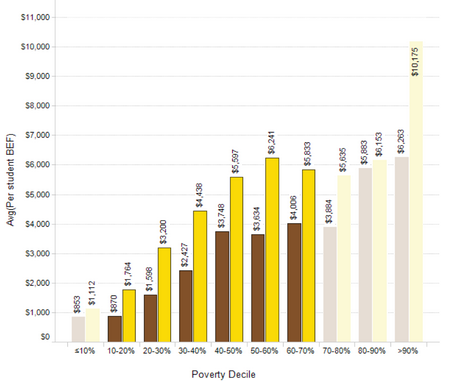
Unsettlingly, recent research from data scientist David Mosenkis finds that poverty alone does not explain the underfunding. Mosenkis delved into funding data for 500 school districts in the state of Pennsylvania. Because richer school districts are able to drum up more cash through taxes, they should receive less state funding, and poorer districts should receive more. He looked at how much money they received and sorted those findings based on race and income.

Using a broad scope, Mosenkis found what one might expect: On the surface poor districts do receive more state funding than rich schools. But when he delved deeper into the data, sorting by race, what he found was disturbing.

If you color code the districts based on their racial composition you see this very stark breakdown. At any given poverty level, districts that have a higher proportion of white students get substantially higher funding than districts that have more minority students.” That means that no matter how rich or poor the district in question, funding gaps existed solely based on the racial composition of the school. Just the increased presence of minority students actually deflated a district’s funding level. “The ones that have a few more students of color get lower funding than the ones that are 100 percent or 95 percent white,” Mosenkis said.

Issues with scarce budgets and troubled urban schools aren’t new, and they exist all over the country. In an article published in The Atlantic in 1954, Henry I. Willett attempted to answer the question of whether or not public schools cost too much by saying, “The amount spent for educational purposes as compared with amounts spent for many other items and services, including luxuries, would indicate that the importance of education in our democracy is not yet realized: and the hour is growing late.”

In Pennsylvania, the crisis is particularly acute. The state’s former governor stripped the education budget significantly. In the years since, schools have shuttered, teachers have been fired, and the schools that remain are existing on bare-bones budgets. Earlier this year, two children died after getting sick at district schools where no nurses were on duty due to budget reductions. Pennsylvania is also one of the only states in the country that hasn’t had a specific formula in place for distributing government aid to its districts. That’s left lots of room for partisan politics and funding bias.

The results are pretty shocking.  At every level when controlling for class, majority white school districts in the state get more funding from the state per student than districts where the majority consists of students of color:


Democratic Gov. Tom Wolf, elected last November, is trying to change that.  But Republicans in the state's legislature have yet to pass a budget.  

We're repeatedly told the problem can't be systemic racism because in 2015 that simply doesn't exist, it's just class.  This study controls for class and greatly seems to prove otherwise, and the state is far from alone.
Related Posts with Thumbnails