Thursday, July 22, 2021

Last Call For The Black Hole Of Justice Kegstand

So, turns out the FBI passed along more than four thousand tips on Justice Brett Kavanaugh before his confirmation hearing to the Trump White House, and the Trump White House dumped the entire file into the garbage can.


Nearly three years after Justice Brett M. Kavanaugh’s tumultuous confirmation to the Supreme Court, the F.B.I. has disclosed more details about its efforts to review the justice’s background, leading a group of Senate Democrats to question the thoroughness of the vetting and conclude that it was shaped largely by the Trump White House.

In a letter dated June 30 to two Democratic senators, Sheldon Whitehouse of Rhode Island and Chris Coons of Delaware, an F.B.I. assistant director, Jill C. Tyson, said that the most “relevant” of the 4,500 tips the agency received during an investigation into Mr. Kavanaugh’s past were referred to White House lawyers in the Trump administration, whose handling of them remains unclear.


The letter left uncertain whether the F.B.I. itself followed up on the most compelling leads. The agency was conducting a background check rather than a criminal investigation, meaning that “the authorities, policies, and procedures used to investigate criminal matters did not apply,” the letter said.

Ms. Tyson’s letter was a response to a 2019 letter from Mr. Whitehouse and Mr. Coons to the F.B.I. director, Christopher A. Wray, posing questions about how the F.B.I.’s review of Mr. Kavanaugh was handled.

In an interview, Mr. Whitehouse said the F.B.I.’s response showed that the F.B.I.’s handling of the accusations into misconduct by Mr. Kavanaugh was a sham. Ms. Tyson’s letter, Mr. Whitehouse said, suggested that the F.B.I. ran a “fake tip line that never got properly reviewed, that was presumably not even conducted in good faith.”


Mr. Whitehouse and six of his Democratic colleagues on the Senate Judiciary Committee replied to the F.B.I.’s letter on Wednesday with demands for additional details on the agreement with the White House that governed the inquiry. They also pressed for more information on how incoming tips were handled.

“Your letter confirms that the F.B.I.’s tip line was a departure from past practice and that the F.B.I. was politically constrained by the Trump White House,” the senators wrote. Among those signing the letter were Senator Dick Durbin of Illinois, the committee’s chairman, Mr. Coons and Senator Cory Booker of New Jersey.

Donald F. McGahn, the White House’s general counsel at the time, and the F.B.I. did not immediately respond to requests for comment.
 
I could see this becoming the impetus for the removal of FBI Director Chris Wray down the road, but frankly that's going to be a wildly political move, something that not even Trump dared to do. It's certainly not going to get Kavanaugh to resign, so other than this being a rather stark reminder of Democrats' utter failure in the last ten years on Supreme Court issues, I don't see what the point of this is at all.

Move on.

Biden Fights The Viral, Con't

Here in Cincinnati last night, President Biden held a town hall meeting televised on CNN to talk to the American people, and the big topic was the resurgence of COVID-19's delta variant over the last several weeks that have tripled the number of new infections since the beginning of the month.

President Biden pleaded urgently Wednesday with anyone eligible for a vaccine shot to get one, asserting in an unusually direct way that the pandemic is now essentially a problem only for those who are still refusing to get immunized.

Biden spoke at a pivotal moment in the pandemic, as new cases and deaths are far down from their peak. But the emergence of the coronavirus’s delta variant, along with the refusal of large parts of the population to get vaccinated, has prompted a resurgence in some states and fears of a major spike in the fall.

Speaking to voters in Ohio at a town hall-style event broadcast by CNN, Biden was challenged on issues including the economy and gun laws. But the resurgent pandemic took up most of the discussion, and Biden — while careful not to assign blame — was blunt in making a distinction between those who are now at risk of hospitalization or death and those who are much less so.

“It’s real simple: We have a pandemic for those who haven’t gotten a vaccination,” he said.

He also challenged Americans to reject conspiracy theories and face the reality of the Jan. 6 insurrection at the U.S. Capitol, whatever their politics. A pro-Trump mob overran the U.S. Capitol that day in an attempt to prevent Congress from confirming Biden’s election victory.

“I don’t care if you think I’m Satan reincarnated. The fact is, you can’t look at that television and say nothing happened on the 6th. You can’t listen to people who say this was a peaceful march,” the president said.

The question-and-answer session at Mount St. Joseph University included questions from people who said they had supported the Democrat in his presidential run last year and some who said they had not.

Biden said he expected the Centers for Disease Control and Prevention to recommend that children under 12 returning to school next fall wear masks. He said the Food and Drug Administration probably fully would approve a vaccine around the beginning of the school year, rather than the current emergency authorization.
 
We're in for a bad fall, folks. And, if we're not careful, a bad tumble, as well.

School Of Hard Right Knocks, Con't


A Missouri legislative committee on Monday held a hearing on how educators teach K-12 students about race and racism without hearing from any Black Missourians.

No Black parents, teachers or scholars testified to the Joint Committee on Education during the invite-only hearing on critical race theory.

Aside from an official from Missouri’s education department, the only people who testified Monday were critics of critical race theory, which is a way of thinking about America’s history through the lens of racism.

Missouri NAACP President Rod Chapel called it “ridiculous” to have a conversation about inequity while “excluding the very people who are saying we’ve been treated inequitably.”

“That talks more to the kind of hearing that they wanted to have than the information that they wanted to gather,” Chapel told reporters after the hearing. “They wanted to hear from their friends who were going to support their political talking points.”

Republican Sen. Cindy O’Laughlin, who leads the committee, said she wanted to use the hearing to highlight voices of parents upset about critical race theory who have said local school officials ignored their complaints.

“I felt today it was important to hear from people who have tried to go through the official cycle of authority within their districts and have basically been turned away,” she told committee members.

O’Laughlin said she also invited an associate professor of teaching who specializes in Black history, but he declined to testify.

She said there will be more committee hearings on critical race theory and more opportunities for the public to weigh in.

“I’m certain this won’t be the last conversation,” she said.
 
They don't want a debate. They want cover to erase Black history from America, and they're winning

In May, the North Carolina House voted along partisan lines to move to the Senate the “Ensuring Dignity & Nondiscrimination/Schools” bill prohibiting public schools from promoting concepts such as that an individual should feel “discomfort, guilt, anguish” or bear responsibility for actions from the past based on their race or sex; and opposing the characterization that the belief that the United States is a meritocracy is “inherently racist or sexist.” In support of the legislation, the Republican State Superintendent of Public Instruction Catherine Truitt vouched to eradicate CRT from classrooms, saying, “There is no room for divisive rhetoric that condones preferential treatment of any one group over another.” Democratic Rep. James Gailliard of Nash County called it a “don’t-hurt-my-feelings bill” that reproduces “discrimination, fanaticism, bigotry.”

Former President Donald Trump, conservative activists, media, and political figures have turned CRT, which has largely been applied to academic research fields and isn’t actively taught in K-12 schools, into a wedge issue, feeding into parents’ concerns that their children are being indoctrinated with dangerous, radical leftist ideologies. But for the most part, the decades-old academic framework is wrongfully being weaponized as a catchall term to conflate and delegitimize conversations about race, diversity, equity, and inclusion in schools.

“Just teaching about history isn’t CRT,
” Sherick Hughes, a critical race scholar and expert in Black education at the University of North Carolina-Chapel Hill School of Education, says. The backlash, he adds, is prompted by the idea of doing any critical analysis of not just the present but the past. 

In the end, it's about making sure white kids -- and white parents -- never have to think about the bad parts of US race history, only now there's an entire political party dedicated to disappearing that history forever.

Wednesday, July 21, 2021

Last Call For Do Fear The Reaper

At this point, openly choosing to not take the vaccine really does have consequences, and it's time that more people learned exactly what the stakes are.
 
Dr. Brytney Cobia said Monday that all but one of her COVID patients in Alabama did not receive the vaccine. The vaccinated patient, she said, just needed a little oxygen and is expected to fully recover. Some of the others are dying.

“I’m admitting young healthy people to the hospital with very serious COVID infections,” wrote Cobia, a hospitalist at Grandview Medical Center in Birmingham, in an emotional Facebook post Sunday. “One of the last things they do before they’re intubated is beg me for the vaccine. I hold their hand and tell them that I’m sorry, but it’s too late.”

Three COVID-19 vaccines have been widely available in Alabama for months now, yet the state is last in the nation in vaccination rate, with only 33.7 percent of the population fully vaccinated. COVID-19 case numbers and hospitalizations are surging yet again due to the more contagious Delta variant of the virus and Alabama’s low vaccination rate.

For the first year and a half of the pandemic, Cobia and hundreds of other Alabama physicians caring for critically ill COVID-19 patients worked themselves to the bone trying to save as many as possible.

“Back in 2020 and early 2021, when the vaccine wasn’t available, it was just tragedy after tragedy after tragedy,” Cobia told AL.com this week. “You know, so many people that did all the right things, and yet still came in, and were critically ill and died.”

In the United States, COVID is now a pandemic of the unvaccinated, according to the head of the U.S. Centers for Disease Control and Prevention. In Alabama, state officials report 94% of COVID hospital patients and 96% of Alabamians who have died of COVID since April were not fully vaccinated.

“A few days later when I call time of death,” continued Cobia on Facebook, “I hug their family members and I tell them the best way to honor their loved one is to go get vaccinated and encourage everyone they know to do the same.”

“They cry. And they tell me they didn’t know. They thought it was a hoax. They thought it was political. They thought because they had a certain blood type or a certain skin color they wouldn’t get as sick. They thought it was ‘just the flu’. But they were wrong. And they wish they could go back. But they can’t. So they thank me and they go get the vaccine. And I go back to my office, write their death note, and say a small prayer that this loss will save more lives.
More than 11,400 Alabamians have died of COVID so far, but midway through 2021, caring for COVID patients is a different story than it was in the beginning. Cobia said it’s different mentally and emotionally to care for someone who could have prevented their disease but chose not to.

“You kind of go into it thinking, ‘Okay, I’m not going to feel bad for this person, because they make their own choice,’” Cobia said. “But then you actually see them, you see them face to face, and it really changes your whole perspective, because they’re still just a person that thinks that they made the best decision that they could with the information that they have, and all the misinformation that’s out there.
 
 Only a third of Alabama is fully vaccinated.

That is, at this point, a choice.

Understand the consequences of that choice being at best, a disease that will cause you chronic health issues for life, and at worst a disease that will cause you chronic health issues for life with the length of that lifespan being measured in days, if not agonizing hours where you drown in your own flooded lungs despite the tube shoved down your throat trying desperately to pump the fluid out.

Make the right choice.

The Big Lie, Con't

America still has questions about the January 6th terrorist insurrection, and the majority of us expect Congress to get us some damn answers, which ostensibly is a problem for the GOP.


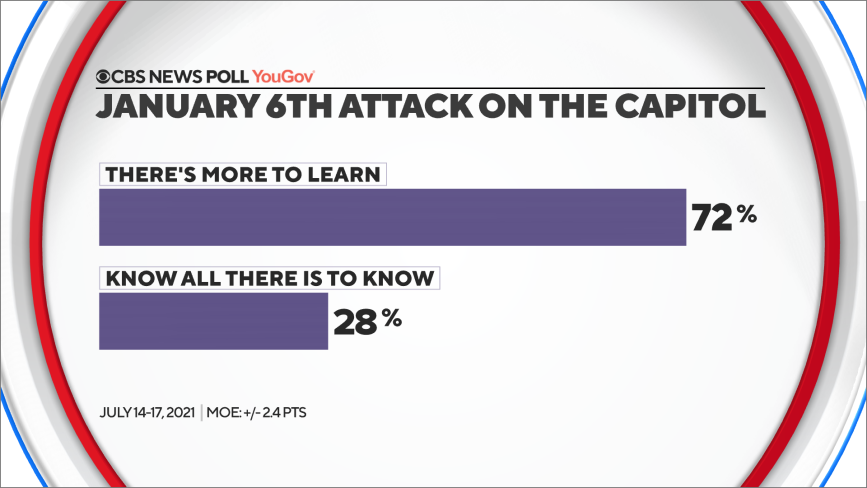
With Congress' January 6 Select Committee slated to start work soon, Americans still overwhelmingly disapprove of the events they witnessed that day, a sentiment that includes big majorities of both Republicans and of former President Trump's voters, too — and most do think there's more to learn about it. But beyond that larger sentiment, not everyone describes what happened the same way.

A majority of Americans still specifically call what happened that day an "insurrection" and an attempted overthrow of the government. This is where most Democrats and independents land. But roughly one-third of the country call it patriotism, or defending freedom, even though some of them nonetheless disapprove of the attack itself. And on those descriptors, we see divides within the GOP.

 25-attackoncapitol.png


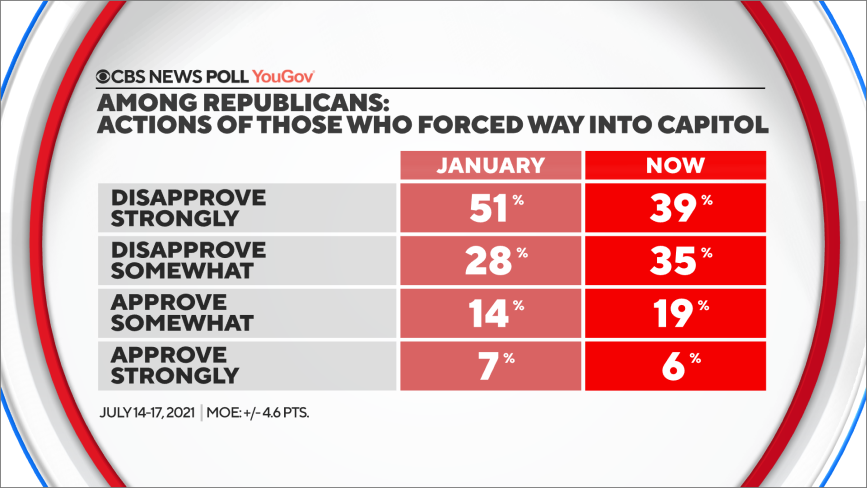
This may be worth watching: among Republicans, there is some shifting sentiment as they disapprove, though not quite as strongly as they used to. This less intense disapproval, among some in the Republican base, comes perhaps on the heels of recent comments about the day from former President Trump and others.
27-repsattackoncapitol.png  
Here's the thing though: "There's more to learn" in this case to the GOP clearly means "goofball right-wing conspiracy theories must be investigated and given equal importance", and that's where Kevin McCarthy's merry band of assholes comes in.  


House Minority Leader Kevin McCarthy has made his selection of five Republicans to join the select committee investigating January 6, ensuring that Republicans will have input in the investigation run by Democrats. 
Republican Reps. Jim Banks of Indiana, Jim Jordan of Ohio, Rodney Davis of Illinois, Kelly Armstrong of North Dakota and freshman Troy Nehls of Texas have been selected by McCarthy, the minority leader confirmed to CNN. The group of House Republicans who were named to the select committee huddled in McCarthy's office for a meeting on Monday evening. 
When asked how he arrived at his selections, McCarthy said he carefully chose a mix of members who represent a wide swath of views inside the House GOP conference and can each bring a different area of expertise to the table because of their past jobs or current committee assignments. 
"You've got a mix from the entire conference, from people who objected, people who didn't object. ... You've got people who authored the commission," McCarthy told reporters. "So, you've got a microcosm of the conference."


Please note the "microcosm of the conference" here are all white men from the Midwest, three of the five (Jordan, Banks, and Nehls) who voted to make Trump dictator on January 6th. Rod Davis is the one Republican in that group that actually voted for the January 6th Committee.

But let's be real about what the goal here is:
 
When asked by CNN what Republicans want to accomplish on the select committee, Jordan attacked Democrats: "You know what this is about. This is about going after President Trump. The Democrats don't want to talk about anything else." 
Banks was selected to be the ranking Republican on the committee and is also the head of the Republican Study Committee, the largest conservative caucus in the House. 
In a statement, Banks confirmed that he had accepted McCarthy's appointment, but outlined his concerns with the scope of the committee, framing it as an effort by Democrats "to malign conservatives and to justify the Left's authoritarian agenda." 
"I have accepted Leader McCarthy's appointment to this committee because we need leaders who will force the Democrats and the media to answer questions so far ignored. Among them, why was the Capitol unprepared and vulnerable to attack on January 6?" Banks asked.
T
The goal was always to muddy the water and produce ignoble headlines like "Dems, GOP Clash On January 6th Committee" for several weeks, and America tunes the arguing out.
 
Pelosi knows this, so she told Jordan and Banks to piss off.
 
McCarthy has now pulled all Republicans from the committee and vows that he'll keep it from going forward.

The fact that Jordan, who should be a potential witness called to answer for his role in the insurrection, was chosen the committee signals very clearly that the GOP is going to do its dead level best to cover up the mess here, and America will just shrug and go back to watching reruns of Judge Judy.

Republicans don't want answers. They want the Big Lie.

A Little Sinema Verite, Con't

Arizona Democratic Sen. Krysten Sinema is in real trouble with her party if she doesn't change her tune on the filibuster, at least according to a new poll in Mother Jones.
 
Sen. Kyrsten Sinema’s support for the Senate filibuster appears to be doing real damage to her political brand back home. The first-term Arizona Democrat has often defended the Senate’s 60-vote supermajority requirement as a necessary check on partisan whiplash, arguing that it forces the chamber to put together “durable” coalitions. But according to a new survey shared with Mother Jones from the progressive polling and policy firm Data for Progress, her stance has left her far less popular in Arizona than either President Joe Biden or her recently elected Senate colleague, Mark Kelly—and perhaps even vulnerable to a primary challenge.

According to the survey, which was conducted from June 28 to July 6th, Sinema is viewed favorably by 38 percent of voters, compared to 47 percent for Kelly and 51 percent for Biden—all of whom were elected in recent years by similar margins to Sinema. (Republican Gov. Doug Ducey’s favorability sits at 44 percent.) The numbers are more stark when you look at the partisan breakdown. Sinema is viewed favorably by just 42 percent of Democrats (with 39 percent viewing her unfavorably), while Kelly, who was elected narrowly last fall, is at 75 percent favorability with just 17 percent viewing him unfavorably. Biden? He’s doing just fine according to Arizona Democrats, with 95 percent viewing him positively.


Beyond the toplines, though, there are some ominous numbers for Sinema’s long-term standing back home. Democratic voters overwhelmingly support a $15 minimum wage according the survey; Sinema drew the ire of activists this spring for casting a largely symbolic vote against adding such a minimum-wage hike to the coronavirus stimulus package. They support getting rid of the legislative filibuster and overwhelmingly back the PRO Act, which would expand rights and protections for labor unions, but which Sinema has not signed onto.

After voters were read a script linking the filibuster to Republican obstruction, 66 percent of Democrats said that if given the chance in a 2024 Senate primary, they would “vote for a different candidate who would get rid of the filibuster.”

There’s one silver lining in all these numbers for Sinema. The poll also indicates she’s far more popular among Republicans than either Kelly or Biden. More than twice as popular, in fact. And this isn’t the first recent poll to pick up on such a divide. Another Arizona survey last month—this time of registered voters—showed a similarly stark gap. That survey, from pollster Bendixen & Amandi, found that while Kelly, like Biden, was overwhelmingly popular among Democrats and overwhelmingly unpopular among Republicans, Sinema’s numbers among the two parties were almost identical: She was viewed favorably by 52 percent of Democrats and 51 percent of Republicans.
 
Being underwater with your own party, but preferred by Republicans, well...

Let's just say if I were an Arizona Democrat, I'd be looking at a possible primary challenge to Sinema. We'll see how she reacts to this. You can't stay in office very long if you lose a primary.

Tuesday, July 20, 2021

Last Call For The Rights Thing To Try

Vice President Kamala Harris is making a final push to bring Republican senators on board with voting rights legislation, and while I understand the sentiment, I don't understand why anyone believes a single Republican in Congress will vote for anything involving voting rights that doesn't also include disenfranchising an equal amount of Black, brown, and Asian voters.

Vice President Kamala Harris says she is speaking with Republican senators on a key piece of voting legislation. During a phone interview with CBS News, the vice president said there is "no bright line" defining whom she speaks to about voting rights legislation. She said it's "a non-partisan issue" and "should be approached that way."

In response to a question about whether she had spoken with any GOP senators about S. 1, the sweeping voting rights bill that has been blocked in the Senate, she replied, "I have spoken to Republican senators — both elected Republicans and Republican leaders," Harris said, and she identified one GOP senator.

"I've talked with [Senator Lisa] Murkowski about this issue," Harris said.

Harris' office later clarified that the two had discussed infrastructure, not voting rights. A spokesperson for Murkowski did not respond to a request for comment.

S. 1 is not a bill that Murkowski favors — she has previously called the For the People Act a "partisan, federal takeover of the election system."

The Alaska senator is the co-sponsor of the John Lewis Voting Rights Act, which would essentially restore a portion of the act struck down by the Supreme Court. This bill also faces GOP opposition and has not yet been introduced, but the White House has expressed support for this legislation, too.
 
Oh, never mind, it's one GOP senator, Murkowski, and she won't vote for it. 

I guess we can keep wasting time with this, or go for reconciliation, which was always going to be the answer.

As Good As It Gets, Con't

We're not going to get vaccination numbers above 70% in America, and it's time to accept that the majority of the unvaccinated at this point are staying unvaccinated for political reasons
 
Most Americans who still aren't vaccinated say nothing — not their own doctor administering it, a favorite celebrity's endorsement or even paid time off — is likely to make them get the shot, according to the latest installment of the Axios/Ipsos Coronavirus Index.

Why it matters: The findings are more sobering evidence of just how tough it may be to reach herd immunity in the U.S. But they also offer a roadmap for trying — the public health equivalent of, "So you're telling me there's a chance."

What they're saying: "There's a part of that population that are nudge-able and another part that are unbudge-able," said Cliff Young, president of Ipsos U.S. Public Affairs.
"From a public health standpoint they've got to figure out how you nudge the nudge-able."

Details: 30% of U.S. adults in our national survey said they haven't yet gotten the COVID-19 vaccine — half of them a hard no, saying they're "not at all likely" to take it. We asked the unvaccinated about how likely they'd be to take it in a number of scenarios: 
The best prospect was a scenario in which they could get the vaccine at their regular doctor's office. But even then, 55% said they'd remain not at all likely and only 7% said they'd be "very likely" to do it. That leaves a combined 35% who are either somewhat likely or not very likely but haven't ruled it out. 
The Biden administration's Olivia Rodrigo play won't reach a lot of the holdouts, according to these results: 70% said the endorsement of a celebrity or public figure they like is "not at all likely" to get them to take a shot, and just 4% said they'd be "very likely" to do it. But another combined 24% could be somewhat in play. 
What if your boss gave you paid time off to get the shot? 63% said they'd still be not at all likely to do it, while 5% said they'd be very likely. Another 30% combined are potentially but not eagerly gettable. 
Similar majorities said they’d be unmoved by community volunteers coming to the door to discuss the vaccine, the option to get a shot at work or a mobile clinic, or being lobbied by friends or family members.

The big picture: Overall, Americans' concerns are rising for activities like seeing family and friends outside the home, going to the grocery store or sports events or getting on a plane. 
Those concerns had subsided as vaccines became widely available. But the numbers are creeping back up after recent reports of rising infection rates and the dangers of the Delta variant. 
But this trend is being driven by the vaccinated. The unvaccinated are no more concerned than they were before, which wasn't much.
 
As the body count continues to rise in the weeks and months ahead, the entire point will be to blame Biden's "failure" to convince Americans to get the vaccine. The goal is to see the casualty list post-January 20 exceed that of the final year of the Trump regime, and that's when Biden and the Democrats become "worse than Trump was" at containment of the virus.

You can bet your bottom dollar that Republicans will run on that in 2022 and 2024.

And yes, I'm absolutely serious about this. They want to own the libs by getting a deadly disease, just as long as another half-million or so die (and it isn't them personally because American exceptionalism, if I get sick, my insurance will cover it because I'm a good person) and as long as they can blame Biden for it. See, Trump isn't the worst anymore! Now you have to admit he was better than Biden, stupid libtard! Checkmate!

Yeah I know, that's cynical even for me, even in the era of the Death Cult GOP. But that's how far gone they are, folks.

They'll take as many of us with them as they can. If they can't be in charge of the country, they'll make it hell until we give them the keys to the burning car.

So what will move these numbers? Washington Post columnist Kate Cohen has an idea.

I propose a running tally in bold type: covid deaths among unvaccinated vs. vaccinated citizens. Two numbers, side by side. Every newspaper’s front page, every state and federal website, the crawl at the bottom of every cable television news broadcast.

Google can design something cute for its search bar. Facebook owes it to us.

Every day, all day. Two numbers.

We couldn’t do this until now. When I tried to find out how many covid deaths could have been prevented if people just wore masks, the best I could come up with was the public health literature equivalent of “lots.” A study published last October in Nature Medicine hazarded that with masking nearly 130,000 lives could be saved by the spring, but researchers cautioned the model was more a “sophisticated thought experiment” than a prediction, a rough estimate.

But now that we have the vaccine and almost everyone eligible for it can get it, we don’t have to estimate. We can count. And the numbers show the overwhelming odds that a person who dies of covid has not been vaccinated.

As for the minuscule chance that I, as a vaccinated person, could die of covid? That’s because the unvaccinated are choosing to keep the virus alive.

So, let’s make it simple. Let’s ask our best analysts to put out a single set of numbers every day.
 
To which I reply, simply, "If logical appeals to reason worked on death cultists, we wouldn't be in this situation in the first place." 

At some point, you have to accept that you can only save those who want to be saved, and protect yourself against the rest. We're at that point now.

It's time to accept that, and move into triage mode.

Looking Forward Into The Abyss

David Montgomery gives us a long read at Washington Post Magazine on why Merrick Garland won't fire Trump cultists in the Justice Department, but all you really need are the first three paragraphs.

Merrick Garland, now more than four months into the job of attorney general, is on a quest to slay a monster — a monster that he won’t name and he pretends doesn’t exist. On March 11, his first day, he stood in the Great Hall of Justice Department headquarters and addressed the agency’s 115,000 employees, most watching virtually. It was a homecoming of sorts for Garland, 68, who started at the department as a 26-year-old lawyer in 1979, rising to lead major investigations including the Unabomber case and the Oklahoma City bombing prosecution in the 1990s before spending the last two decades-plus as an esteemed federal judge on the U.S. Court of Appeals for the District of Columbia Circuit. “The only way we can succeed and retain the trust of the American people is to adhere to the norms that have become part of the DNA of every Justice Department employee,” he said in his first speech as attorney general. “Those norms require that like cases be treated alike. That there not be one rule for Democrats and another for Republicans, one rule for friends and another for foes, one rule for the powerful and another for the powerless.”

What he didn’t say — what he never says publicly — is that there are good reasons the department might have lost the trust of the American people in the past four years. During President Donald Trump’s administration, there wasn’t always one rule of law for all, as when presidential friends Roger Stone and Michael Flynn had their prosecutions massaged and softened; or when former attorney general Bill Barr launched an outside investigation of the investigators to see if Trump was unfairly targeted in the Russia probe; or when Barr spun findings by the special counsel and the inspector general in ways most advantageous to Trump; or when Barr changed procedures so U.S. attorneys could dive into Trump’s false claims about election results before the vote tallies were certified.

But when Garland is asked about questionable actions that took place at the Justice Department during the previous administration, he offers a version of a response that he gave during a Q&A session with reporters in June: “I am not going to look backward
.”

 
Eric Holder and later Loretta Lynch did the same thing with Dubya, and here we all are now.

Even if you don't that the next Republican president will put his Democratic predecessor in prison, along with most, if not all, of their cabinet, believe that they will have no problem looking back after Biden, Harris, or whoever may follow them.

It won't be pretty.


Monday, July 19, 2021

Last Call For Too Q-ool For School

Author and conspiracy spread expert Mike Rothschild reminds us that the Q-balls haven't disappeared, they're the ones running to take over your local school board, city council, and state legislature after rebranding themselves for the Biden era.
 
Post-2020, Q believers are once again gearing up to run for office and grow their movement, but with two major strategy changes. One is that Q believers are now getting involved in local elections for school boards and city councils and showing up at board meetings to scream about Q-linked topics. The other is that many of these candidates no longer identify as believers in QAnon — or even acknowledge that a movement with that name ever existed. They’re taking their “secret war” to new recruits looking to strike back against a way of life they feel is eroding — without the public acknowledgement that such a war exists. In doing so, they have the potential to expose new audiences to their violent mythology, without having to explain away the baggage that comes with the term “QAnon.”

Both changes come straight from the top: one from several Q “drops” on the message board 8kun and the other from QAnon hero Michael Flynn. (Flynn trademarked the term “digital soldiers,” which is what many Q believers see themselves as.)


In a September post, “Q” ordered believers to “drop all references re: 'Q' 'Qanon' etc.” to avoid being banned on social media. A month later, Q declared that “there is Q, there are anons, there is no QAnon.” Q posited that the very term “QAnon” was a media creation with no real meaning. It wasn’t true, but it didn’t matter. The term was no longer necessary, because Q’s mythology of an all-powerful deep state that enables child trafficking and election fraud was entering the mainstream conservative discourse.

More recently, in June, Flynn ordered believers at a "Reopen/Reawaken America" event to "not allow school boards to dictate what is happening in our schools." Flynn has also had the quote “local action equals national impact” attributed to him, though only based on a meme on a popular QAnon message board. But again, whether he used that quote or not doesn’t matter here — only the feeling of doing something important matters. Flynn himself has been relentlessly promoting and raising money off QAnon — while simultaneously distancing himself from it.

Spurred on by their leaders, real and imagined, Q believers are showing up at school board gatherings and running for obscure local offices around the country. They’re spouting the same conspiracy theories about sex traffickers, critical race theory and the erasure of conservatives represented by “cancel culture” that have long been at the heart of QAnon. They’re scaring parents while firing up disaffected conservatives. And they’re doing both without publicly associating with or name-dropping Q. Either way, the message is the same: There’s a war going on against your way of life, and the only way to win is if you personally join the fight.

That model, of attempting to gain power at the local level using QAnon mythology while simultaneously discarding the QAnon brand itself, is a sustainable path forward for a movement that had seemed to be teetering on the brink of irrelevance. It forges a new, durable way to actually influence policy without relying on cryptic nonsense found on an extremist message board. And it fits in perfectly with the GOP’s emphasis on pushing culture war issues at the expense of actual governing.

The new Q doesn’t rely on the goodwill of social media giants but on small meetings and text message blasts that stoke fears of conservative culture war bogeymen. It’s putting aside the impossible hope of Donald Trump being “reinstated” as president and focusing on winning real local elections with real impact.

That impact is real. In June, the National Education Association released an op-ed asking “Is QAnon Radicalizing Your School Board?” highlighting board election wins by Q believers in Michigan, Washington, Florida and California. And that was before the more organized attempts to infiltrate school boards with fears of trafficking and critical race theory.

The rebranded Q and its leaders are taking their cues from the Christian right and the tea party, making national issues a Main Street problem. Most people don’t think, as QAnon posits, that Hillary Clinton is a child-trafficking occultist — but many more live in terror of their kids being brainwashed or kidnapped, a fear that Q gurus already exploited in the 2020 “Save the Children” hysteria. Few Republicans think Trump will be “restored” to office, but virtually all believe their way of life is being “canceled” by liberalism’s godless onslaught
.
 
A new coat of paint over the same, rusted, toxic mess, and their rage is being directed towards the Biden administration and local Democrats in their midst. It's setting the stage for violence across the nation, and in a lot of ways it's more dangerous now than it was last year because they have doubled down on the lunacy since losing.
 
They were already vulnerable cultists. Now they serve a new culture war cult, heavy emphasis on the war part.
 
The bullets won't be far behind.


That Poll-Asked Look, Con't

The pollsters were so utterly wrong in 2020 that they basically turned in their worst performance in my lifetime.

Public opinion polls in the 2020 presidential election suffered from errors of “unusual magnitude,” the highest in 40 years for surveys estimating the national popular vote and in at least 20 years for state-level polls, according to a study conducted by the American Association for Public Opinion Research (AAPOR).

The AAPOR task force examined 2,858 polls, including 529 national presidential race polls and 1,572 state-level presidential polls. They found that the surveys overstated the margin between President Biden and former president Donald Trump by 3.9 points in the national popular vote and 4.3 percentage points in state polls.


Polls understated the support for Trump in nearly every state and by an average of 3.3 percentage points overall. Polls in Senate and gubernatorial races suffered from the same problem.

“There was a systematic error that was found in terms of the overstatement for Democratic support across the board,” said Josh Clinton, a Vanderbilt University political science professor who chaired the 19-member task force. “It didn’t matter what type of poll you were doing, whether you’re interviewing by phone or Internet or whatever. And it didn’t matter what type of race, whether President Trump was on the ballot or was not on the ballot.”

The polls did a better job of estimating the average support for Biden, with a few exceptions. In general, support for Biden in the polls was 1 percentage point higher than his actual vote.

An AAPOR task force conducted a similar examination after the 2016 election. Then, national polls generally accurately predicted the size of Hillary Clinton’s popular vote victory over Trump, but state polls proved more problematic, causing many analysts at the time to predict wrongly that Clinton also would win an electoral college majority.

In the new study, task force members were able to rule out a series of reasons that might have caused the 2020 polls to show a bigger margin for Biden over Trump than the actual results. That included some of the problems that affected polling in 2016, such as the failure in that year to account for levels of education in the samples of voters.

But the task force members were not able to reach definitive conclusions on exactly what caused the problems in the most recent election polls and therefore how to correct their methodology ahead of the next elections. “Identifying conclusively why polls overstated the Democratic-Republican margin relative to the certified vote appears to be impossible with the available data,” the report states.

Polling in senatorial and gubernatorial races showed a similar pattern, overstating the margin for Democratic candidates versus their Republican opponents. When state-level presidential polls were removed from the sample, the error level was even higher. For example, polling pointed to possible Democratic gains in House races. Instead, Republicans gained seats.

National presidential polls were accurate in one respect, which was in pointing to the popular vote winner. Of 66 such polls taken in the last two weeks of the campaign, all showed Biden ahead of Trump. “The performance of senatorial polls was notably worse,” the report notes, with just 66 percent correctly identifying the winning candidate.
 
The polls were wrong, particularly for House and Senate races, and they can't figure out why.

Ignore all polls in 2022 and 2024, is what we're saying.
 

Florida Goes Viral Again Con't

With the fast-spreading Delta variant of COVID-19, state mask regulations eliminated, and a third of American adults refusing the vaccine, we're right back to October 2020 daily case numbers and heading for six digits.
 
The United States recorded 79,310 new cases of COVID-19 on Friday, according to Johns Hopkins University. 
The number is the highest in the world, exceeding recorded totals from Indonesia (54,000), the United Kingdom (51,949), and Brazil (45,591), and doubling that of India (38,079). 
The spiking case number matches the level hit in October 2020, a record at the time, though it would not remain so for long. Despite the effectiveness of multiple vaccines against the virus, vaccine hesitancy is fueling “a pandemic of the unvaccinated,” according to CDC Director Dr. Rochelle Walensky. 
The vast majority of all patients currently hospitalized with COVID-19 are unvaccinated, according to the CDC.


Florida will no longer update its COVID-19 dashboard or release daily updates about COVID-19 cases and deaths.

Now the Florida Department of Health will provide reports about coronavirus cases and vaccines on a weekly basis each Friday, according to the Tallahassee Democrat.

There’s no longer a need to create daily reports, Christina Pushaw, press secretary for Gov. Ron DeSantis, told The News Service of Florida on Friday.

“COVID-19 cases have significantly decreased over the past year as we have a less than 5% positivity rate, and our state is returning to normal, with vaccines widely available throughout Florida,” she wrote in an email.

The latest weekly report, issued on Friday, showed 11,900 new COVID-19 cases and 35 new deaths during the past week. The case positivity rate is 3.6%.

In addition, 10 million Floridians have now received at least one COVID-19 vaccine dose, which covers about 53% of the population. More than 8.2 million residents are considered fully vaccinated.

Florida’s COVID-19 state of emergency remains in effect until June 26. DeSantis has said that he doesn’t plan to extend it further, The News Service of Florida reported.
 
 That  was last month. This month, Florida is now responsible for 20% of all new US cases.

The U.S. Court of Appeals for the 11th Circuit in Atlanta late Saturday stayed a judge’s order that would’ve declared the CDC’s COVID-19 regulations for the cruise ship industry as mere recommendations, not rules.

The judge’s order had been expected to go into effect Sunday.

U.S. Federal District Judge Steven Merryday’s decision, now on hold, meant that by July 18 cruise ships would no longer have to enforce COVID-19 safety protocols for its passengers or employees, and the Centers for Disease Control and Prevention’s precautions would’ve been nothing more than recommendations for any cruise line to follow, or not follow, as they see fit.

The panel’s 2-1 ruling marked a win for the CDC.

In its request for the stay of the injunction, the CDC said that by keeping its safety protocols for cruises in place, it was not shutting the cruise industry down but rather providing a framework for them to continue operating safely during the pandemic.

The CDC has battled the state of Florida over the department’s regulations for cruise ships for the past few months. Florida Gov. Ron DeSantis originally filed the lawsuit against the CDC in April.

The CDC issued a conditional sail order last October to work on keeping cases down on ships and from the virus spreading in local communities. The order set forth a four-phased approach that would let ships start sailing again, ranging from testing of crew members, testing requirements for passengers and restricted voyage lengths among other things.

The state of Florida previously sued the CDC over its regulations for the cruise ship industry, arguing that the rules were hurting Florida’s unemployment rate and the state’s ability to do business.

This latest reversal comes as Florida has become a flashpoint in a resurgence of COVID-19 cases. Cases in Florida doubled over the past week, with the Department of Health reporting 45,604 new cases. The positivity rate also climbed to over 11%.

On Friday, the White House said that the state, which accounts for 6.5% of the country’s population, was responsible for 20% of the country’s new infections, the latter figure more than three times greater than the former.
 
Things are going to get bad, fast. By Labor Day it's going to be clear that in unvaccinated counties, people are going to be in dire straits, and Republican governors and legislatures will do nothing as their constituents die in droves.

I did warn you that the rest of the year was going to be bad.

Get vaccinated before Republicans outlaw those, too.

Sunday, July 18, 2021

Last Call For Keeping An Eye On You

The real blowback from Ed Snowden giving the keys to the NSA to the entire world in order to "make information free" is that the tools the NSA uses to conduct surveillance are now freely in the hands of private companies using versions of the technology to sell to the highest bidder, and world governments and the powerful people running them are happily contracting these companies to spy on whomever they want to in order to hurt the US. The most recent example of this is Israeli firm NSO Group, who apparently have been spying on western journalists' smartphones for a significant amount of time.

Military-grade spyware licensed by an Israeli firm to governments for tracking terrorists and criminals was used in attempted and successful hacks of 37 smartphones belonging to journalists, human rights activists, business executives and two women close to murdered Saudi journalist Jamal Khashoggi, according to an investigation by The Washington Post and 16 media partners.

The phones appeared on a list of more than 50,000 numbers that are concentrated in countries known to engage in surveillance of their citizens and also known to have been clients of the Israeli firm, NSO Group, a worldwide leader in the growing and largely unregulated private spyware industry, the investigation found.

The list does not identify who put the numbers on it, or why, and it is unknown how many of the phones were targeted or surveilled. But forensic analysis of the 37 smartphones shows that many display a tight correlation between time stamps associated with a number on the list and the initiation of surveillance, in some cases as brief as a few seconds.

Forbidden Stories, a Paris-based journalism nonprofit, and Amnesty International, a human rights group, had access to the list and shared it with the news organizations, which did further research and analysis. Amnesty’s Security Lab did the forensic analyses on the smartphones.

The numbers on the list are unattributed, but reporters were able to identify more than 1,000 people spanning more than 50 countries through research and interviews on four continents: several Arab royal family members, at least 65 business executives, 85 human rights activists, 189 journalists, and more than 600 politicians and government officials — including cabinet ministers, diplomats, and military and security officers. The numbers of several heads of state and prime ministers also appeared on the list.

Among the journalists whose numbers appear on the list, which dates to 2016, are reporters working overseas for several leading news organizations, including a small number from CNN, the Associated Press, Voice of America, the New York Times, the Wall Street Journal, Bloomberg News, Le Monde in France, the Financial Times in London and Al Jazeera in Qatar.


The targeting of the 37 smartphones would appear to conflict with the stated purpose of NSO’s licensing of the Pegasus spyware, which the company says is intended only for use in surveilling terrorists and major criminals. The evidence extracted from these smartphones, revealed here for the first time, calls into question pledges by the Israeli company to police its clients for human rights abuses.


The media consortium analyzed the list through interviews and forensic analysis of the phones, and by comparing details with previously reported information about NSO. Amnesty’s Security Lab examined 67 smartphones where attacks were suspected. Of those, 23 were successfully infected and 14 showed signs of attempted penetration.

For the remaining 30, the tests were inconclusive, in several cases because the phones had been replaced. Fifteen of the phones were Android devices, none of which showed evidence of successful infection. However, unlike iPhones, Androids do not log the kinds of information required for Amnesty’s detective work. Three Android phones showed signs of targeting, such as Pegasus-linked SMS messages.

Amnesty shared backup copies of data on four iPhones with Citizen Lab, which confirmed that they showed signs of Pegasus infection. Citizen Lab, a research group at the University of Toronto that specializes in studying Pegasus, also conducted a peer review of Amnesty’s forensic methods and found them to be sound.

In lengthy responses, NSO called the investigation’s findings exaggerated and baseless. It also said it does not operate the spyware licensed to its clients and “has no insight” into their specific intelligence activities.

NSO describes its customers as 60 intelligence, military and law enforcement agencies in 40 countries, although it will not confirm the identities of any of them, citing client confidentiality obligations. The consortium found many of the phone numbers in at least 10 country clusters, which were subjected to deeper analysis: Azerbaijan, Bahrain, Hungary, India, Kazakhstan, Mexico, Morocco, Rwanda, Saudi Arabia and the United Arab Emirates. Citizen Lab also has found evidence that all 10 have been clients of NSO, according to Bill Marczak, a senior research fellow.

Forbidden Stories organized the media consortium’s investigation, titled the Pegasus Project, and Amnesty provided analysis and technical support but had no editorial input. Amnesty has openly criticized NSO’s spyware business and supported an unsuccessful lawsuit against the company in an Israeli court seeking to have its export license revoked. After the investigation began, several reporters in the consortium learned that they or their family members had been successfully attacked with Pegasus spyware.

Beyond the personal intrusions made possible by smartphone surveillance, the widespread use of spyware has emerged as a leading threat to democracies worldwide, critics say. Journalists under surveillance cannot safely gather sensitive news without endangering themselves and their sources. Opposition politicians cannot plot their campaign strategies without those in power anticipating their moves. Human rights workers cannot work with vulnerable people — some of whom are victims of their own governments — without exposing them to renewed abuse.

For example, Amnesty’s forensics found evidence that Pegasus was targeted at the two women closest to Saudi columnist Khashoggi, who wrote for The Post’s Opinions section. The phone of his fiancee, Hatice Cengiz, was successfully infected during the days after his murder in Turkey on Oct. 2, 2018, according to a forensic analysis by Amnesty’s Security Lab. Also on the list were the numbers of two Turkish officials involved in investigating his dismemberment by a Saudi hit team. Khashoggi also had a wife, Hanan Elatr, whose phone was targeted by someone using Pegasus in the months before his killing. Amnesty was unable to determine whether the hack was successful.

“This is nasty software — like eloquently nasty,” said Timothy Summers, a former cybersecurity engineer at a U.S. intelligence agency and now director of IT at Arizona State University. With it “one could spy on almost the entire world population. … There’s not anything wrong with building technologies that allows you to collect data; it’s necessary sometimes. But humanity is not in a place where we can have that much power just accessible to anybody.”


Which was of course the point to the entire Snowden operation, and the successful hacks that followed. Who counts as a "major criminal" or "terrorist" depends entirely on perspective, you see. Of course it was going to be abused once the genie was unleashed from the bottle. Information warfare is the battlefield of this century, and we're in the scenario where the cyberwar equivalent of the Manhattan Project was leaked to everyone with ears to listen.

So yes, the rise of the private information security company is real, and it's really awful. It was inevitable, to be sure, but it's one of Putin's crowning achievements in the field.

Now, we have to live with it.

Sunday Long Read: Blacking Out Social Media

Today's Sunday Long Read comes to us from Wired's Jason Parnham, who gives us the oral, written, and tweeted history of Black Twitter, Part I, the early years, 2008-2012, with the people who were there.

NEAR THE END of 2009, during the twilight months of a decade that saw the first Black man elected to the US presidency, Ashley Weatherspoon was chasing virality on a young app called Twitter. As the personal assistant for the singer Adrienne Bailon, a former member of the pop groups 3LW and the Cheetah Girls, Weatherspoon often worked on social media strategy. For weeks, she and Bailon had been testing out hashtags on both their feeds to see what would connect with fans. A mild success came with variations on #UKnowUrBoyfriendsCheatingWhen. Later, on a car ride around Manhattan, they began playing with #UKnowUrFromNewYorkWhen. “We started going ham on it,” Weatherspoon told me when we spoke over the phone in June. As the two women were laughing and joking, an even better idea popped into Weatherspoon’s head. “Then I said, oh, ‘You know you’re Black when …’”

It was the first Sunday in September, at exactly 4:25 pm, when Weatherspoon logged on to Twitter and wrote, “#uknowurblackwhen u cancel plans when its raining.” The hashtag spread like wildfire. Within two hours, 1.2 percent of all Twitter correspondence revolved around Weatherspoon’s hashtag, as Black users riffed on everything from car rims to tall tees. It was the viral hit she was after—and confirmation of a rich fabric being threaded together across the platform. Here, in all its melanated glory, was Black Twitter.

More than a decade later, Black Twitter has become the most dynamic subset not only of Twitter but of the wider social internet.
Capable of creating, shaping, and remixing popular culture at light speed, it remains the incubator of nearly every meme (Crying Jordan, This you?), hashtag (#IfTheyGunnedMeDown, #OscarsSoWhite, #YouOKSis), and social justice cause (Me Too, Black Lives Matter) worth knowing about. It is both news and analysis, call and response, judge and jury—a comedy showcase, therapy session, and family cookout all in one. Black Twitter is a multiverse, simultaneously an archive and an all-seeing lens into the future. As Weatherspoon puts it: “Our experience is universal. Our experience is big. Our experience is relevant.”

Though Twitter launched exactly 15 years ago today, with the goal of changing how—and how quickly—people communicate online, the ingenious use of the platform by Black users can be traced, in a way, much further back in time. In 1970, when the computer revolution was in its infancy, Amiri Baraka, the founder of the Black Arts Movement, published an essay called “Technology & Ethos.” “How do you communicate with the great masses of Black people?” he asked. “What is our spirit, what will it project? What machines will it produce? What will they achieve?”

For Black users today, Twitter is Baraka’s prophetic machine: voice and community, power and empowerment. To use his words, it has become a space “to imagine—to think—to construct—to energize!!!” What follows is the first official chronicling of how it all came fantastically together. Like all histories, it is incomplete. But it is a beginning. An outline. Think of it as a kind of record of Blackness—how it moves and thrives online, how it creates, how it communes—told through the eyes of those who lived it.

Afrofuturism has always been part of the Black experience. Imagining a better world, and how we get there as a society, and what that society has to do? Black folk have been making that journey inside our heads and through oral history and song and on paper and now online for a very, very long time. Carving out our own niche and making it ours, defending it, leveraging it, and guiding it as a shared reality across vast distances, there is nothing more quintessential to our culture in America. We used it to define the events in our recent history on our own terms, and the world paid attention.

What follows is a fascinating discussion among multiple Black voices involving Twitter's biggest events in the late 2000's and early 2010's, one worth chronicling, and more of this series will be coming in the weeks ahead.

Saturday, July 17, 2021

Last Call For I Want A New Trump

When it comes to Republican "Never Trumpers" in Iowa, it's best to remember that there is no such thing as a Never Trumper. They want 100% of Trump's racist policies, they just want a better figurehead, and that's what they are after in 2024.  To paraphrase Huey Lewis and the News:

I want a new Trump, one that won't make me sick
One that won't make me crash my car
Or make me feel three-feet thick
I want a new Trump, one that won't hurt my head
One that won't make my mouth too dry
Or make my eyes too red
One that won't make me nervous
Wonderin' what to do
One that makes me feel like I feel when I'm with you
When I'm alone with you...


If ever there was a political bloc that could be counted on to hold a candle for Donald Trump, it would seem to be white evangelical Christians, who maintained a near-uniform front for the Republican throughout his presidency and beyond.

Yet, as some 1,200 evangelicals gathered here for the Family Leadership Summit, widely seen as the first political event on the long road to the 2024 Republican primary, there was a feeling among some that it was time to move on.

“I agree with pretty much everything Trump did on policy as president, but I don’t think it would be good for him or good for the country if he ran again,” said Ken Hayes, a retired nonprofit worker from rural Fort Dodge, who said he prayed for Trump every day the man was in office.


Held in the Des Moines convention center, the daylong event is considered a key preview of how would-be candidates resonate among social conservatives, who dominate the Republican caucuses here. It featured appearances from former vice president Mike Pence, former secretary of state Mike Pompeo, and South Dakota Governor Kristi Noem.

To be sure, there was plenty of praise for Trump, and more than a few attendees said they have his back as he continues to make baseless claims about the 2020 election.

But in interviews with 15 people at the conference, all of whom voted for Trump, none said they hoped the former president would run again.

“I am interested in who comes next,” said 58-year-old Cheryl Prall.

Trump himself has remained largely focused on bogus audits in states he lost to President Biden. Denied access to major social media platforms, most days he churns out press releases complaining about the election and those he feels have slighted him. On Friday alone, he released at least four press statements on the topic through his political action committee.

But for Mary Bloom, a 55-year-old homeschooling parent who attended Friday’s event and believes some of Trump’s claims about the 2020 election, “It is what it is and we all need to move on to the next election.”

Indeed, while Iowa traditionally grants winners of the first-in-the-nation contest momentum in the presidential race, in 2024 it could do something else: show that the party is moving on. That subtext was apparent in speeches on Friday.

Pence talked repeatedly about “our administration” with Trump and said being his vice president was “the greatest honor of my life.” Yet he also bashed the Biden administration, setting up a possible 2024 battle cry.

“After 177 days of open borders, higher taxes, runaway spending, defunding the police, abortion on demand, censoring free speech, canceling our most cherished liberties, I’ve had enough,” said Pence to applause.

Pompeo brought up how Trump called him in January after a major news outlet said he was Trump’s most loyal Cabinet member. But he mainly focused on his own story and time as secretary of state. Noem didn’t mention Trump at all, and instead focused on her time as governor and her refusal to lock down her state during the pandemic.

“A lot of the people I’m talking to sort of realize that 2020 happened and we need to focus on 2024 if we’re going to get anything done, because worrying about the past isn’t going to help,” said Ronald Forsell, the Republican Party chair in Dallas County, a fast-growing suburban county.

Despite his popularity with evangelicals, Trump initially did not win over the voting bloc here in 2016. Instead, this network of pastors and homeschooling parents helped give Iowa Caucus victories to Texas Senator Ted Cruz over Trump in 2016, and before that to former Arkansas governor Mike Huckabee in 2008 and former Pennsylvania senator Rick Santorum in 2012.

But the adulation for Trump here is not in doubt. A Des Moines Register/Mediacom poll last month found that 84 percent of Iowa Republicans said they would vote for Trump again for president.

And when Iowa Republican Party Chair Jeff Kaufmann was asked in an interview if Trump would win the next Iowa Caucuses, he said, “I believe he would, yes.”

 
The hate junkies don't get the same rage high off Trump the Loser anymore, but they're still addicted to him. They want Trump 2.0, someone who enables them to be just as hateful and terrible to anyone who isn't a white evangelical, but if they can't chase that dragon, they'll gladly go with the same poison in their veins as last time.
 
I've seen enough junkie behavior in my life to immediately recognize Trump voters as what they are.  Anyone who remains in the party is a hate addict, period.

And strung-out addicts who make no effort to get better eventually will do anything to get their next fix.

Anything.

Keep that in mind.
Related Posts with Thumbnails