Wednesday, May 17, 2017

Last Call For Killing The Messenger

The Trump regime is now in the "lashing out" phase as the DoJ now says it plans to hunt down anyone who leaks to the press and bury them.

Under intense pressure from the White House, the Justice Department is prepared to aggressively prosecute government officials who leak classified information. Justice Department officials told The Daily Beast that targeting leakers will be a priority during Jeff Sessions’ time as attorney general—a posture that will hearten national security hawks, while concerning advocates of whistleblower protections. 
“As the Attorney General has said, the Department of Justice takes unlawful leaks very seriously and those that engage in such activity should be held accountable,” an official told The Daily Beast. 
On Monday afternoon, the Washington Post broke the news that Trump shared classified information about ISIS with Russian officials. And on Tuesday, the New York Times reported that that intelligence initially came from Israel. Both stories cited anonymous individuals as sources of the information. 
Those stories generated searing criticism for the president, and chaos at the White House. But his allies say the leak is the real story. Breitbart, the far right site formerly helmed by Steve Bannon, has pushed this line enthusiastically. They aren’t alone in that view. 
“The fact that the president shared classified information with a foreign government official, in and of itself, is classified,” a former senior intelligence official told The Daily Beast. “So whoever was trying to burn him for thinking he’s doing something wrong actually is the only one that committed a crime here.” 
That all adds up to massive pressure on the Justice Department to track down and prosecute the officials responsible for the leaks. And the department’s new leadership could be uniquely up to the task.

Rod Rosenstein, Sessions’ top deputy at the Justice Department, is no stranger to leak prosecutions; one of the most high-profile cases he worked on as the Maryland U.S. Attorney was the prosecution of James Cartwright, the former Vice Chairman of the Joint Chiefs of Staff, on charges related to leaking. The DOJ announced on Oct. 17, 2016 that Cartwright had pled guilty to making false statements to federal investigators. Obama pardoned him a few days before Trump’s inauguration, and before his sentencing. 
Rosenstein, meanwhile, was unequivocal about his view that Cartwright deserved to do prison time. 
People who gain access to classified information after promising not to disclose it must be held accountable when they willfully violate that promise,” he said when the plea deal was announced.

Pay attention to this, as the obvious right-wing crusade here will be to attack leakers and the press that publishes the leaks, and for both groups to be exterminated by Trump.

This is the real test of how authoritarian we're going to be under Trump, more than a few times Trump officials have casually mentioned things like "putting journalists in prison" or that America needs the equivalent of the UK's State Secrets Act allowing that to happen.

Don't be surprised if we start going that route, especially the closer we get to finding out the truth on Trump and Russia.  The call to start rounding up reporters will be very loud, and there will be tens of millions of Americans who will want to go along with it.

The rest of us have to be ready to resist.

Double The Breaking, Double The News

Two massive stories breaking tonight, first, Deputy Attorney General Rod Rosenstein has appointed former FBI Director Robert Mueller as a special counsel to investigate Trump's ties to Russia.

The U.S. Justice Department said on Wednesday it appointed former FBI Director Robert Mueller as special counsel to investigate possible collusion between President Donald Trump's 2016 campaign team and Russia.

The move followed rising demands for an independent probe of alleged Russian efforts to sway the outcome of November's presidential election in favor of Trump and against Democrat Hillary Clinton.

Pressure has been building on Trump over the Russia issue since his firing last week of FBI chief James Comey, who had been leading a federal probe into the matter.

U.S. intelligence agencies said earlier this year that Russia interfered in the U.S. election.

"My decision (to appoint a special counsel) is not the finding that crimes have been committed or that any prosecution is warranted. I have made no such determination," Deputy Attorney General Rod Rosenstein said in a statement.

"I determined that a special counsel is necessary in order for the American people to have full confidence in the outcome," he said.

This would be a massive story in its own right, but it gets even worse for the Republicans this evening as somebody in the GOP leaked a recording from June of House Majority Leader Kevin McCarthy telling other House leaders that he believed Putin was paying Trump off.

A month before Donald Trump clinched the Republican nomination, one of his closest allies in Congress — House Majority Leader Kevin McCarthy — made a politically explosive assertion in a private conversation on Capitol Hill with his fellow GOP leaders: that Trump could be the beneficiary of payments from Russian President Vladimir Putin.

There’s two people I think Putin pays: Rohrabacher and Trump,” McCarthy (R-Calif.) said, according to a recording of the June 15, 2016 exchange, which was listened to and verified by The Washington Post. Rep. Dana Rohrabacher is a Californian Republican known in Congress as a fervent defender of Putin and Russia.

House Speaker Paul D. Ryan (R-Wis.) immediately interjected, stopping the conversation from further exploring McCarthy’s assertion, and swore the Republicans present to secrecy.

Before the conversation, McCarthy and Ryan had emerged from separate talks at the U.S. Capitol with Ukrainian Prime Minister Volodymyr Groysman, who had described a Kremlin tactic of financing populist politicians to undercut Eastern European democratic institutions.

News had just broken the day before in The Washington Post that Russian government hackers had penetrated the computer network of the Democratic National Committee, prompting McCarthy to shift the conversation from Russian meddling in Europe to events closer to home.

Swore them to secrecy...and one of them not only had recorded the conversation but gave it to the Washington Post.  And remember, this happened the day after the Russian hack of the DNC story broke.

More as it comes.

Russian To Judgment, Con't

While the fallout over yesterday's news that fired FBI Director James Comey kept the receipts on Trump pressuring him to drop the federal investigation into former National Security Adviser Mike Flynn piles up, the federal investigation into former Trump campaign manager Paul Manafort continues full speed ahead, with NBC News reporting now that Manafort's mysterious real estate dealings have been subpoenaed as the follow the money game presses on.

Federal investigators have subpoenaed records related to a $3.5 million mortgage that former Trump campaign manager Paul Manafort took out on his Hamptons home just after leaving the campaign, according to a source familiar with the matter. 
The mortgage document that explains how Manafort would pay back the loan was never filed with Suffolk County, New York — and Manafort's company never paid up to $36,000 in taxes that would be due on the loan. 
In addition, despite telling NBC News previously that all his real estate transactions are transparent and include his name and signature, Manafort's name and signature do not appear on any of the loan documents that are publicly available. A Manafort spokesperson said the $3.5 million loan, which was taken out through a shell company, was repaid in December, but also said that paperwork showing the repayment was not filed until he was asked about the loan by NBC News. 
New York Attorney General Eric Schneiderman is also taking a "preliminary look" at Manafort's real estate transactions, according to a separate source. The Wall Street Journal reported Friday that the Justice Department has requested Manafort's banking records. 
Jason Maloni, a spokesperson for Manafort, said, "Mr. Manafort has not been contacted by any authorities other than the United States Congress and officials responsible for FARA guidance, and he is cooperating with those inquiries."

So a $3.5 million home in the Hamptions, a shell company mortgage, no paperwork, possible tax evasion...yeah, there's nothing suspicious here.  Also note that NY AG Eric Schniederman wants in on this action too, so if the Feds somehow don't break this wide open, you can bet he will.

Again, building a RICO case seems to be the way to go here, the ol' "They got Capone on tax evasion in the end" adage is true for a reason.  Follow the money and the rest comes out.  I'm betting that trail leads to our friends in Moscow.

Very Dark Shadows

So, not only are the hacker collective known as the Shadow Brokers taking responsibility for last week's WannaCry ransomware chaos (gosh, I was correct about who was behind that), they are now promising a monthly attack unless they are paid handsomely. Lawfare's Nick Weaver:

Yesterday I was interviewed by NPR about the Shadow Brokers and their relationship to WannaCry. Overall I think it went well, especially since NPR is very comfortable with answers that start with “we don’t know” and then set out the evidence we do know. But I may have been wrong on one significant thing: I thought the Windows tools were the most damaging the Shadow Brokers have to offer. Today, with the announcement of the Shadow Broker’s Data Dump of the Month club, I may need to eat some crow
Recall that the Shadow Brokers are an unidentified actor or group of actors who appears to have penetrated the NSA and then released the stolen information. They have conducted four releases so far: of a 3 year old collection of router exploits that nonetheless included a Cisco zero-day, a similar collection of mailserver exploits, a collection of Windows exploits, and the apparent internal working directory of an NSA operation aimed at gathering intelligence about SWIFT bank transactions in the Middle East. All indications point to this data being legitimate. 
I’m pretty sure that these releases do not derive from a single source. Both the mailserver and router exploits seem to be active working directories because they include notes and other information that should identify the actual source. The SWIFT release, on the other hand, is most likely the internal, Internet-connected workstation of a Texas NSA analyst because it consists entirely of operational notes and an in-progress slide deck detailing the operation. The only release which didn’t include massive pointers enabling the NSA to find the particular source is the Windows exploits. 
And now the Shadow Brokers are back with yet another missive. Although this could be a hoax, assuming it is legitimate, it should raise serious alarm bells. Although I still believe the auction & payment demands are very much theater designed to attract attention, the Shadow Brokers have earned a reputation for honesty about what they’ve obtained. 
Part of their statement is effectively a disclaimer of responsibility for WannaCry. They note that their published directory listing in January resulted in the NSA notifying Microsoft, which in turn released a patch. So by the time the Shadow Brokers released the Windows tools they were no longer zero-days. This disclaimer is fair: All systems exploited were either unpatched or running an obsolete, unsupported version of Windows. 
But the Shadow Brokers’ threat to launch a “dump of the month” service if they aren’t paid is ominous. Again, I think the Bitcoin payment demand is little more than a bit of theater intentionally paired with the amusingly awful English, but what are they threatening to release? It could be, according to them: 
  • web browser, router, handset exploits and tools
  • select items from newer Ops Disks, including newer exploits for Windows 10
  • compromised network data from more SWIFT providers and Central banks
  • compromised network data from Russian, Chinese, Iranian, or North Korean nukes and missile programs
Given the Shadow Brokers’ demonstrated willingness to reveal incredibly sensitive NSA material—including tools that even Wikileaks would hesitate to publish because of the damage to benefit ratio—we have to take this threat seriously.

And given the evidence that our good friends the Russians are bankrolling the Shadow Broker operation, I wouldn't hold your breath on seeing that "compromised Russian network data".  The whole problem with the notion that Russia was hardest hit by WannaCry is that the people reporting that are 1) the Russian government and 2) Kaspersky Labs, the anti-virus lab headed by Eugene Kaspersky, former GRU agent and Putin protege.

Ahh but the most successful of Putin's operations was of course our friend Eddie Snowden, who is very busy attacking the NSA these days, and that led to WikiLeaks and now the Shadow Brokers running loose and causing damage.

I'll tell you what, Putin has done more to harm the US than any nuclear weapon could so far.  Expect more of this as the months go by.

StupidiNews!

Tuesday, May 16, 2017

Last Call For Comey's Revenge

As if today wasn't crazy enough, now the NY Times drops this blockbuster that ends the issue on whether Trump was truly obstructing justice by firing now former FBI Director James Comey.

President Trump asked the F.B.I. director, James B. Comey, to shut down the federal investigation into Mr. Trump’s former national security adviser, Michael T. Flynn, in an Oval Office meeting in February, according to a memo Mr. Comey wrote shortly after the meeting. 
“I hope you can let this go,” the president told Mr. Comey, according to the memo. 
The existence of Mr. Trump’s request is the clearest evidence that the president has tried to directly influence the Justice Department and F.B.I. investigation into links between Mr. Trump’s associates and Russia. 
Mr. Comey wrote the memo detailing his conversation with the president immediately after the meeting, which took place the day after Mr. Flynn resigned, according to two people who read the memo. The memo was part of a paper trail Mr. Comey created documenting what he perceived as the president’s improper efforts to influence a continuing investigation. An F.B.I. agent’s contemporaneous notes are widely held up in court as credible evidence of conversations.
Mr. Comey shared the existence of the memo with senior F.B.I. officials and close associates. The New York Times has not viewed a copy of the memo, which is unclassified, but one of Mr. Comey’s associates read parts of the memo to a Times reporter.

“I hope you can see your way clear to letting this go, to letting Flynn go,” Mr. Trump told Mr. Comey, according to the memo. “He is a good guy. I hope you can let this go.”

That would be the ballgame if any of this actually mattered to the GOP.  But we will get platitudes and bleating about "concern" and the Republicans will talk tough, but in the end none of them will lift a finger.  The worst of them will simply dismiss Comey's memo as meaningless, which I'm sure will make the FBI and rest of the intelligence community have a fit, but they can't really do anything about Trump either.

Republicans immediately want Comey to testify, and it is there, almost certainly behind closed doors, where this story will die.

Eventually somebody will talk Trump into pulling the trigger on pardons, and that will be it.  What voters will do is anyone's guess.  After all, we elected him knowing full well who and what he was.

We're deep into authoritarian crisis mode now.  Either the GOP acts, or the voters will have to.

I'm not sure either group will even give a damn.

The Blue Wave May Be Here

The latest monthly survey from Public Policy Polling shows some pretty dire news for the GOP and for Trump, as Republicans appear to be on the verge of a blowout in the midterms.


PPP's new national poll finds that Republicans are facing significant backlash over the health care bill that's having the effect of firing up Democrats and putting them in position to make major gains in the House next year. 
Democrats now have a 49-38 lead overall on the generic Congressional ballot, up from 47-41 a month ago. Even more notable though is that among voters who say they're 'very excited' to turn out in the 2018 election, the Democratic lead balloons to 27 points at 61-34. The outcome of lower turnout midterm elections often hinges on which side is more engaged, and Democrats have the clear advantage at this point on that front- 63% of their voters say they're 'very excited' about voting in next year's election, compared to only 52% of Republicans who say the same. 
The American Health Care Act has been a complete disaster politically for Republicans. Only 25% of voters support it, to 52% who are opposed. Even among Republican voters there's only 49% support for the measure, while Democrats (76%) are considerably more unified in their opposition to it. Voters say by a 20 point margin that they're less likely to vote for a member of Congress who supported the AHCA- just 27% say they're more likely to vote for a pro-AHCA candidate, compared to 47% who are less likely to vote for one. 

That's the second poll this month (PPP along with Quinnipiac) showing Democrats with a double digit lead in the generic ballot. Quinnipiac has the Dems ahead by a whopping 54-38% margin in May.

On the PPP side on Trump, for the first time, a plurality now wants him impeached.

Only 40% of voters approve of the job Trump is doing to 54% who disapprove. For the first time we find more voters (48%) in support of impeaching Trump than there are (41%) opposed to the idea. Only 43% of voters think Trump is actually going to end up serving his full term as President, while 45% think he won't, and 12% aren't sure one way or the other. 
Voters are both having buyer's remorse about the outcome of the 2016 election and wishing they could return to the good old days of 4 months ago. By an 8 point margin, 49/41, they say they wish Hillary Clinton was President instead of Trump. And by a 16 point margin, 55/39, they say they wish Barack Obama was still in office instead of Trump.

Last week was brutal for Trump's numbers, and remember these polls were taken before today's revelations about Trump spilling classified info to Russia while meeting with the Russian ambassador and Foreign Minister in the Oval Office, and it turns out hey, the source of that info was Israel.

It will get worse from here.


Loose Trumps Sink Ships

It's nice to know that all this time, the top secret plan to get Donald Trump to give the Russians classified military intelligence was to simply get him to talk a length in the same room as some Russians. The Washington Post's front page:

President Trump revealed highly classified information to the Russian foreign minister and ambassador in a White House meeting last week, according to current and former U.S. officials, who said Trump’s disclosures jeopardized a critical source of intelligence on the Islamic State.

The information the president relayed had been provided by a U.S. partner through an intelligence-sharing arrangement considered so sensitive that details have been withheld from allies and tightly restricted even within the U.S. government, officials said.

The partner had not given the United States permission to share the material with Russia, and officials said Trump’s decision to do so endangers cooperation from an ally that has access to the inner workings of the Islamic State. After Trump’s meeting, senior White House officials took steps to contain the damage, placing calls to the CIA and the National Security Agency.

“This is code-word information,” said a U.S. official familiar with the matter, using terminology that refers to one of the highest classification levels used by American spy agencies. Trump “revealed more information to the Russian ambassador than we have shared with our own allies.”

To recap, Trump's White House handlers realized that Tang The Conqueror here had blabbed some serious info on an ISIS agent to a foreign power and actually ratted him out for doing so to the press.  Reuters is corroborating the story as well.

U.S. President Donald Trump disclosed highly classified information to Russia's foreign minister about a planned Islamic State operation during their meeting last week, two U.S. officials with knowledge of the situation said on Monday.

The intelligence shared at the meeting with Russian Foreign Minister Sergei Lavrov and Russian Ambassador Sergei Kislyak was supplied by a U.S. ally in the fight against the militant group, both officials said.

The White House said the allegations, first reported by the Washington Post, were not correct.

"The story that came out tonight as reported is false," H.R. McMaster, Trump's national security adviser, told reporters at the White House, adding that the two men reviewed a range of common threats including to civil aviation.

"At no time were intelligence sources or methods discussed. The president did not disclose any military operations that were not already publicly known. ... I was in the room. It didn't happen," he said.

The White House also released a statement from Secretary of State Rex Tillerson, who said the meeting focused on counterterrorism, and from deputy national security adviser Dina Powell, who said the Washington Post story was false.

Reacting to the news, the Senate's No. 2 Democrat, Dick Durbin, called Trump's conduct "dangerous" and "reckless." The Republican head of the Senate Foreign Relations Committee, Bob Corker, called the allegations "very, very troubling" if true.

Notice McMaster's dodge here.  "Sources and methods" weren't discussed directly, but that still leaves a huge swath of things that could be the topic, like, say, Trump confirming that we had somebody in ISIS giving us intel and Lavrov being able to figure it out.

The Reuters story goes on to say that the intel Trump dumped was related to the reason why the regime wants a ban on electronic devices in flights to the US from Europe and the Middle East.

The gang at Lawfare gives us a very good summary of this disastrous situation and while Trump can disclose classified info to whomever he wants to as the guy in the Oval Office, actually doing so could be construed as a major violation of the Oath of Office.

Questions of criminality aside, we turn to the far more significant issues: If the President gave this information away through carelessness or neglect, he has arguably breached his oath of office. As Quinta and Ben have elaborated on in some detail, in taking the oath President Trump swore to “faithfully execute the Office of President of the United States” and to “preserve, protect and defend the Constitution of the United States” to the best of his ability. It’s very hard to argue that carelessly giving away highly sensitive material to an adversary foreign power constitutes a faithful execution of the office of President.

Violating the oath of office does not require violating a criminal statute. If the President decided to write the nuclear codes on a sticky note on his desk and then took a photo of it and tweeted it, he would not technically have violated any criminal law–just as he hasn’t here. He has the constitutional authority to dictate that the safeguarding of nuclear materials shall be done through sticky notes in plain sight and tweeted, even the authority to declassify the codes outright. Yet, we would all understand this degree of negligence to be a gross violation of his oath of office.

Congress has alleged oath violations—albeit violations tied to criminal allegations or breaches of statutory obligations—all three times it has passed or considered seriously articles of impeachment against presidents: against Andrew Johnson (“unmindful of the high duties of his oath of office”), Richard Nixon (“contrary to his oath”), and Bill Clinton (“in violation of his constitutional oath”). Further, two of the three articles of impeachment against Nixon alleged no direct violation of the law. Instead, they concerned Nixon’s abuse of his power as President, which, like the President putting the nuclear codes on Twitter, is an offense that can only be committed by the President and has thus never been explicitly prohibited in criminal law.

There’s thus no reason why Congress couldn’t consider a grotesque violation of the President’s oath as a standalone basis for impeachment—a high crime and misdemeanor in and of itself. This is particularly plausible in a case like this, where the oath violation involves giving sensitive information to an adversary foreign power. That’s getting relatively close to the “treason” language in the impeachment clauses; it’s pretty easy to imagine a hybrid impeachment article alleging a violation of the oath in service of a hostile foreign power. So legally speaking, the matter could be very grave for Trump even though there is no criminal exposure.

This approach to sensitive information does not appear to be a one-off. President Trump has previously taken heat for his cavalier attitude towards safeguarding classified information, for example when he openly reviewed plans related to a North Korean nuclear test in the Mar-a-Lago dining room in full view of other diners or when he appeared to inadvertently confirm the authenticity of leaked CIA documents on Fox News.

Finally, this morning Trump confirmed the story in a pair of tweets.

U.S. President Donald Trump on Tuesday defended his decision to share information with Russia, saying he shared facts with Russian officials at an publicly known meeting at the White House last week.

"As President I wanted to share with Russia (at an openly scheduled W.H. meeting) which I have the absolute right to do, facts pertaining to terrorism and airline flight safety. Humanitarian reasons, plus I want Russia to greatly step up their fight against ISIS & terrorism," Trump said on Twitter.

In other words if last week was terrible for Trump, this week just got abysmal, and it's only Tuesday morning.  And please remember none of this is in a vacuum, all of Trump's previous actions have directly led up to this moment.

I asked earlier this week what it would take besides the obvious Comey firing to get the GOP to act.  Giving away classified info to the Russian ambassador and Foreign Minister is actually far worse, but I'm betting by the end of the day the story will be "hunting down who leaked the story to the press" rather than "Trump screws his new National Security Adviser in front of everyone".

StupidiNews!

Monday, May 15, 2017

Last Call For Some Rare Good NC News

It looks like the Supreme Court has declined to hear North Carolina's case to reinstate its voter suppression law that the 4th Circuit found unconstitutional last year, which means the legislation is dead and buried...for now.

The Supreme Court is letting stand a lower court opinion from last summer that struck down North Carolina's voter ID law. 
The law was challenged by civil rights groups and the Obama administration, which argued that the law's photo ID requirement had a disparate impact on minority voters. 
The North Carolina General Assembly had urged the court to review a lower court decision that held the law targeted "African-Americans with almost surgical precision." The Supreme Court declined to weigh in, but Chief Justice John Roberts wrote separately to stress that the denial should not be read as an endorsement of the lower court's decision.
The case was complicated by the fact that after the election, North Carolina's new governor, Democrat Roy Cooper, moved to dismiss the appeal that was first filed when Republican Pat McCrory was governor, while lawyers for the General Assembly urged the court to move forward. 
"Given the blizzard of filings over who is and who is not authorized to seek review in the court under North Carolina law, it is important to recall our frequent admonition that the denial of writ of certiorari imports no expression of opinion on the merits," Roberts wrote in a statement. 
It would have taken four justices to take up the case, but Roberts' separate statement reflects the fact that the court saw a procedural obstacle and will instead likely wait for another similar case to come to the court before giving any more guidance on the divisive issue of identification for voters at the polls. 
Last summer, before the election, the justices signaled they were closely divided when they split 4-4 on a request to allow the provision of the law to go into effect for the election. 
The Supreme Court's order meant provisions of the law -- concerning a tightening in voter ID requirements, cutbacks on early voting and the preregistration of 16-year-olds -- remained off the books for November's election. 
"Today's announcement is good news for North Carolina voters," Cooper said in a statement. "We need to be making it easier to vote, not harder -- and the court found this law sought to discriminate against African-American voters with 'surgical precision.' I will continue to work to protect the right of every legal, registered North Carolinian to participate in our democratic process."

The key here is Chief Justice Roberts saying that SCOTUS will pass on the case because there's too many thorny procedural issues here, which means the Roberts Court does want to tackle Voter ID laws and voter suppression, just not with North Carolina's version of the law.  My guess is we'll see the Texas version be the one that Roberts and Co. decide to take up.

It's a win for NC voters certainly, but that win may be short-lived if the Roberts Court looks to make a national precedent for voting before November 2018.

We'll see.

But He Won't Cut My Programs, The Trump Voter Said

Paul Ryan and the House GOP have the green light from Trump to burn down the federal safety net system, and the damage is going to be horrific.

House Republicans just voted to slash hundreds of billions of dollars in health care for the poor as part of their Obamacare replacement. Now, they’re weighing a plan to take the scalpel to programs that provide meals to needy kids and housing and education assistance for low-income families. 
President Donald Trump’s refusal to overhaul Social Security and Medicare — and his pricey wish-list for infrastructure, a border wall and tax cuts — is sending House budget writers scouring for pennies in politically sensitive places: safety-net programs for the most vulnerable.

Under enormous internal pressure to quickly balance the budget, Republicans are considering slashing more than $400 billion in spending through a process to evade Democratic filibusters in the Senate, multiple sources told POLITICO
The proposal, which would be part of the House Budget Committee's fiscal 2018 budget, won't specify which programs would get the ax; instead it will instruct committees to figure out what to cut to reach the savings. But among the programs most likely on the chopping block, the sources say, are food stamps, welfare, income assistance for the disabled and perhaps even veterans benefits. 
If enacted, such a plan to curb safety-net programs — all while juicing the Pentagon’s budget and slicing corporate tax rates — would amount to the biggest shift in federal spending priorities in decades. 
Atop that, GOP budget writers will also likely include Speaker Paul Ryan’s (R-Wis.) proposal to essentially privatize Medicare in their fiscal 2018 budget, despite Trump’s unwavering rejection of the idea. While that proposal is more symbolic and won’t become law under this budget, it’s just another thorny issue that will have Democrats again accusing Republicans of “pushing Granny off the cliff.”

Granny will have a softer landing after the her fall, there will already be a lot of bodies down there for her to land on.  Bottom line: Republicans are expecting to be able to use budget reconciliation to make draconian austerity cuts, but hey as long as it's those people who suffer the most, Trump voters will happily go along with the plan.

This was always coming, and Trump voters knew it deep down.  They just figured Trump wouldn't hurt them personally.  When that happens, well he can just blame someone else.  The GOP victimhood complex is fascinating, isn't it?

Fear Of A Non-White Planet

The latest electoral sop term to placate Trump voters comes to us from The Nation, who finds that the number one reason people voted for Emperor Caligulorange is "fear of diversity".  I guess the Nation pays by the word coming up with three words when a simple "racism" would do.

In previous analyses of Trump’s support during the primaries, we showed that racial resentment played a larger role in the 2016 election than economic concerns. Recently released survey data allows us to ascertain in what ways Trump’s general election support compares to previous elections. The data also give us the opportunity to focus in on those voters who switched from Obama in 2012 to Trump in 2016, and compare them to those voters who did not support Trump in 2016 but voted for Romney in 2012. 
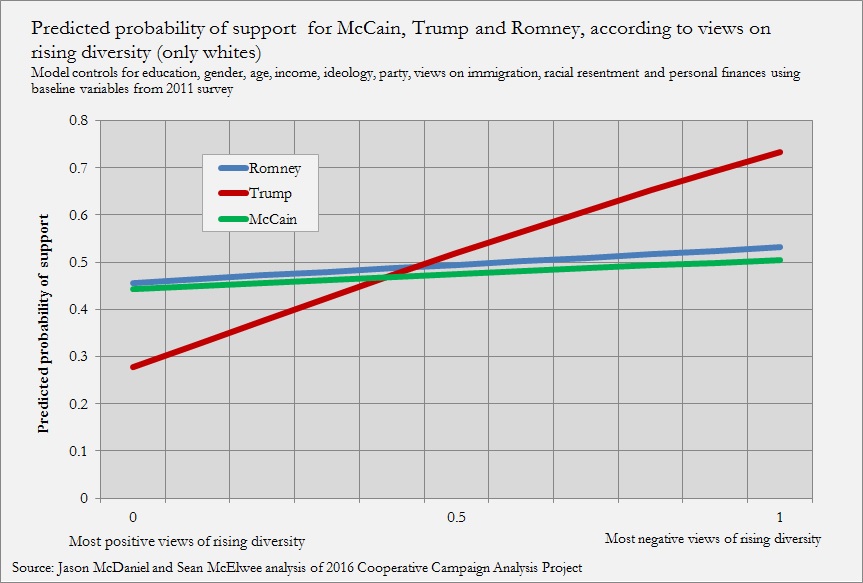
We find that opinions about how increasing racial diversity will affect American society had much more impact on support for Trump during the 2016 election compared to support for the Republican candidates in the two previous presidential elections. We also find that individuals with high levels of racial resentment were more likely to switch from Obama to Trump, but those with low racial resentment and more positive views about rising diversity voted for Romney but not Trump. 
In short, our analysis indicates that Donald Trump successfully leveraged existing resentment towards African Americans in combination with emerging fears of increased racial diversity in America to reshape the presidential electorate, strongly attracting nativists towards Trump and pushing some more affluent and highly educated people with more cosmopolitan views to support Hillary Clinton. Racial identity and attitudes have further displaced class as the central battleground of American politics.

Well no kidding, racists voted for Trump.

To test how views on diversity affected voting during the 2016 election, we created a model that controls for age, race, education, income, gender, party identification, concern about rising immigration, racial resentment, and worries about personal finances. In order to provide some historical context for how Trump reshaped the electorate, we also modeled voting for Mitt Romney in 2012 and John McCain in 2008. 
The results, displayed in the chart below, show that probability of support for Trump increases sharply with negative views on rising diversity, and positive views towards diversity decrease the probability of voting for Trump. Interestingly, these attitudes have no significant effect on probability of voting for Romney or McCain. 
 
While race and racial attitudes have been and continue to play an important role in support for Republican presidential candidates, fears about growing racial diversity appear to be uniquely important to support for Trump compared to previous Republican candidates. Although our analysis does not speak to whether these attitudes were primed by Trump’s campaign, or whether he capitalized on emergent attitudes and rode them to victory, it seems clear that they will play a key role in the future of the Republican Party.

Trump: number one with racists because he made racism acceptable again, and he won a narrow victory because of it.  I could have told you that living here in Northern Kentucky.

Still, the lesson remains that the GOP has fully embraced racism now, and whether or not you hold Trump's awful views on "the blacks" and "the Mexicans" remains irrelevant: people who voted for the GOP and for Trump specifically are okay with a leader who represents them having those views.

We now have a party and country led by people who accept that as a acceptable quality in their politicians, period.  I don't care about why you voted for the racist. you still voted for the racist.

End rant.

StupidiNews!

Sunday, May 14, 2017

Meanwhile In North Korea...

So it looks like Pyongyang got its act together long enough to finally test fire a missile into the North Japan Sea, much to the consternation of pretty much everybody in the neighborhood.

North Korea fired a ballistic missile on Sunday in defiance of calls to rein in its weapons program, days after a new leader in its old rival South Korea came to power pledging to engage it in dialogue.

The U.S. Pacific Command said it was assessing the type of missile but it was "not consistent with an intercontinental ballistic missile". Japanese Defense Minister Tomomi Inada said the missile could be of a new type.

The missile flew 700 km (430 miles) and reached an altitude of more than 2,000 km (1,245 miles), according to officials in South Korea and Japan, further and higher than an intermediate-range missile North Korea successfully tested in February from the same region of Kusong, northwest of its capital, Pyongyang.

North Korea is widely believed to be developing an intercontinental missile tipped with a nuclear weapon that is capable of reaching the United States.

U.S. President Donald Trump has vowed not to let that happen.

An intercontinental ballistic missile is considered to have a range of more than 6,000 km (3,700 miles).

Experts said the altitude the missile tested on Sunday reached meant it was launched at a high trajectory, which would limit the lateral distance it traveled.

But if it was fired at a standard trajectory, it would have a range of at least 4,000 km (2,500 miles), experts said.

Kim Dong-yub, of Kyungnam University's Institute of Far Eastern Studies in Seoul, said he estimated a standard trajectory would give it a range of 6,000 km.

Japan said the missile flew for 30 minutes before dropping into the sea between North Korea's east coast and Japan. The North has consistently test-fired missiles in that direction.

"The launch may indeed represent a new missile with a long range," said Jonathan McDowell of the Harvard Smithsonian Center for Astrophysics, referring to the estimated altitude of more than 2,000 km. "It is definitely concerning."

In Washington, the White House said Trump "cannot imagine Russia is pleased" with the test as the missile landed closer to Russia than to Japan.

Anything to get America off that whole Comey firing/admitting to impeachable crimes thing, huh guys?

Sunday Long Read: Home Alone

In the New York Times Magazine, Matthew Desmond points out that the one of the largest drivers of inequality over the last four decades has been owning a home, specifically the mortgage deduction in America's income tax system, a massive yearly entitlement that favors the rich at the expense of the middle-class and poor.

When we think of entitlement programs, Social Security and Medicare immediately come to mind. But by any fair standard, the holy trinity of United States social policy should also include the mortgage-interest deduction — an enormous benefit that has also become politically untouchable.

The MID came into being in 1913, not to spur homeownership but simply as part of a general policy allowing businesses to deduct interest payments from loans. At that time, most Americans didn’t own their homes and only the rich paid income tax, so the effects of the mortgage deduction on the nation’s tax proceeds were fairly trivial. That began to change in the second half of the 20th century, though, because of two huge transformations in American life. First, income tax was converted from an elite tax to a mass tax: In 1932, the Bureau of Internal Revenue (precursor to the I.R.S.) processed fewer than two million individual tax returns, but 11 years later, it processed over 40 million. At the same time, the federal government began subsidizing homeownership through large-scale initiatives like the G.I. Bill and mortgage insurance. Homeownership grew rapidly in the postwar period, and so did the MID.

By the time policy makers realized how extravagant the MID had become, it was too late to do much about it without facing significant backlash. Millions of voters had begun to count on getting that money back. Even President Ronald Reagan, who oversaw drastic cuts to housing programs benefiting low-income Americans, let the MID be. Subsequent politicians followed suit, often eager to discuss reforms to Social Security and Medicare but reluctant to touch the MID, even as the program continued to grow more costly: By 2019, MID expenditures are expected to exceed $96 billion.

“Once we’re in a world with a MID,” says Todd Sinai, a professor of real estate and public policy at the University of Pennsylvania’s Wharton School, “it is very hard to get to a world without the MID.” That’s in part because the benefit helps to prop up home values. It’s impossible to say how much, but a widely cited 1996 study estimated that eliminating the MID and property-tax deductions would result in a 13 to 17 percent reduction in housing prices nationwide, though that estimate varies widely by region and more recent analyses have found smaller effects. The MID allows home buyers to collect more after-tax savings if they take on more mortgage debt, which incentivizes them to pay more for properties than they could have otherwise. By inflating home values, the MID benefits Americans who already own homes — and makes joining their ranks harder.

The owner-renter divide is as salient as any other in this nation, and this divide is a historical result of statecraft designed to protect and promote inequality. Ours was not always a nation of homeowners; the New Deal fashioned it so, particularly through the G.I. Bill of Rights. The G.I. Bill was enormous, consuming 15 percent of the federal budget in 1948, and remains unmatched by any other single social policy in the scope and depth of its provisions, which included things like college tuition benefits and small-business loans. The G.I. Bill brought a rollout of veterans’ mortgages, padded with modest interest rates and down payments waived for loans up to 30 years. Returning soldiers lined up and bought new homes by the millions. In the years immediately following World War II, veterans’ mortgages accounted for over 40 percent of all home loans.

But both in its design and its application, the G.I. Bill excluded a large number of citizens. To get the New Deal through Congress, Franklin Roosevelt needed to appease the Southern arm of the Democratic Party. So he acquiesced when Congress blocked many nonwhites, particularly African-Americans, from accessing his newly created ladders of opportunity. Farm work, housekeeping and other jobs disproportionately staffed by African-Americans were omitted from programs like Social Security and unemployment insurance. Local Veterans Affairs centers and other entities loyal to Jim Crow did their parts as well, systematically denying nonwhite veterans access to the G.I. Bill. If those veterans got past the V.A., they still had to contend with the banks, which denied loan applications in nonwhite neighborhoods because the Federal Housing Administration refused to insure mortgages there. From 1934 to 1968, the official F.H.A. policy of redlining made homeownership virtually impossible in black communities. “The consequences proved profound,” writes the historian Ira Katznelson in his perfectly titled book, “When Affirmative Action Was White.” “By 1984, when G.I. Bill mortgages had mainly matured, the median white household had a net worth of $39,135; the comparable figure for black households was only $3,397, or just 9 percent of white holdings. Most of this difference was accounted for by the absence of homeownership.”

This legacy has been passed down to subsequent generations. Today a majority of first-time home buyers get down-payment help from their parents; many of those parents pitch in by refinancing their own homes. As black homeowners, Asare and Jean-Charles are exceptions to the national trend: While most white families own a home, a majority of black and Latino families do not. Differences in homeownership rates remain the prime driver of the nation’s racial wealth gap. In 2011, the median white household had a net worth of $111,146, compared with $7,113 for the median black household and $8,348 for the median Hispanic household. If black and Hispanic families owned homes at rates similar to whites, the racial wealth gap would be reduced by almost a third.

Racial exclusion was Roosevelt’s first concession to pass the New Deal; his second, to avoid a tax revolt, was to rely on regressive and largely hidden payroll taxes to fund generous social-welfare programs. A result, the historian Michelmore observes, is that we “never asked ordinary taxpayers to pay for the economic security many soon came to expect as a matter of right.” In providing millions of middle-class families stealth benefits, the American government rendered itself invisible to those families, who soon came to see their success as wholly self-made. We forgot because we were not meant to remember.

The reality is that the mortgage interest deduction in America is now a $70 billion yearly handout, and those who need help the most with housing get precisely none of that. Actual tax reform, and working to solve America's affordable housing crisis, starts with fixing the MID.

Of course, that will never happen.  Even more than Social Security or Medicare, touching that would mean immediate political annihilation from both voters and business groups. But until it's fixed, we'll continue to shove tens of billions at people who don't need it, and continue to force rental prices higher and higher.

Related Posts with Thumbnails