Wednesday, May 6, 2020

Last Call For Our Little Domestic Terrorism Problem, Con't

The coming COVID-19 economic depression is absolutely going to be marked by massive public unrest and violence here in the US, and we already know exactly where to start looking for the bad guys.

A Colorado man who planned to attend a “Reopen” rally in Denver on May 1 before he was arrested by the FBI for possessing pipe bombs was involved in the boogaloo movement, a far-right militia offshoot that uses cryptic pop-culture references to prepare for a future civil war. 
FBI agents and other law enforcement executing search warrants on Bradley Bunn’s residence in Loveland, Colo. on May 1 discovered four pipe bombs at the 53-year-old man’s home, according to a press release issued by the US Attorney’s office in Denver. Agents also discovered two one-pound containers of .308 caliber cartridge reloading gunpowder, a potential pipe bomb component, in Bunn’s vehicle. If convicted for possession of destructive devices, Bunn faces up to 10 years in prison and a $250,000 fine.

The arrest set off a flurry panicked texts from Bunn’s extremist associates in Colorado to allies networked across the country through boogaloo-inspired Facebook pages. On the morning of Bunn’s arrest, Chevy Lee McGee wrote on his Facebook page in all caps: “I might need backup ASAP. Possible police raid at my house.” Then he posted the address of his mother’s house in Fort Collins. He ended with a request: “Need QRF teams,” using a military term for “quick reaction force.”
The day after Bunn’s arrest, McGee identified “Bradley” as “the guy who was arrested and is still being held in corrections by the FBI” in a long Facebook message to Red Flag Alert, a gun-rights page. McGee described an encounter with a SWAT team outside Bunn’s house, a frantic effort to shake off pursuing law enforcement vehicles and an hours-long hideout in wilderness park. Then, after seeing a social-media post from another friend saying the police were at his house, McGee wrote, “I knew I was going to be next, so I made that post for everyone to standby just in case something happened. Then my mom’s freaking out because she works with the sheriff’s office [in Larimer County] and they were talking about me and how I talked to Bradley’s etc. [sic], so she told me to get my ass home. It could’ve been a setup so I have a couple bois roll with me there etc.” 
On the evening of May 1, the administrator of Allegheny Rescue Co., a boogaloo-inspired Facebook page, posted Bunn’s intake record at the Larimer County Detention Center, writing that it was proof of the arrest and the FBI’s involvement. 
Commenters erupted in anger on the page. 
“Should’ve shot their way out,” one commenter wrote. “This is why we need dedicated regiments and strike teams. Get your county and state boog bois together and be ready to go.” 
Another wrote: “This is fucking horse shit. The feds are nervous now, they see people arming and organizing.” He went on to reassure another commenter, using in-group boogaloo code for “brother”: “There will come a time when the police are the ones outnumbered, borther.”
Still another wrote: “They’re on to the boog bus. Tactics may have to change y’all. Just speaking objectively.” He went on to reference the Jan. 20 Second Amendment rally in Richmond, Va., and April 30 rally in Lansing, when Reopen protesters stormed the Michigan state capital: “Richmond was a success and recently Michigan scared some people… and they didn’t like that.”

When it becomes clear that the US economy is going to take a massive hit -- and there's evidence that we've already lost more than twice the jobs lost in 2008 to the Great Recession -- then the outrage and unrest will make this summer hot in more ways than one.

These jobs aren't coming back, folks.  The guy in charge is too busy looting the palace to care. And the rage in his wake is going to plunge us into something very, very bad.

Who Was That Masked Man, Con't

The biggest psychological barrier to Americans wearing a mask to go out is Donald Trump, period.

Most Americans have never had to wear a mask for their health before, let alone while they shop for groceries or go for a run. 
So, even as businesses or states increasingly require them, rebellion is natural -- to a degree, says Dr. David Aronoff, director of Vanderbilt University Medical Center's Division of Infectious Diseases and professor of medicine. 
But he urges Americans to think of the mask guidance not as forced conformity, but as a necessary act of solidarity: Wearing a cloth mask could stop seemingly healthy people from infecting others with coronavirus if they're asymptomatic. 
"We're all hopeful that this pandemic disappears," he said. "Then we can stop doing as much risk mitigation. But for now, we really depend on the trust and kindness of others to protect our wellbeing. And that's part of being an American." 
Even though wearing masks isn't compulsory in much of the US, adhering to these rules may feel like, to some, a forfeiture of their freedoms. 
People naturally rebel when they're told what to do, even if the measures could protect them, said Steven Taylor, a clinical psychologist and author of "The Psychology of Pandemics." 
"People value their freedoms," he said. "They may become distressed or indignant or morally outraged when people are trying to encroach on their freedoms." 
Aronoff compared the mask guidance to the ban on smoking cigarettes in restaurants or schools. 
"There are rules about not smoking in enclosed restaurants and bars because that smoke can be deleterious to someone else's health," he said. "Now we're in a situation where, if I'm infected with the Covid-19 virus, my breath can be lethal to someone else." 
But while that legislation is permanent, wearing masks won't be, Aronoff said.
But to vocal opponents, even temporary guidance is too much of a concession. 
In Michigan, where up to 700 protesters recently descended on the state Capitol to protest stay-at-home orders, masks are required in stores and businesses. This month, police say a Michigan Family Dollar security guard was shot and killed by customers who he'd asked to wear masks before entering the store.

Also in Michigan, a customer wiped his face on a Dollar Tree employee's shirt after police say the employee told him to wear a mask. 
And within a day of issuing an emergency proclamation requiring masks, the city of Stillwater, Oklahoma, amended the proclamation after citizens threatened violence. 
"Many of those with objections cite the mistaken belief the requirement is unconstitutional, and under their theory, one cannot be forced to wear a mask," city manager Norman McNickle said in a statement. "No law or court supports this view."

Any other president would say "wear a mask, it's the right thing to do."  Trump refuses to do even that.  There's no feeling of shared duty, rather, Trump tells us the shared duty is to go to work while sick to save the economy and his reelection chances.

I'm under no illusion that if Obama or Hillary were president right now that the protests wouldn't be happening, or that two-thirds of Republicans would think large sporting events were perfectly safe.

But good lord, we would have saved tens of thousands of lives.

Trump Goes Viral, Con't

The Trump regime has now dropped all pretense of a "federal response" to COVID-19 and is declaring that Americans will have to die to save the US economy.

President Donald Trump launched headlong into his push to reopen the country on Tuesday, saying Americans should begin returning to their everyday lives even if it leads to more sickness and death from the pandemic.

Trump, speaking in Phoenix during his first trip outside Washington in more than a month, said he’s preparing for “phase two” of the U.S. response to the coronavirus. That will include disbanding the White House task force of public health experts, including Anthony Fauci and Deborah Birx, that have steered the government response to the outbreak so far.

Trump acknowledged that reopening the economy would likely lead to more suffering.

“Will some people be affected? Yes. Will some people be affected badly? Yes,” Trump said. “But we have to get our country open and we have to get it open soon.”

On his visit to a Phoenix-based Honeywell International Inc. factory producing medical masks, Trump made his most forceful case yet that the economic damage to the country has become too great to sustain an extended shutdown. He encouraged Americans to think of themselves as “warriors” as they consider leaving their homes, a tacit acknowledgment of deep public reservations about re-opening the country too soon.
The president has expressed increasing frustration with the coronavirus-sparked recession that has put more than 30 million Americans out of work and hurt his case for a second term. The U.S. continues to sport the largest coronavirus outbreak in the world, with about 1.2 million people infected and more than 70,000 killed so far.

Speaking separately in an ABC News interview that aired Tuesday evening, Trump said closing down the nation was “the biggest decision I’ve ever had to make.”

And he was resolute about the decision to reopen the nation, despite the certainty of suffering it will cause until a vaccine is developed.

“There’ll be more death,” he said. “The virus will pass, with or without a vaccine. And I think we’re doing very well on the vaccines but, with or without a vaccine, it’s going to pass, and we’re going to be back to normal.”
“But it’s been a rough process. There is no question about it,” Trump said. “I think our economy is going to be raging” next year, he added.

The White House medical taskforce is being disbanded.  No more federal help is coming. States and cities are now on their own. Tens of thousands, perhaps hundreds of thousands, will die to a preventable disease, but only the economy matters, and lives will have to be sacrificed for the greater good of quarterly profits.

The man in charge of the country is going to sacrifice as many of us as it takes. And as far as Republicans around the country are concerned, the pandemic is over and the governors who took no social distancing measures are taking victory laps.

Why are we allowing this to happen?

StupidiNews!

Tuesday, May 5, 2020

Last Call For Black Lives Still Matter, Con't

On February 23, a 25-year-old unarmed black man in Georgia named Ahmaud Arbery was jogging through a neighborhood on a sunny day when he was ambushed, shot and killed by two white men lying in wait. He died in the middle of the street and the men still have not been charged, because in 2020 it is still legal in multiple states to kill a black man in broad daylight in the middle of a street and claim "stand your ground".

The killing of an unarmed black man at the hands of armed white men here has sparked outrage and drawn fresh attention to the state’s stand-your-ground law. 
Ahmaud Arbery, 25, was running down a street in the city’s Satilla Shores neighborhood early in the afternoon of Feb. 23 when he caught the attention of Gregory McMichael. A former cop and investigator with the local district attorney’s office, McMichael was sitting in his son Travis’ front yard. 
“Travis, the guy is running down the street, let’s go,” Gregory told his son, according to a police report obtained by The New York Times.

The men, who are white, said they suspected Arbery, who is black, might be connected to recent thefts in their neighborhood. They grabbed weapons—a shotgun and a .357 magnum—and followed Arbery in Travis McMichael’s pickup truck, which bears the Gadsden flag and its “Don’t tread on me” motto. A neighbor, William Bryan, joined the McMichaels in pursuing Arbery, according to police. 
Soon after, the trio confronted Arbery. According to Gregory McMichael’s account in the police report, Arbery turned toward Travis McMichael’s truck as he stopped and exited, and struck Travis. A video that circulated widely on Tuesday—and that Arbery’s aunt, Thea Brooks, said depicted her nephew—shows a black man and white man struggling both on and off-screen as shots ring out. But the video’s provenance, and whether it was the same footage shot by Bryan that was cited by a local prosecutor—who initially declined to press charges in connection with the shooting—was unclear. 
“Travis fired a shot and then a second later there was a second shot,” the police report states. At least two shots struck Arbery, the Glynn County Coroner’s Office told The Daily Beast last week. 
Arbery died in the middle of the street where he fell, and no one has been arrested or charged with a crime. But on Tuesday, District Attorney Tom Durden—the third prosecutor to tackle the killing—announced that he would present the case to a grand jury
Meanwhile, Arbery’s family was moving to hold a protest in the area Tuesday evening.
“It’s murder. It’s heartbreaking to even look at. The whole city has seen it,” Brooks, Arbery’s aunt, told The Daily Beast of the clip circulating. “Right now we just have to stay calm because it’s a graphic video, it was very painful to watch, and we know what we knew the other day: one man was murdered, and two men are out.” 
At his son’s home on Friday, Gregory McMichael told The Daily Beast he “never would have gone after someone for their color,” and that the “closest version of the truth” exists in a letter effectively exonerating him and his son that was written by a prosecutor who recused himself from the case, George Barnhill.

Repeated attempts to reach Gregory McMichael, Travis McMichael, and William Bryan by phone after the video surfaced on Tuesday were unsuccessful.

The video circulating appears to have been taken by the third man, William Bryan.   He is in his vehicle driving around a curve and on the right side of the road we see Ahmaud running as Bryan is coming up behind him.  Ahmaud sees a white truck parked on the right shoulder and runs around to the right on the grass to avoid it as the vehicle with Bryan slows down to approach the same truck.

The vehicle pulls up behind the truck and we hear a gunshot.  Two white men come out from the right side of the truck,  Ahmaud is in a struggle with an older white man, who is holding a long rifle. Ahmaud grabs the barrel of the rifle in an effort to defend himself.  A second shot rings out and Ahmaud takes a few steps and staggers to the pavement.

They were lying in wait for Ahmaud.

This was a lynching, straight up, in 2020 America.

Ahmaud Arbery died in the middle of the street.

They took a video of the act.

The NY Times's 1619 Project on the 400-year history of slavery in America won a Pulitzer Prize this week for commentary for Nikole Hannah-Jones.  The right, in particular Federalist editor Ben Shapiro, have ruthlessly been attacking the 1619 Project as "divisive" and "hateful" towards America itself, as "revisionist history".  Shapiro in particular was livid over the award, promising a "large part" of his upcoming book would be dedicated to debunk the "notion" that slavery was the driving force of American history.

I mention this because Shapiro's chief argument is that slavery and racism have been "solved" by white America, and that black America, in particular black folk of my generation and younger, have lived in a country where civil rights have been guaranteed by law all our lives, and that racism is an ugly relic of the past used to blame white America for the problems that black America now needs to "solve" themselves.

And to Shapiro, I say Ahmaud Arbery was ambushed and murdered in the middle of the street like an animal.

A black man was lynched in 2020 Georgia.

Very little has changed from 400 years ago.

Hostage Taking 101, Con't

Donald Trump made it clear again this week that he expects the people in the states who didn't vote for him to suffer catastrophic effects and that he refuses to help them in any way.

President Donald Trump says it would be unfair to Republicans if Congress passes coronavirus "bailouts" for states because he said the states that would benefit from that funding are run by Democrats. 
"I think Congress is inclined to do a lot of things but I don't think they're inclined to do bailouts. A bailout is different than, you know, reimbursing for the plague,” Trump told the New York Post in a sit-down interview in the Oval Office on Monday. 
The president continued, "It's not fair to the Republicans because all the states that need help — they're run by Democrats in every case. Florida is doing phenomenal, Texas is doing phenomenal, the Midwest is, you know, fantastic — very little debt."

The president named California, Illinois and New York as examples of states that are currently run by Democratic governors and are in "tremendous debt" because he said they "have been mismanaged over a long period of time." 
Democrats have made it clear that approving funding for states and municipalities is their top priority for the next piece of legislation
Maryland's GOP governor, Larry Hogan, who serves as the chairman of the National Governors Association, has also been urging Congress to send states financial aid. His own state is facing a nearly $3 billion budget shortfall this year. 
"To stabilize state budgets and to make sure states have the resources to battle the virus and provide the services the American people rely on, Congress must provide immediate fiscal assistance directly to all states," Hogan recently said in a statement. 
Hogan said that if Congress doesn't appropriate at least $500 billion specifically for states and territories to meet the budget shortfalls, "states will have to confront the prospect of significant reductions to critically important services all across this country."
Last week, Trump addressed the issue on Twitter, saying, "Why should the people and taxpayers of America be bailing out poorly run states (like Illinois, as example) and cities, in all cases Democrat run and managed, when most of the other states are not looking for bailout help? I am open to discussing anything, but just asking?" 
Senate Majority Leader Mitch McConnell, R-Ky., has suggested that instead of Congress sending aid to states, they should declare bankruptcy, a comment that has deeply angered Democrats.

Trump won't sign a bill that gives money to blue states, period.  If they suffer, why should he care? What is California going to do, not vote GOP?

Be more like red states.

Because red states are completely great with money.

The state of Mississippi allowed tens of millions of dollars in federal anti-poverty funds to be used in ways that did little or nothing to help the poor, with two nonprofit groups instead using the money on lobbyists, football tickets, religious concerts and fitness programs for state lawmakers, according to a scathing audit released on Monday.

According to the report, released by the state auditor’s office, the money also enriched celebrities with Mississippi ties, among them Brett Favre, a former N.F.L. quarterback whose Favre Enterprises was paid $1.1 million by a nonprofit group that received the welfare funds. The payments were for speaking engagements that Mr. Favre did not attend, the auditors said.

Other large sums went to a family of pro wrestlers whose flamboyant patriarch, Ted DiBiase, earned national fame performing as the “Million Dollar Man.” In a news conference on Monday, Shad White, the state auditor, said it was possible that many recipients of the money did not know it had come from the federal welfare program.

Mr. Favre could not be reached for comment Monday. Mr. DiBiase declined to comment.
Mr. White called the findings “the most egregious misspending my staff have seen in their careers.” The audit found that more than $98 million from the federal Temporary Assistance for Needy Families program, or TANF, was funneled to the two Mississippi-based nonprofit groups over three years. About $94 million of that was “questioned” by state auditors, meaning the money was in all likelihood misspent or the auditors could not verify that it had been spent legally, Mr. White said.

The breadth of the audit — which auditors said included funds that were “misspent, converted to personal use, spent on family members and friends of staffers and grantees or wasted” — raises broad questions about the efficacy of America’s social safety net.

In 1996, the TANF program converted the old federal welfare system, in which cash benefits to poor families were deemed an entitlement, to a system of block grants issued to the states. The new program created work rules and time limits on aid — and, notably, gave each state much more leeway on how to spend the money. Critics say that states do not have to clearly justify that they are spending the money on helping the poor.
“There’s this incredible amount of flexibility,” said LaDonna Pavetti, vice president for family income support policy at the Center on Budget and Policy Priorities. “It could allow for a lot of things to happen.”

Mississippi Republican lawmakers concerned about the misuse of federal funds have enacted safeguards to prevent fraud by potential welfare recipients. A ThinkProgress article found that in 2016, only 167 of the 11,700 Mississippi families who applied for a TANF payment were approved.

For those who support anti-poverty initiatives, the unfolding scandal has left a particularly bitter taste. “It’s just, ‘How can you?’” said Oleta Garrett Fitzgerald, southern regional director for the Children’s Defense Fund.

Monday’s audit comes after the arrest in February of John Davis, the former director of the Mississippi Department of Human Services, the agency that distributes the federal welfare block grants. Mr. Davis is accused of taking part in a multimillion-dollar embezzlement scheme.

Trump's been a grifter all his life, maybe the most successful con artist in human history.  But the grift in the GOP has been there for decades, and it always comes at the expense of the people who can least afford it.

Food For Thought, Con't

As I've been talking about for weeks now, the meat shortages are now reaching the retail grocery store level. Kroger is starting to limit meat purchases in the Midwest, and Costco is being hit too, and they have a lot more control over their meat supply chain.

Costco on Monday became the latest retailer to implement purchasing limits on fresh meat because of the slowdown at processing plants during the coronavirus pandemic.

The company announced it’s limiting shoppers to three items of beef, pork and poultry products to “help ensure more members are able to purchase merchandise they want and need.”

Kroger, the country’s largest supermarket chain, announced a similar rule. The limits are because of high demand from shoppers while top meat suppliers are temporarily closing their factories because workers are falling ill.

The United Food and Commercial Workers International Union estimated last week that 20 meatpacking and food processing workers have died so far. The union said last week the closures have resulted in a 25% reduction in pork slaughter capacity and 10% reduction in beef slaughter capacity. President Donald Trump recently signed an executive order aimed at keeping meat plants open during the crisis.

Tyson Foods warned Monday that it expects more meat plant closures this year. The company also said it will continue producing less meat than usual, as workers refrain from coming to work during the outbreak. The pandemic has halved the amount of pork processing capacity in the country, Tyson said in its earnings call.

Demand is up sharply as the weather gets nicer and we get closer to Memorial Day weekend.  People want to grill out in the backyard. They may not invite the neighbors over, but they want to get out of the house and have some semblance of normalcy.  I can't blame them.

Meanwhile, plant closures are happening at the same time.

It's going to get worse before it gets better.


StupidiNews!

Monday, May 4, 2020

Last Call For Our Little Domestic Terrorism Problem, Con't

Two-thirds of states are lifting COVID-19 restrictions this month as governors give in to pressure from Trump, business groups, and oh yeah, domestic terrorists who want to use violence because they refuse to wear masks.

A Colorado man arrested after federal agents allegedly discovered pipe bombs in his home had also been helping organize an armed protest demanding the state lift its coronavirus restrictions, an official briefed on the case tells ABC News.

FBI and ATF agents served search warrants Friday morning at the Loveland, Colorado, home of Bradley Bunn, 53. Agents discovered four pipe bombs and potential pipe bomb components inside the house, according to a press release from the office of U.S. Attorney for Colorado Jason Dunn.

It is not clear what, if anything, Bunn planned to do with the pipe bombs, the official said.

Bunn came to the attention of law enforcement after using social media to encourage people to bring assault rifles to a planned May 1 rally at the Colorado capitol building, ABC News has learned.

In the days leading up to the protest, investigators discovered social media posts described as angry and aggressive, the official said. Soon after, investigators received information that he was in possession of pipe bombs. Bunn was arrested before he could attend Friday’s rally.

And yes, governors are now folding on social distancing and closures because one, they need the tax revenue (because Senate Republicans refuse to help states and local governments) and two, people are getting killed over stupid things like this as the chaos gets worse.

The Genessee County Prosecutor's office said Monday afternoon that a Flint Family Dollar security guard who was killed on Friday was shot following a dispute with a customer who would not put on a mask in the store.

The 43-year-old security guard was shot Friday afternoon at the Family Dollar on Fifth Ave in Flint. He was pronounced dead at the hospital.

Police have not released his name but MLive has identified him as Calvin “Duper” James Munerlyn. According to family members MLive spoke with, including Calvin's wife, Latryna Sims-Munerlyn, she was told the shooting was over Calvin's instructions to a customer to wear a mask.

Prosecutors confirmed that to FOX 2 Monday afternoon.

Michigan State Police Lt. Davi Kaiser said Sunday that law enforcement was looking into the possibility that an argument over a mask led to the shooting.

It is required to wear a mask when in an enclosed public space, per Governor Gretchen Whitmer's executive order issued on April 24 to combat the spread of coronavirus.

There are no punitive charges for disobeying the order but stores can refuse service to customers to protect the public and employees.

Shot and killed because he said "no, wear a mask, protect yourself and others."

It's going to be bad, folks.

Very bad.

Trump Goes Viral, Con't


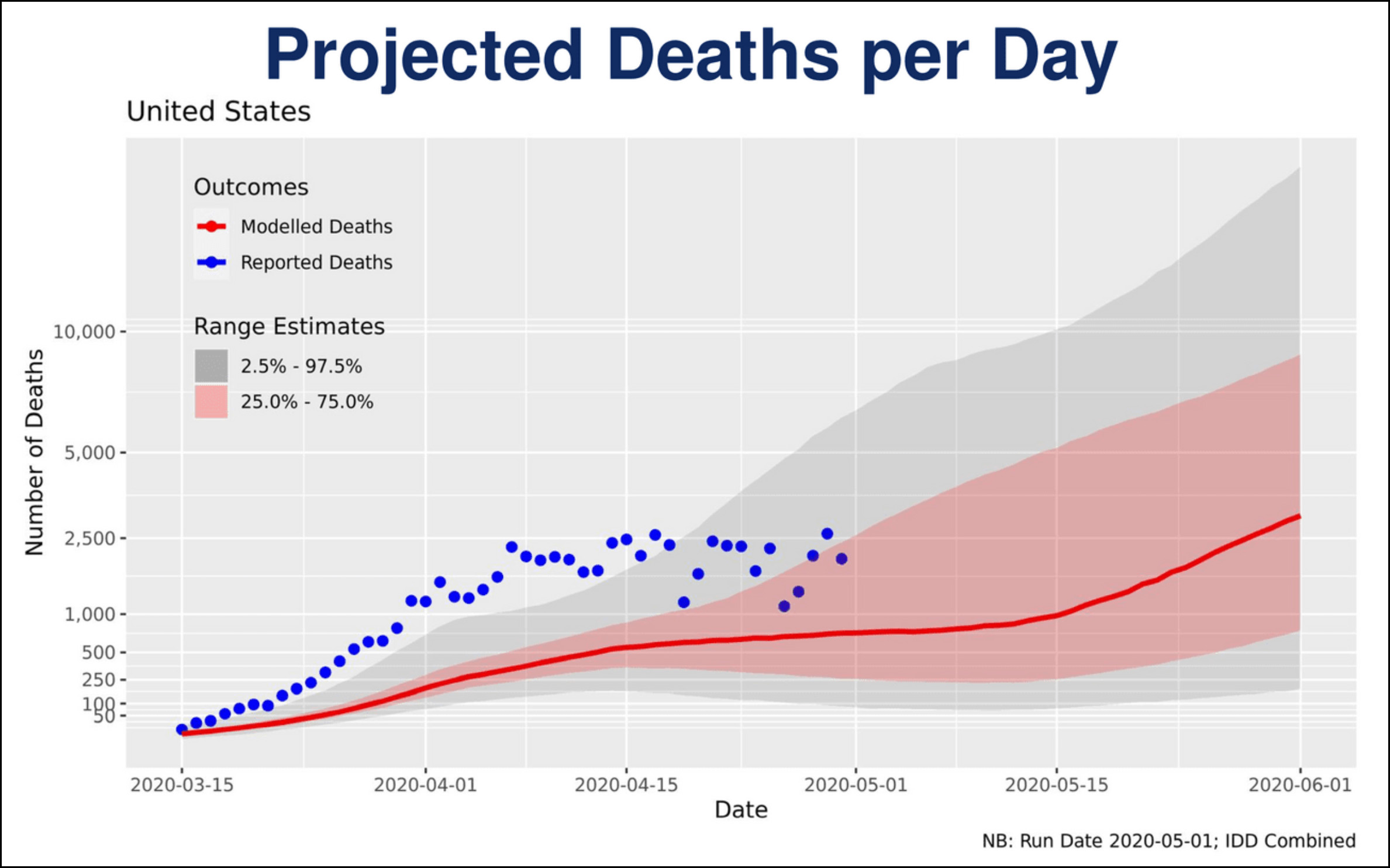
As President Trump presses for states to reopen their economies, his administration is privately projecting a steady rise in the number of cases and deaths from the coronavirus over the next several weeks, reaching about 3,000 daily deaths on June 1, according to an internal document obtained by The New York Times, nearly double from the current level of about 1,750.

The projections, based on government modeling pulled together in chart form by the Federal Emergency Management Agency, forecast about 200,000 new cases each day by the end of the month, up from about 25,000 cases now
.

The numbers underscore a sobering reality: While the United States has been hunkered down for the past seven weeks, not much has changed. And the reopening to the economy will make matters worse.

“There remains a large number of counties whose burden continues to grow,” the C.D.C. warned.

The projections confirm the primary fear of public health experts: that a reopening of the economy will put the nation right back where it was in mid-March, when cases were rising so rapidly in some parts of the country that patients were dying on gurneys in hospital hallways as the health care system grew overloaded.

“While mitigation didn’t fail, I think it’s fair to say that it didn’t work as well as we expected,” Scott Gottlieb, Mr. Trump’s former commissioner of food and drugs, said Sunday on the CBS program Face the Nation. “We expected that we would start seeing more significant declines in new cases and deaths around the nation at this point. And we’re just not seeing that.”

On Sunday, Mr. Trump said deaths in the United States could reach 100,000, twice as many as he had forecast just two weeks ago. But his new estimate still underestimates what his own administration is now predicting to be the total death toll by the end of May — much less in the months that follow. It follows a pattern for Mr. Trump, who has frequently understated the impact of the disease.

“We’re going to lose anywhere from 75, 80 to 100,000 people,” he said in a virtual town hall on Fox News. “That’s a horrible thing. We shouldn’t lose one person over this.”

Mr. Gottlieb said Americans “may be facing the prospect that 20,000, 30,000 new cases a day diagnosed becomes the new normal.”

Some states that have partially reopened are still seeing an increase in cases, including Iowa, Minnesota, Tennessee and Texas, according to Times data. Indiana, Kansas and Nebraska also are seeing an increase in cases and reopened some businesses on Monday. Alaska has also reopened and is seeing a small number of increasing cases.

While the country has stabilized, it has not really improved, as shown by data collected by The Times. Case and death numbers remain stuck on a numbing, tragic plateau that is tilting only slightly downward.

At least 1,000 people with the virus, and sometimes more than 2,000, have died every day for the last month. On a near-daily basis, at least 25,000 new cases of the virus are being identified across the country. And even as New York City, New Orleans and Detroit have shown improvement, other urban centers, including Chicago and Los Angeles, are reporting steady growth in cases.

The situation has devolved most dramatically in parts of rural America that were largely spared in the early stages of the pandemic. As food processing facilities and prisons have emerged as some of the country’s largest case clusters, the counties that include Logansport, Ind., South Sioux City, Neb., and Marion, Ohio, have surpassed New York City in cases per capita.

Understand that this is the nightmare scenario that all the experts have been predicting for months now, where small city and rural hospitals around the country are inundated, and that raises the mortality rate significantly.  We are headed that way right now, in a matter of weeks, not months. Under no circumstances should states be reopening anything.


200,000 cases per day means 10,000 dead per day 7-14 days later.  It will be absolute chaos. reopening the economy now is only guaranteeing a massive spike in cases and deaths, and an economic crash into depression.  As I said before, I guess it's going to take hundreds of thousands of deaths until Americans get it through their thick skulls.

Steve M sums it all up (emphasis his):

I think many Americans won't be able to grasp this because it's close to unthinkable, but let me restate what's being reported here: The president of the United States, who has been incessantly cheerleading for a reopening of the economy, is doing so even though his own administration's model is informing him that this will significantly increase the number of people who are sickened and killed by the coronavirus. President Trump is not crossing his fingers and hoping that the reopenings take place with few bad consequences. President Trump is choosing to kill innocent American citizens.

Trump will not be impeached for this, or for anything else between now and the end of his term in January 2021. But knowingly and willfully causing the deaths of tens of thousands of Americans is an offense worthy of impeachment and removal from office.

At the very least, some Democrats should be saying this now. They should be demanding to see the forecasts. They should be calling Trump a murderer. 

And as bad as May will be?

June will be far, far worse.

Who Was That Masked Man?

Ohio GOP Gov. Mike DeWine is dropping requirements that residents wear masks when out and about, rather it's become a "strong suggestion". Kentucky Democratic Gov. Andy Beshear is following suit, wanting residents to wear masks starting May 11, but it won't be enforced in any way.

Ohio Gov. Mike DeWine (R) explained his decision to rescind an order requiring people to wear face masks in retail stores, stating on ABC's "This Week" on Sunday that it "became clear to me that that was just a bridge too far. People were not going to accept the government telling them what to do.
Why it matters: DeWine has earned praise for his aggressive and early steps to mitigate the impact of the coronavirus in Ohio, such as closing schools before any governor in the country and postponing the state's March 17 primary. 
His decision to reverse himself on the face mask requirement reflects a challenge that dozens of governors are navigating as they attempt to enforce public safety measures while not angering their constituents by overstepping. 
What he's saying: "We put out dozens and dozens of orders. That was one that it just went too far. But at the same time we pulled that back, I said that, look, this is highly recommended." 
DeWine added that wearing a mask in retail stores — if customers are able — is the "kind thing" to do in order to keep store workers and fellow customers safe.

It is the kind thing to do, and the smart thing to do.

And I guarantee you 90% of people will ignore it.

I just don't know what people expect.  We're still seeing 2,500-3,000 deaths per day and while the death toll is dropping in NYC, it's rising pretty much everywhere else.  People are just giving up and pretending it's all over.

It's insane.

StupidiNews!


Sunday, May 3, 2020

Last Call For No Help Coming


Don't expect fast action on the next coronavirus stimulus package, known on Capitol Hill as "phase 4." Senior sources in the Republican Senate conference tell me that most GOP senators want to wait a bit before passing another big aid bill.


Between the lines: The two parties are miles apart ahead of the next stage of talks. 
Mitch McConnell has sounded the alarm about the deficit after $3 trillion so far in virus spending. 
In a conference call last week, McConnell urged Republican senators to push back against the White House's impulse to spend trillions on infrastructure. 
Democrats want significantly more money to help state and local governments. 
And McConnell and House Minority Leader Kevin McCarthy put out a rare joint statement in which they said they won't support another coronavirus bill unless it protects businesses from lawsuits should they choose to reopen during the pandemic. 
House Speaker Nancy Pelosi dismissed this idea: "Especially now, we have every reason to protect our workers and our patients in all of this. So we would not be inclined to be supporting any immunity from liability."

Yes, but: On CNN's "State of the Union," this morning, Trump's top economic adviser Larry Kudlow told Jake Tapper, "There's kind of a pause period right now." 
Kudlow added: "We have put up $3 trillion of direct federal budget assistance in one way or another. The Federal Reserve has actually put in as much as $4 trillion to $6 trillion. So it's a huge, huge package. Let's see how it's doing as we gradually reopen the economy."

Behind the scenes: One idea that's gathering momentum on the Hill and in the White House: legislation that would encourage American companies to build critical supply chains at home, reducing foreign dependency — especially on pharmaceuticals from China.

That's right: more corporate tax incentives.

The White House is now officially operating on the assumption that the worst of the pandemic is over.  They are getting cover from pundits and industry groups who want to get back to record profits, and from dark money groups funding protests around the nation.  Governors are breaking down and giving in across the country, and Americans are simply ignoring social distancing anyway.

It's going to be abundantly clear what the consequences will be very shortly, and may God have mercy upon us when that happens.

Our Little Domestic Terrorism Problem, Con't

The "grassroots" anti-government protests against COVID-19 measures to help Donald Trump and sponsored by big GOP interests are of course being used by white supremacist domestic terrorist militias to recruit and to plan further attacks.

America’s extremists are attempting to turn the coronavirus pandemic into a potent recruiting tool both in the deep corners of the internet and on the streets of state capitals by twisting the public health crisis to bolster their white supremacist, anti-government agenda.

Although the protests that have broken out across the country have drawn out a wide variety of people pressing to lift stay-at-home orders, the presence of extremists cannot be missed, with their anti-immigrant and anti-Semitic signs and coded messages aimed at inspiring the faithful, say those who track such movements.

April is typically a busy month for white supremacists. There is Hitler’s birthday, which they contort into a celebration. There is the anniversary of the Oklahoma City bombing, the domestic attack 25 years ago that killed 168 people and still serves as a rallying call for new extremist recruits.

But this April, something else overshadowed those chilling milestones. It was the coronavirus, and the disruption it wreaked on society, that became the extremists’ battle cry.

Embellishing Covid-19 developments to fit their usual agenda, extremists spread disinformation on the transmission of the virus and disparage stay-at-home orders as “medical martial law” — the long-anticipated advent of a totalitarian state.

“They are being very effective in capitalizing on the pandemic,” said Devin Burghart, a veteran researcher of white nationalists who runs the Institute for Research and Education on Human Rights, a Seattle-based research center on far right movements.

What success the groups have had in finding fresh recruits is not yet clear, but new research indicates a significant jump in people consuming extremist material while under lockdown. Various violent incidents have been linked to white supremacist or anti-government perpetrators enraged over aspects of the pandemic.

The New Jersey Office of Homeland Security and Preparedness said in March that white supremacists have encouraged followers to conduct attacks during the crisis to incite fear and target ethnic minorities and immigrants. “We have noticed domestic extremist groups taking advantage of the Covid-19 pandemic by spreading disinformation,” Jared M. Maples, its director, said in a statement. The coronavirus has been dismissed as a hoax, painted as a Jewish-run conspiracy and, alternatively, described as a disease spread by nonwhite immigrants, he said.

Last month, the Department of Homeland Security warned law enforcement officials throughout the United States of the mobilization of violent extremists in response to stay-at-home measures, according to a senior law enforcement official and a congressional staff member, who were not authorized to discuss the warning publicly.

A department memo dated April 23 noted the recent arrests of individuals who had threatened government officials imposing coronavirus-related regulations. The memo was distributed to law enforcement “fusion centers” that counter terrorism nationwide and to congressional committees, the officials said.

Extremist organizations habitually try to exploit any crisis to further their aims. While not monolithic, a spectrum of organizations — from anti-immigrant groups to those with a variety of grievances and those that overtly espouse violence — found something to like about the coronavirus.

“They view it as a chance to turn people,” said Megan Squire, a professor at Elon University in North Carolina who tracks online extremist chatter.

At its core is one of the oldest fallacies in the books, the suggestion that COVID-19 is a disease that only kills the inferior. To the white supremacist, it's a tailor-made recruiting tool.

Please note that the biggest proponent of the notion that everything is fine and that everyone is overreacting is our racist-in-chief himself.

But let's not forget the domestic terrorism angle, too.

An emergency proclamation issued Thursday in Stillwater, Oklahoma, requiring the use of face masks in stores and restaurants was amended Friday after threats of violence. 
"In the short time beginning on May 1, 2020, that face coverings have been required for entry into stores/restaurants, store employees have been threatened with physical violence and showered with verbal abuse," Stillwater City Manager Norman McNickle said in a statement. 
"In addition, there has been one threat of violence using a firearm. This has occurred in three short hours and in the face of clear medical evidence that face coverings helps contain the spread of Covid-19." 
Due to the threats of violence the city has decided to amend their emergency order but still want people to wear face masks whenever possible, the statement said. 
The proclamation issued Thursday required, among other things, businesses to require patrons to cover their faces to combat the spread of coronavirus.  
But on Friday, Mayor Will Joyce softened the rule to encourage, not require, face coverings, after several reports emerged of employees being verbally abused and being threatened with physical violence while trying to enforce the order -- all in just three hours of the rule going into effect. 
"Many of those with objections cite the mistaken belief the requirement is unconstitutional, and under their theory, one cannot be forced to wear a mask. No law or court supports this view," said City Manager Norman McNickle in a statement. "It is further distressing that these people, while exercising their believed rights, put others at risk."

It's going to get a lot worse in the weeks and months ahead.

Sunday Long Read: Going Postal

The GOP has been trying to get rid of the US Postal Service and privatize it for decades in order to corrupt the mail and make bank, not to mention rob African-Americans of thousands of postal service jobs, and our Sunday Long Read this week comes to us from Esquire's Jesse Lichtenstein achives from 2013 on why rural America in particular should be going to the pitchforks to keep the USPS.


The letter is mailed from Gold Hill, Oregon. 
The eleven hundred residents of this lingering gold-rush town, mostly mechanics and carpenters and retail clerks in other places, wake with the sun and end their day with a walk to the aluminum mailbox bolted to a post at the edge of their yard. In between, Carrie Grabenhorst heads out of town on highway 99, follows the Rogue River, and turns right on Sardine Creek Road. She turns left at a large madrone tree and heads up a quarter mile of dirt road, takes the right fork, goes past the sagging red barn to a white clapboard house with green trim, where she takes a dog biscuit from her pocket and offers it to the large golden retriever. It's a Monday, about 2:00 p.m. The dog stops barking. This is the usual peace, negotiated after thousands of visits over eighteen years. 
Often Grabenhorst's elderly customers are waiting at the door, or even by the mailbox, for her right-hand-drive Jeep to edge onto the shoulder. Many of them are alone all day. Their postal carrier is that one reliable human contact, six days a week. Some are older veterans. Quite a few have limited mobility, and it isn't uncommon for her to lend a hand with an errand; she's been known to pick up milk in town and bring it along with the mail. Grabenhorst drives seventy miles a day and makes 660 deliveries. On a typical day, that might include fifty packages of medicine. 
Her route is one of 227,000 throughout America. On the South Side of Chicago, carriers walk cracked sidewalks, past empty lots and overfilled projects. In the suburbs of Phoenix, mail trucks deliver to banks of mailboxes outside gated communities. In Brooklyn, they pushed their carts up sidewalks and ducked into bodegas on September 11, as they always do. Residents say they were comforted to see their postal workers still making the rounds, the government still functioning. In rural Alaska, mail comes by snowmobile and seaplane. In chaps and a cowboy hat, Charlie Chamberlain leads a train of postal mules down to the bottom of the Grand Canyon, where a tribe of Havasupai Indians lives. Wearing blue trunks and a ball cap, Mark Lipscomb delivers letters by speedboat up and down the Magnolia River in Alabama. 
Want to send a letter to Talkeetna, Alaska, from New York? It will cost you fifty dollars by UPS. Grabenhorst or Lipscomb can do it for less than two quarters: the same as the cost of getting a letter from Gold Hill to Shady Cove, Oregon, twenty miles up the road. It's how the postal service works: The many short-distance deliveries down the block or across the city pay for the longer ones across the country. From the moment Benjamin Franklin was appointed the first postmaster general in 1775, the purpose of the post office has always been to bind the nation together. It was a way of unifying thirteen disparate colonies so that the abolitionist in Philadelphia had access to the same information and newspapers as the slaveholder in Augusta, Georgia. 
Today the postal service has a network that stretches across America: 461 distribution centers, 32,000 post offices, and 213,000 vehicles, the largest civilian fleet in the world. Trucks carrying mail log 1.2 billion miles a year. The postal service handles almost half of the entire planet's mail. It can physically connect any American to any other American in 3.7 million square miles of territory in a few days, often overnight: a vast lattice of veins and arteries and capillaries designed to circulate the American lifeblood of commerce and information and human contact. 
Grabenhorst sports a few blond streaks in her brown bangs, which curl over her forehead, perfectly framing her azure eyes and chiseled cheekbones. Rural carriers don't wear official uniforms, so today she's in shorts and an Oregon State T-shirt. Letters arrive at the post office in Gold Hill already sequenced in the order Grabenhorst will deliver them, but the "flats" — magazines, catalogs, large envelopes — and packages do not, so in the back of the post office she and her two colleagues stand at their own three-sided bank of metal slots, hundreds of them, one for each address, and merge the separate streams — a process called "throwing the mail." 
As the junior carrier, Grabenhorst has the peanut route. Paula Joneikis is the senior carrier, thirty-three years on the job; she took over her route from another lifer named Bev Washburn. That's how these jobs work — when you get a route, you hold on to it, maybe even try to pass it on to someone in your family. Failing that, you take a younger colleague under your wing and share your particular wisdom: the life history of your customers, how this one is related to that one, when so-and-so got to town, when so-and-so split up. Joneikis has a lot of "silver foxes" on her route — she tries to remember who's recently had an operation, and she'll come to the door with the mail. "We're a lifeline to these people," she says. 
"All of these people are family," Grabenhorst adds. She color-codes all 660 addresses for her morning sort: a little pink flag affixed to a slot means the customer is on vacation; a yellow flag means the whole family has moved; an orange flag is for customers who don't want packages left when they aren't home; a green flag means an individual has left the family: moved out, gone to college, divorced, died. 
When she gets to their driveway, she'll put the bundle into their box, her box. By law, only the postal service can put mail into a mailbox. It's a monopoly that ensures every citizen, in every square mile of the country, has the ability to receive mail and that the government can reach every citizen. No branch of government serves us so consistently, so intimately — a federal employee literally touching every house in America every day but Sunday. 
In mid-November, the postmaster general, Patrick Donahoe, reported that the post office had lost $15.9 billion for the year and was operating on just a few days' cash flow, having reached its legal debt limit. He all but begged Congress to take action. Mail was down 5 percent from the year before, and wages and benefits and other worker-related costs were an unsustainable 80 percent of the postal service's $81 billion operating expenses.
But nobody wants to hear that more than 70 percent of those losses were for extraordinary budget obligations mandated by Congress, or that the postal service posted its thirteenth-straight quarter of productivity gains. In a nation obsessed with cutting budgets and government fat, there is no better target than the federal postal worker who will have her route delivering paper mail for life, and then try to pass it on to her daughter. 
Eighty-five percent of America's critical infrastructure is controlled by the private sector. We let private companies fight our wars; we have 110,000 defense contractors in Afghanistan compared with 68,000 American troops. We let private companies lock up 16 percent of our federal inmates and instruct 10 percent of our students. They provide our phone service and Internet access and air travel and hospital care. Surely, many believe, private companies can deliver our mail better and faster and cheaper than the federal government. 
If you work with actual pieces of mail — if you are a carrier, a handler, a clerk, but not an administrator — it is said that you "touch the mail." The postal service has more than half a million full-time workers and a hundred thousand contract employees, the vast majority of which are mail touchers. Each morning, Grabenhorst enters into a ledger she keeps at her workstation exactly how much mail she's thrown and will be delivering that day. In Washington, D.C., they count in billions of pieces, but carriers talk about mail volume in feet — the width of a mail stack laid on its edge, face to flap.
On this unremarkable Monday, she'd written 14.75 feet. She flipped the pages of the ledger back to the previous year, to the same date: 17.5 feet. 
That we're sending less mail is not debatable. Nor is it debatable that the post office as we've known it for the past forty years, one built for speed and brute force in sorting and distributing an ever-surging flood of paper documents, is outdated in our digital world. 
This isn't a story about whether we could live without the post office. 
It's about whether we'd want to.

Seven years later the guy in the Oval Office is trying to destroy the postal service just to hurt the man who owns the Washington Post.
Related Posts with Thumbnails