Tuesday, July 28, 2020

Last Call For Our Little White Supremacist Domestic Terrorism Problem, Con't


Riots in downtown Richmond over the weekend were instigated by white supremacists under the guise of Black Lives Matter, according to law enforcement officials.

Protesters tore down police tape and pushed forward toward Richmond police headquarters, where they set a city dump truck on fire.

Police declared the event an “unlawful assembly” and ordered people to leave, later deploying tear gas.

Six people were arrested. The mayor of Richmond thanked the Black Lives Matter protesters he said tried to stop the white supremacists from spearheading the violence.

“Their mission is simple, not the Richmond we know,” said Mayor Levar Stoney.

Besides the police department, damage also occurred in and around the VCU campus.

Meanwhile, the Trump regime is trying to instigate its own riot in Portland.

The Trump administration is sending more federal agents to Portland, Ore., as officials consider pushing back harder and farther against the growing crowds and nightly clashes with protesters, vandals and rioters, The Washington Post has learned.

To strengthen federal forces arrayed around the city’s downtown courthouse, the U.S. Marshals Service decided last week to send 100 deputy U.S. Marshals to Portland, according to an internal Marshals email reviewed by The Post. The personnel began arriving Thursday night, the email says.

The Department of Homeland Security is also considering a plan to send an additional 50 U.S. Customs and Border Protection personnel to the city, but a final decision on the deployment has not been made, according to senior administration officials involved in the federal response who spoke on the condition of anonymity to describe internal deliberations.

Such moves would mark a significant expansion of the federal force operating at the courthouse — there were 114 federal agents there in mid-July — though it is unclear how many personnel there now would be relieved and sent home once the reinforcements arrive.

“The agency took steps to identify up to 100 personnel to send to the District of Oregon in case they were needed to relieve or supplement deputies permanently stationed in the district,” Drew J. Wade, a spokesman for the Marshals Service, said in written statement. “They may also be used to rotate with personnel already sent there to support district operations during the civil unrest mission to insure the function and safety of judicial proceedings.”

A spokesman for the Department of Homeland Security did not respond to requests for comment.

It'll just take one particularly bloody event where a lot of people are hurt or killed for Trump to start declaring martial law nationwide.

Just one.

And he needs it to happen before the election.


A Taxing Explanation, Con't

The fight over Trump's tax returns continues after the Supreme Court punt a few weeks ago, and the regime has no intention of cooperating with New York state prosecutors.

In a second amended complaint filed in federal court in Manhattan, Trump’s lawyers argued that the subpoena was “wildly overbroad,” and was issued in “bad faith” and amounts to “harassment.”

The subpoena “is so sweeping that it amounts to an unguided and unlawful ‘fishing expedition’ into the President’s personal and financial dealings,” Trump’s lawyers wrote in the complaint.
Trump, who is seeking re-election on Nov. 3, asked the court to declare the subpoena invalid.

Manhattan District Attorney Cyrus Vance last August issued the grand jury subpoena to Trump’s accounting firm, Mazars USA, demanding eight years of his business and personal returns and other documents as part of an investigation involving Trump and the Trump Organization, his family’s real estate business.

On July 9, the Supreme Court in a 7-2 vote rejected his argument that he was immune from state criminal probes while in the White House. The high court said, however, that Trump could challenge the subpoena on other grounds.

In the newly amended complaint, Trump’s lawyers say Vance is demanding documents that relate to topics beyond New York jurisdiction, and argue the subpoena was issued in bad faith because it mirrors a congressional subpoena.

Vance’s investigation began after reports that Trump’s former lawyer Michael Cohen paid pornographic film actress Stormy Daniels $130,000 for her silence before the 2016 election about sexual encounters with Trump, which he has denied.

Carey Dunne, general counsel for Vance, on July 16 warned U.S. District Court Judge Victor Marrero against allowing Trump to delay long enough to get beyond statutes of limitations.

That's the real issue.  Trump's lawyers are trying to run out the clock on his tax crimes, ones that would almost certainly put him in prison for the rest of his life.  If he wins, he gets away with it. If he loses, he goes to jail.

That's the core of all of this.

Kentucky Goes Viral, Con't

Here in Kentucky, Democratic Gov. Andy Beshear is closing bars and rolling back restaurant seating capacity for two weeks in order to cut down on COVID-19 cases.

Gov. Andy Beshear announced Monday that Kentucky bars must close and restaurants will have to reduce their indoor capacity to 25 percent.

The order, which comes around a month after bars were allowed to open and restaurant capacity was allowed to increase to 50 percent, goes into effect at 12:01 a.m. Tuesday and will last for two weeks.

“This is going to hurt a lot of restaurants,” Beshear said. “But the White House’s modeling shows this is absolutely necessary to control the spread.”

He dismissed the idea of increasing restrictions only in counties that are hardest hit, noting that 74 of Kentucky’s 120 counties are either listed as red or yellow by the White House as coronavirus cases spread.

Beshear said the administration will enforce “seat rules” for bars that serve food. Everyone who comes in must have a seat and must stay in that seat unless they’re going to the bathroom. Restaurants can have unlimited outdoor seating, so long as it complies with social distancing orders. He said he is hopeful that restaurants will be able to get back up to 50 percent after two weeks.

The order comes as the extra $600 in weekly unemployment benefits from the federal government has expired. Congress is still negotiating whether they should extend the benefits. There are currently around 68,000 unresolved unemployment claims in Kentucky.

He also recommended that public and private schools in Kentucky wait until at least the third week of August to start in-person instruction.

“The line and the trend is undeniable,” Beshear said. “This virus is now escalating and spreading so much statewide that statewide action is necessary.”
Beshear made the order after a month of increased spread of COVID-19 throughout Kentucky. The 11,977 COVID-19 cases so far in July is nearly double the number of cases in June, even though the number of tests completed is similar. There were 169,495 people tested in June and 184,145 people have been tested so far in July. 

Bars and restaurant indoor seating never should have happened, and schools should remain closed.  Kentucky has nearly doubled our total cases in July and we almost certainly will by the end of the month, from 15,624 on June 30 to 27,601 now.  We'll almost certainly hit that 31,000 mark by Friday, and if we don't, we will by this time next week.

The depressing part is our daily testing average remains under 10k. We need to be testing 1% of the population per day to have any shot at rounding this thing up, and that means 45k tests per day.

The bigger issue is that daily hospitalizations have jumped 50% in the last two weeks from 400 per day on July 18 to 600 now.  We're rapidly running out of ICU beds here.

Right now deaths are coming in at about 10 per day still, but it's going to get much worse quickly if this rate keeps up.  We'll see if Beshear's latest order helps.

School starts in two weeks.


StupidiNews!

Monday, July 27, 2020

Last Call For Trump Goes Viral, Con't

Six months into the COVID-19 pandemic, and the Washington Post asks why Trump seems completely uninterested in getting rid of the virus.  The answer is he thinks it'll kill Black and Latino Americans and Democratic voters for him and make him president.

People close to Trump, many speaking anonymously to share candid discussions and impressions, say the president’s inability to wholly address the crisis is due to his almost pathological unwillingness to admit error; a positive feedback loop of overly rosy assessments and data from advisers and Fox News; and a penchant for magical thinking that prevented him from fully engaging with the pandemic.

In recent weeks, with more than 146,000 Americans now dead from the virus, the White House has attempted to overhaul — or at least rejigger — its approach. The administration has revived news briefings led by Trump himself and presented the president with projections showing how the virus is now decimating Republican states full of Trump voters. Officials have also set up a separate, smaller coronavirus working group led by Deborah Birx, the White House coronavirus response coordinator, along with Trump son-in-law and senior adviser Jared Kushner.

For many, however, the question is why Trump did not adjust sooner, realizing that the path to nearly all of his goals — from an economic recovery to an electoral victory in November — runs directly through a healthy nation in control of the virus.

“The irony is that if he’d just performed with minimal competence and just mouthed words about national unity, he actually could be in a pretty strong position right now, where the economy is reopening, where jobs are coming back,” said Ben Rhodes, a deputy national security adviser to former president Barack Obama. “And he just could not do it.”
Many public health experts agree.

“The best thing that we can do to set our economy up for success and rebounding from the last few months is making sure our outbreak is in a good place,” said Caitlin Rivers, epidemiologist at the Johns Hopkins Center for Health Security. “People are not going to feel comfortable returning to activities in the community — even if it’s allowed from a policy perspective — if they don’t feel the outbreak is under control.”

Some aides and outside advisers have, in fact, tried to stress to Trump and others in his orbit that before he could move on to reopening the economy and getting the country back to work — and life — he needed to grapple with the reality of the virus.

But until recently, the president was largely unreceptive to that message, they said, not fully grasping the magnitude of the pandemic — and overly preoccupied with his own sense of grievance, beginning many conversations casting himself as the blameless victim of the crisis.

In the past couple of weeks, senior advisers began presenting Trump with maps and data showing spikes in coronavirus cases among “our people” in Republican states, a senior administration official said. They also shared projections predicting that virus surges could soon hit politically important states in the Midwest — including Michigan, Minnesota and Wisconsin, the official said.

This new approach seemed to resonate, as he hewed closely to pre-scripted remarks in a trio of coronavirus briefings last week.

“This could have been stopped. It could have been stopped quickly and easily. But for some reason, it wasn’t, and we’ll figure out what that reason was,” Trump said Thursday, seemingly to simultaneously acknowledge his predicament while also trying to assign blame elsewhere.

He can't do it. 

He's emotionally and intellectually incapable of doing it. He thought that 1) COVID-19 was an "urban" problem that would punish big cities and spare his voters, and 2) he thought blue state governors like Cuomo and Newsom would get all the blame.

On top of that, he news stories in April that COVID-19 was causing a higher mortality rate among Black and Latino communities was when the virus stopped being a national concern to Republicans in general.  They all thought Trump was right and that COVID-19 was going to become a "poor Ni-CLANG!" disease that was going to be the Democrats' problem in 2020.

They weren't going to lift a finger until it started killing Florida seniors in The Villages.

Now it's too late.

The Road To Gilead, Con't

Two Bible Belt Republicans laid out their plans for what a post-Trump GOP will look like this weekend, and it looks like current GOP plans only without Trump's personal baggage weighing things down, making things much easier for them. Alabama Sen. Tom Cotton is all in on the police fascism angle and the slavery was 100% necessary evil angle, and now Missouri Sen. Josh Hawley is laying his marker down on ending abortion.

Sen. Josh Hawley (R-Mo.), a member of the Senate Judiciary Committee, said Sunday that he would not support any future nominee for the Supreme Court unless they had publicly stated before their nomination that Roe v. Wade, the 1973 ruling that established federal protection for abortion, was “wrongly decided.”

“I will vote only for those Supreme Court nominees who have explicitly acknowledged that Roe v. Wade is wrongly decided,” Hawley said in an interview with The Washington Post. “By explicitly acknowledged, I mean on the record and before they were nominated.”

Hawley added: “I don’t want private assurances from candidates. I don’t want to hear about their personal views, one way or another. I’m not looking for forecasts about how they may vote in the future or predications. I don’t want any of that. I want to see on the record, as part of their record, that they have acknowledged in some forum that Roe v. Wade, as a legal matter, is wrongly decided.”

Hawley’s new marker comes as Republicans are preparing for the possibility that President Trump could name a third member of the court later this year, should there be a vacancy.

And it comes as conservatives nationally are pushing to overhaul the court’s jurisprudence supporting the right of a woman to choose the procedure. But they have recently been disappointed by the court’s rulings on this front — and particularly by Chief Justice John G. Roberts Jr.

Last month, the Supreme Court struck down a restrictive Louisiana abortion law. It was a dramatic victory for abortion rights activists and a bitter disappointment to conservatives in the first showdown on the issue since Trump’s remake of the court.

This is a win-win for Hawley, if Trump does win he's made his play for why he should be the top Republican on the Senate Judiciary as opposed to Huckleberry Graham, and if Trump loses, he has an instant 2024 platform to run against Biden on.

Meanwhile, Marco Rubio just got some bad news for 2022.

Former U.S. Rep. David Jolly may have some bigger moves in his future.

Jolly, the U.S. Rep. for Florida’s 13th Congressional District from 2014 to 2017, indicated on Twitter Sunday morning that he’s considering a run for Florida Governor or the U.S. Senate in 2022.

A tweet from TV personality Lea Black kicked off the idea. Black, a member of the cast of The Real Housewives of Miami, tweeted that she thought Jolly should run for Governor.

And Jolly, about five hours later, replied to her tweet.

“Thank you Lea. Very kind,” he tweeted at 7:05 a.m. “Haven’t ruled it out, but strongly considering the U.S. Senate seat in ’22. Will consider whether either is the right decision and decide about this time next year. For now, I’m loving the time at home with our little one! Many thanks.”

Republican U.S. Sen. Marco Rubio will be on the ballot in 2022.

Jolly, a former Republican, switched to be an Independent in 2018, and he indicated elsewhere on Twitter Sunday that he is not likely to return to his old party.

He replied to a comment critical of the GOP by saying, “Fully agree. Not going back.”

Ron DeSantis probably isn't going to be too popular in 2022 the way things are going on the COVID-19 front in the state right now, so that means Jolly can be a real nuisance for the Florida GOP in two years with either a run at Rubio or a run at DeSantis.

We'll see which one the GOP wants more.

Our Little White Supremacist Domestic Terrorism Problem, Con't


Investigators believe a fire that caused extensive damage to state Democratic Party headquarters early on Friday in downtown Phoenix was intentionally set.

Heavy smoke and fire were billowing from the building about 1 a.m. near Central Avenue and Thomas Road as Phoenix firefighters arrived at the scene. They quickly entered the building in search of people and began a fire attack to put out the flames, according to officials.

No one was inside the building at the time, and no injuries were reported.

Phoenix Fire Investigation Task Force and Bureau of Alcohol, Tobacco, Firearms and Explosives investigators were investigating the fire. Phoenix police spokeswoman Sgt. Mercedes Fortune said the incident is being investigated as an arson based on evidence discovered at the scene.

Phoenix police also responded to the fire to assist with security and traffic control in the area, according to Fortune.

More information will be released as it becomes available, according to Fortune.

Felecia Rotellini, chair of the state Democratic Party, learned of the fire at 2 a.m. after the security system went off and staffers made her aware.

“At this point, it’s too soon to tell,” she said, referring to the extent of the damage. “The investigators are scheduled to be at the scene at 8 a.m. so we don’t know anything right now, but we’re very fortunate that everyone is safe and in this virtual environment. We can continue to run the party and do everything we need to do for November. 

The state's Democratic Party convention went on this weekend as planned because it was a mostly virtual event anyway.

Although members of the party were in "complete shock" at the news of the fire, they still managed to go on with the convention with some changes to the agenda, according to the party's communications director, Edder Diaz-Martinez.

The event was already planned to be virtual through Zoom because of COVID-19 with more than 700 people signed up.

Unlike previous meetings, Democratic Party members spent a few minutes speaking about the fire. Thousands of dollars in donations from legislative districts poured in to support the rebuilding of the party's headquarters later in the meeting with the state Democratic Party receiving more than $40,000 in donations.

Steven Slugocki, the county party chair, choked back tears while speaking about the fire that destroyed their office on Friday morning. Investigators say the fire was intentionally set based on the evidence discovered at the scene.

He described the event as a "heinous crime" that was deliberately set by someone who threw a "bomb" into the window.

Although most of the building was damaged, Slugocki pointed out that the Arizona and U.S. flags survived the flames.

"We won't let this deter us like the bird this city is named after — the Phoenix," Slugocki said. "We will rise from the ashes stronger than ever before."

"We have never backed down in the face of adversity. We will rebuild stronger than ever before," he added.

I hope so.  It won't be long now until one of these terrorists manages to cause a massive casualty event.

Then all bets are off as to what happens.

Donald Trump has many weapons at his disposal if he wants to try to cling to power after an election loss, but the general impression that he's a figure of stability is not one of them. He's trying to make that case right now by sending armed provocateurs into major cities. This is stirring the blood of Trump's base, but the rest of the country appears to be reacting with indifference -- Trump's job approval numbers continue to be awful, and his numbers in a matchup with Biden aren't getting better.

If Trump steals this election, it won't be because he wins respect as the strongman in a turbulent nation. It'll be because no one knows how to prevent him from doing legally indefensible things that the majority of Americans don't want done. It'll be because he has the Supreme Court, the U.S. Senate, and Rpublican-controlled state legislatures on his side, and no one can force them to acknowledge or ratify Biden victories in key states. Under these circumstances, Trump will continue to be widely hated, and to be seen as having driven the nation into a state of chaos, but he might emerge from the chaos having manipulated his way to a second term, with the help of people much smarter than he is, and nearly as amoral -- William Barr, Mitch McConnell, John Roberts -- along with lockstep loyalists in state governments.

Besides, Trump doesn't really want to be a stabilizing influence. He may think he does, but what he really wants is what he enjoys so much on Fox: endless conflict, with people like him depicted as heroes fighting a never-ending battle against the forces of pure evil. A public that doesn't want that seems prepared to defeat him decisively. Let's hope we succeed.

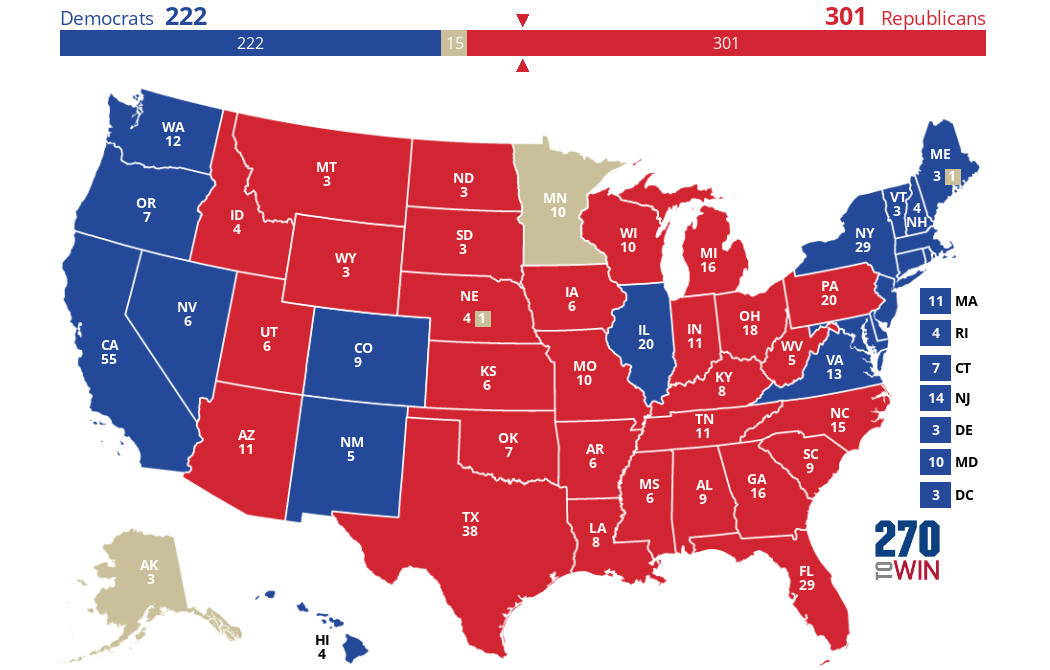
Assume now that Trump gets all the electoral votes in Florida, Georgia, Texas, NC, Wisconsin, Michigan, Ohio and  Pennsylvania because the state legislatures refuse to certify elections. In fact, if we went solely by state legislatures, the electoral map looks like this:


Click the map to create your own at 270toWin.com


Definitely something to keep in mind.

StupidiNews!

Sunday, July 26, 2020

Last Call For All Out, The Family

America is no longer a great place to raise a family, and the precipitous decline in birth rates (not to mention the massive disparity in pregnancy-related deaths among Black and Latino women) mean that increasingly the American dream of a house, two kids and a car are out of reach for the vast majority of us and that the increasingly majority decision by younger Gen Xers like myself, Millennials, and Zoomers now entering their twenties to not raise a family in the US is a completely conscious, if not moral one.

In case you thought America wasn’t experiencing enough turmoil of late, the United States has been named the second-worst wealthy nation in which to raise a family in 2020, according to new research by travel site Asher & Lyric.

“The first time I looked at the data, I was in disbelief,” co-founder Lyric Benson-Fergusson said of the findings in the “Raising a Family Index” (RAFI).

The Los Angeles-based mother of two started the site with her Aussie husband, Asher Fergusson, to help people “stay safe, healthy, and happy at home and while traveling,” per the website’s description.

To determine the most and least family-friendly countries, the couple rated 35 OECD countries (part of the Organization for Economic Co-operation and Development forum) according to safety, happiness, cost, health, education and time.

The US clocked in at an abysmal 34th place, just ahead of last-place finisher Mexico, whose murder rate jumped to the highest in nearly two years as drug cartels have run amok during the coronavirus lockdown. Leading the pack of overall fam-safe nations were Iceland, Norway, Sweden and Finland.


“I think if we, as Americans, are truly honest with ourselves, we might understand why the United States ranks solidly as the second-worst country to raise a family,” said Benson-Fergusson.

Case in point: The red-white-and-blue came in dead last in terms of time — which the RAFI gauged by maternity leave, vacation days and other factors — and cost, as measured by out-of-pocket health spending, cost of living, income ratio and more.

The study noted that the US is the only country that doesn’t require employers to offer maternity leave. Even worse, the average household blows 31.79% of their income on child care compared to the 4 to 10% spent by Scandinavian nations.


Most surprising was America’s global safety rating, which was, according to the research, the second-poorest after Mexico.

Despite statistics showing that reported crimes have been on the decline nationwide, the US homicide rate is still eclipsed only by Mexico, per the research. And America reportedly tops the list in school shootings with a whopping 288 incidents from 2009 to 2018, with Mexico placing second at eight and all other countries recording zero, per the study.

The Land of the Free also came in “fourth-worst” for human rights — here defined broadly across several categories including “protection against enslavement, the right to free speech and the right to education.”

Think about that.  We're 34 out of 35, just ahead of a literal narco-state, and the main reason Mexico's crime rate is so bad is because of our War on Drugs.

Do you blame anyone between 18-45 in not having kids?  Because I'm noticing that it's becoming a majority position for a lot of us these days.

Working The Refs, Senate GOP Edition

With 100 days to go until the election, Senate Republicans are now directly complaining to the media that Democratic challengers aren't being "scrutinized" enough and the GOP wants the Village to start demanding Important Debates In The Age Of Covid.

In Iowa, Sen. Joni Ernst (R) has challenged her Democratic competitor to six debates, starting in August. In North Carolina, Sen. Thom Tillis (R) pressed his Democratic opponent to accept five debates, which he wanted to start in the spring.

And in Maine, Sen. Susan Collins (R) declared that she wants to debate her opponent 16 times, once in each of the state’s counties, starting immediately.

Republicans acknowledge that this upends the usual debate about debates, in which an incumbent rarely wants to give the challenger the same platform. Incumbent senators are pleading with their lesser-known rivals to join them on debate stages, or Zoom, trying to elevate the profile of these Democrats.
But they view this as a matter of necessity in a campaign in which Republicans are running into the head winds of President Trump’s sagging poll numbers amid his stumbling response to the coronavirus pandemic.

And the pandemic has limited campaign activities that are normal for a big Senate race, activities such as state fairs, beach walks and large church services — and without those staples, there are fewer chances for candidates to make mistakes.

Instead, Republicans are growing fearful that Democratic candidates are receiving such little scrutiny that they could steamroll to victory, and to the Senate majority, mostly by raising huge amounts of money that fund smart media campaigns on TV and social media.

“The more voters see their candidates, the worse off they are. This is a very weak crop of recruits,” said Jesse Hunt, spokesman for the National Republican Senatorial Committee.

No writing by WaPo's Paul Kane that the Democrats are not a "weak crop of recruits".  In fact this seems like a straight up NRSC press release.

Republicans think that if they can get on a debate stage with these nominees, they can make them look foolish.

“We’ve invited him — how many times does an incumbent invite a challenger to debates? He’s deferred on all,” Tillis complained in a recent interview with the conservative outlet Newsmax.

Tillis’s campaign has created a logo accusing Cunningham of campaigning from the “DSCC windowless basement.”

Cunningham and Tillis agreed Friday to two debates and are trying to schedule a third, not quite the five the incumbent wanted.

I don't blame the GOP here, they're headed for loss of the Senate unless something changes dramatically overall (very unlikely) or enough changes individually in each race.  But this nonsense where Republicans are demanding eight or ten or sixteen debates is pure working the ref, and I'm glad to see that Democrats aren't falling for the "debate me you coward!" ploy.

Our Village betters though are already vulnerable.  Expect to see a lot more of this in the weeks ahead as they try to create a controversy.


Sunday Long Read: The Most Luxurious Lip-Sync

Author and comic Sarah Cooper has become something of an internet phenomenon by lip-syncing Donald Trump's rambling speeches on social media, and in treating Trump like the gigantic cosmic buffoon that he is, we all get a much needed laugh.

Donald Trump is hard to listen to. That was true even before he was elected president of the United States, but the power he commands now makes hearing from him that much more agonizing. 
At press conferences and rallies, his words tumble out in a furious clutter. Some of it is hateful and frightening. Some of it is incomprehensible, which is alarming for its own reasons. When he submits to interviews, even well-prepared journalists like Leslie Stahl and Chris Wallace look somewhat agog. He said what?

The problem is also his voice. The novelist Lorrie Moore has insisted that it “has music,” but I hear the record skipping. His voice sounds pinched and abrasive, even grating. It sounds condescending. It sounds familiar to women who have been talked over in meetings.

So it comes as a surprise to those of us who once preferred not to listen to it for extended periods of time that that voice has begun to inspire a different reaction—not despair or rage but laughter.

For the past several months, comedian and actor Sarah Cooper has been posting videos to TikTok and Twitter in which she impersonates the president. The imitations set her apart from those who’ve mocked Trump in the past. Unlike Alec Baldwin, who crowned his famous impressions with a flaxen helmet, she makes no effort to look like him. Unlike Stephen Colbert, who has at this point caricatured most members of the Trump clan, she doesn’t even attempt to sound like him.

In truth it isn’t fair to write that Cooper mimics Trump when what she does so well is pantomime him. While his voice rambles on in her videos, Cooper moves her own lips with frightening precision. The result feels like watching the social media era’s first silent film star. The bluster and performance are the point.

Case in point:


Cooper has been doing this bit since April and it's still hysterical.

He's getting exactly what he deserves, and I hope Cooper gets an amazing gig out of this.

Saturday, July 25, 2020

Last Call For Not Even The Ghost Of The Gipper

Not even Zombie Ronald Reagan wants anything to do with Der Trumpenfuhrer anymore.

The Ronald Reagan Presidential Foundation and Institute, which runs the 40th president’s library near Los Angeles, has demanded that President Trump and the Republican National Committee (RNC) quit raising campaign money by using Ronald Reagan’s name and likeness.
“It was simply handled with a phone call mid-last week to the RNC, and they agreed to stop,” Reagan Foundation chief marketing officer Melissa Giller said in an email Saturday.

What came to the foundation’s attention — and compelled officials there to complain — was a fundraising email that went out July 19 with “Donald J. Trump” identified as the sender and a subject line that read: “Ronald Reagan and Yours Truly.”

The solicitation offered, for a donation of $45 or more, a “limited edition” commemorative set featuring two gold-colored coins, one each with an image of Reagan and Trump. The coins were mounted with a 1987 photograph of Reagan and Trump shaking hands in a White House receiving line — the type of fleeting contact that presidents have with thousands of people a year.

“Friend,” the fundraising email purportedly from Trump said, “I just saw our new Trump-Reagan Commemorative Coin Sets and WOW, these coins are beautiful - I took one look and immediately knew that I wanted YOU to have a set. These aren’t any ordinary coins. They symbolize an important time in our Nation. This year, in addition to being re-elected as YOUR President, it also marks the 40th anniversary of our Nation’s 40th President, Ronald Reagan. Unfortunately, we already sold out of the first batch we had in stock. But I liked these coins so much that I asked my team to rush order another batch for my TOP SUPPORTERS ONLY.”

It cautioned: “I’ve authorized a very limited production of these iconic coins, which is why I’m ONLY offering them to our top supporters, like YOU. This offer is NOT available to the general public, so please, do NOT share this email with anyone.”

Proceeds from the coin sales went to the Trump Make America Great Again Committee, a joint fundraising operation that benefits both the Trump campaign and the RNC.

I keep thinking of Reagan's infamous "11th Commandment" -- Thou Shalt Not Disparage Another Republican -- and I laugh for a good fifteen minutes.

Not even Reagan wants anything to do with Trump the Nazi loser.

The Country Goes Viral, Con't

Our old friends at Sinclair Broadcasting are openly working to discredit Dr. Fauci publicly through the dozens of local TV news station that they own, with a horrific lie that may threaten public safety across the country.

Local television stations owned by the Sinclair Broadcast Group are set to air a conspiracy theory over the weekend that suggests Dr. Anthony Fauci, the nation's top expert on infectious diseases, was responsible for the creation of the coronavirus. 
The baseless conspiracy theory is set to air on stations across the country in a segment during the program "America This Week" hosted by Eric Bolling. The show, which is posted online before it is broadcast over the weekend, is distributed to Sinclair Broadcast Group's network of local television stations, one of the largest in the country. A survey by Pew Research Group earlier this year showed that local news was a vital source of information on the coronavirus for many Americans, and more trusted than the media overall. 
In this week's episode of the show, Bolling spoke with Judy Mikovits, the medical researcher featured in the discredited "Plandemic" video that went viral earlier this year and which was banned from platforms such as Facebook and YouTube. Throughout the segment, the on-screen graphic read, "DID DR. FAUCI CREATE COVID-19?" 
Bolling also spoke with Mikovits' attorney, Larry Klayman, a right-wing lawyer who also has a history of pushing misinformation and representing conspiracy theorists. 
During the interview Mikovits told Bolling that Fauci had over the past decade "manufactured" and shipped coronaviruses to Wuhan, China, which became the original epicenter of the current outbreak. Bolling noted that this was a "hefty claim," but did not meaningfully challenge Mikovits and allowed her to continue making her case. 
Klayman, who did not respond to a request for comment, also pushed conspiracy theories about the coronavirus. He said the "origins" of the virus were in the United States. Bolling didn't meaningfully challenge Klayman either. 
In the segment that immediately followed, Bolling spoke to Dr. Nicole Saphier, a Fox News medical contributor, to get her response to the claims from Mikovits and Klayman. 
Bolling and Saphier agreed that it was, in Saphier's words, "highly unlikely" that Fauci was behind the coronavirus. But they went on to theorize about other possible explanations for what had happened. Saphier said it was possible the virus was "man-made within a laboratory" and escaped. That claim has been rejected by experts who have studied the virus' genetic sequence. 

And now millions of people who get their information from the local news station they trust are going to be wondering if Dr. Fauci created the "China virus" to hurt Donald Trump's reelection and to destroy America on purpose.

Sinclair should have their FCC license revoked for this, but of course that won't happen.  But now we have to deal with this on top of everything else.
 

Bluenami Tsunami, Con't

Even grouchy contrarian Josh "The Democrats are always in trouble" Kraushaar now has the Republicans drowning in a tidal wave come November.
.

There are hints of the looming GOP shellacking all over. Joe Biden is up by a whopping 13 points in Trump’s new home state of Florida, according to a new Quinnipiac poll, as close to a must-win as it gets for the president. Trump is trailing in Texas by 1 point, consistent with other surveys showing the president in trouble in a state Republicans have carried in every election since 1976. Democrats are investing millions in Georgia, convinced that they can contest not just the presidential race but both Senate seats up for grabs in the traditionally red state. Democrats provided us with remarkable internal data from reliably Republican House seats—from Oklahoma to Indiana—showing districts that Trump carried by double-digits are now Biden battlegrounds in the presidential race.

Biden is now the heavy favorite to win the presidency. This week, The Cook Political Report declared Democrats are favored to win back the Senate, with a massive Democratic gain of five to seven seats more likely than a narrow Republican majority. And our House race rankings of the most competitive races contained more Republican-held seats than Democratic ones, a stunning dynamic given how many red-district seats Democrats are defending after riding a big blue wave in the 2018 midterms.

Indeed, the last midterm election is a useful benchmark for examining this year’s election. Optimistic Republican strategists are holding out hope that the political environment would be similar to that of two years ago, when Republicans badly struggled in the suburbs but ran competitively in wide swaths of the country. Republicans point out that GOP candidates notched a few significant wins that year despite their overall struggles, winning a big Senate seat and governor’s race in Florida, toppling a couple of red-state Democratic senators, and holding their own in working-class territory where Trump made major gains in his first presidential race.

Right now, replicating that 2018 environment looks like a best-case scenario for Republicans. They’re losing even more ground in the suburbs, forcing the party to write off nearly any district where Trump was already losing ground before. And as the coronavirus continues to spread across the country, Republicans are taking hits among normally dependable white working-class constituencies. The rural heartland of Iowa would normally be a golden opportunity for Republicans to mount a comeback. Instead, GOP Sen. Joni Ernst is struggling against a little-known challenger, and the GOP could whiff on three promising pickup opportunities in the House.
Actions are speaking as loudly for Republicans as the polls. Trump’s decision to dramatically scale back the Republican convention—canceling proceedings in Jacksonville after demanding a packed house full of Trump supporters weeks ago—is a sign of Republicans’ declining fortunes. A clear majority of voters don’t believe Trump has taken the pandemic seriously, and is continuing to punish him and his party for the misconduct. With early voting in many states beginning in two months, there’s not much time left for the president to shake off the widespread perception of incompetence on the biggest issue of the day. Businesses have again been forced to close in major hotspots across the South and Sun Belt, threatening another economic speed bump that Republicans simply can’t afford.

Internal Republican divisions are also beginning to emerge, in ways that suggest the party is already looking ahead to a post-Trump future. Republicans are struggling to find consensus on a new coronavirus-relief package, a fight that pits fiscal conservatives wary of spending additional public money against the risk of economic calamity that awaits if they don’t. Several House GOP hard-liners went after Republican Conference Chair Liz Cheney this week, accusing her of being insufficiently supportive of the president. Cheney, a potential future party leader, fired back by portraying them as political nihilists. In Kansas, outside Republican groups are pouring millions into a primary in a desperate attempt to prevent a hard-right candidate from costing the party an otherwise winnable Senate race.

This is the sign of a political death spiral. At this point, Republicans would be content to suffer through another blue-wave election, holding out hope the Senate could remain narrowly in Republican hands. Right now, Republicans are staring at the reality of a historic tsunami, wiping out all their avenues of power in a rebuke against a hapless president
. 

"Hotline" Josh Kraushaar usually can't get enough of Democratic misery, so for him to openly proclaim a "political death spiral" like this is a pretty good sign for November.

Also this weekend Cook Political Report's Amy Walter moves Florida into Biden's column, giving him an overwhelming electoral college win in November.

Given its track record in presidential campaigns over the last 20 years, it’s hard to think of Florida as anything other than a Toss Up. Since 2000, the winner of the state has never carried it by more than 5 points. In fact, in four of the last five presidential elections, the winner squeaked in by 3 points or less.

But, at this point, this battleground state looks less like a 50-50 proposition and more like a state that is leaning Biden’s way.
To paraphrase CNN’s crack polling analyst Harry Enten; sometimes politics is complicated, sometimes it’s not. Right now, it’s really not. When a major health crisis hits, Americans expect their leaders to handle it. If they don’t, voters will turn against them.

In Florida, as COVID-19 cases started to rise this summer, Trump has seen his vote margin and his job approval rating drop.

In the FiveThirtyEight poll tracker, Trump held a decent — though unimpressive, 47-48 percent of the vote against Joe Biden in the Sunshine state from March through April. By May, it had dropped to 45 percent. He has spent most of June in the 42-43 percent range. Biden’s lead has expanded from 2 points in March to almost 7 points in July.

It’s not just Trump who has seen his numbers slump as the state has struggled to contain the virus this summer. GOP Gov. Ron DeSantis has seen a drastic change in his political fortunes from spring to summer. A Quinnipiac poll released this week found DeSantis’ job approval rating at just 41 percent favorable to 52 percent unfavorable — a 19 point shift in negative opinion since April.

That July Quinnipiac poll found Biden leading Trump by 20 points on who is best able to handle the coronavirus, including an eight-point lead with those 65 and older. For months, Trump has questioned the severity of this crisis. But in Florida, 83 percent of voters see coronavirus as a serious problem, and 66 percent are very, or somewhat worried that they will get this virus. The only group not taking coronavirus seriously are Republican voters; 52 percent say they think the virus is under control.


Back in April, the last time Quinnipiac polled Florida, Biden had a narrow 4 point (46-42 percent) lead. In July, that lead has ballooned to 13 points (51-38). The big changes from April to July were among independents (Biden went from +7 to +16), men (Biden from -6 to +7) and white men (Biden from -21 to -11). Biden also improved his vote among Latinos by 9 points (from +8 to +17).

Trump supporters can criticize Quinnipiac’s recent track record in the state (their final polls in 2018 showed Democrats significantly ahead in both the Governor and Senate races). Even so, theIr final 2016 poll showed a dead heat in a state that Trump won by less than 2 points. More important than any polling, however, is the fact that Trump announced on Thursday that the RNC was cancelling their convention in Jacksonville. This is about all the proof you need that he and the campaign realize how big of a hole he’s currently sitting in.

Florida always finds a way to stay close. And, there’s reason to believe that Trump can win back some of the white men he lost from April to July. But, Biden is better positioned with these voters than Hillary Clinton was in 2016. A July 2016 Quinnipiac poll found Clinton’s favorable/unfavorable rating in the state at a dismal 35 to 59 percent (including 53 percent who viewed her very unfavorably). Opinions of Biden are evenly divided - 43 percent favorable to 43 percent unfavorable. Among white men, 71 percent viewed the former Secretary of State very unfavorably in July of 2016. Biden’s strongly unfavorable ratings among these voters are 44 percent.

Indeed, at this point Cook has Biden at 308 to Trump's 187, with tossups now moving to Trump's firewall states of AZ, GA, NC and Maine's 2nd. And yes, Iowa, Ohio, and Texas are all in play.

Having said that, my usual caveat: Trump's goal is to use COVID-19, federal mercenaries, a depression, and a broken Postal Service to drive turnout to under 40% so he can win.

Take nothing for granted, including your right to vote.

Tales From The Trump Depression, Con't

The moratorium on federal housing evictions expires today, and millions of Americans will be getting 30-day notices to pay up the full amount on rent due or face eviction in August.

The ban on evictions at federally backed properties that Congress passed in March as part of the CARES Act has played a significant role in shielding the nation’s renters from the risk of losing their homes during the pandemic, a ProPublica analysis of eviction cases filed before and during the pandemic shows.

In the months before the passage of the CARES Act, evictions at federally backed apartment buildings made up more than a third of the eviction cases filed in cities like Atlanta and Houston every month, according to ProPublica estimates. In those two cities alone, that amounted to more than 7,700 households a month.

In the months since the law went into effect, eviction filings at those properties have dropped to less than 200 a month on average, making up about 5% of eviction filings in May and June.

The reach of the federal moratorium varied widely by city. While over 40% of evictions in metro Atlanta before the pandemic were at federally backed apartments, that number was just over 20% in St. Louis and around 10% in Milwaukee.

At the same time, ProPublica found eviction filings were also down significantly, if less dramatically, at apartment complexes not covered by the ban. That suggests that other factors — including expanded unemployment benefits and rental assistance programs, an anemic rental market, and state and local court closures and eviction moratoriums — also played a crucial role in reducing the level of eviction cases filed against tenants during the coronavirus crisis thus far.

“The moratorium was just one component,” said Paula Cino, vice president of construction, development and land use policy at the National Multifamily Housing Council, a group that represents apartment owners. “The financial support of unemployment insurance, stimulus checks and other relief, we think that that was really a lifeline and it was successful in helping many Americans meet their housing needs.”

That financial support has allowed most tenants to make the rent each month, Cino said, pointing to survey data her group collects that shows only a small percentage drop in people able to make rent payments in July compared with a year earlier.

But both expanded unemployment payments and the federal eviction ban are set to wind down at the end of the month, and eviction filings have started to tick up in recent weeks as courts in many jurisdictions are either scheduled to or have already reopened.

That sets the stage for a potential crisis for renters and landlords alike if lawmakers don’t extend measures to support renters as Congress returned to session this week, housing advocates say.

“The next three weeks are going to be critically important,” said Diane Yentel, president and CEO of the National Low Income Housing Coalition, a tenant advocacy group. “There will be a bill at the end of it, one way or another, and the scope and extent of it will determine if a tsunami of evictions will happen.”

Without another CARES Act, there will be a massive housing crisis at the end of the month and heading into September. Millions will be evicted into a deadly pandemic and economic depression, and the effects on both will be exponential and brutal.

By Labor Day we will have an unavoidable crisis, and the GOP took millions hostage by sitting on the HEROES Act that House Democrats passed ten weeks ago until the current CARES Act expired. Even if a bill was passed now, it would still take weeks to get things moving again.

It's going to get bad even with a bill, it's too late now.

Should the Senate adjourn for August recess without passing another bill, it's going to be devastating.

Related Posts with Thumbnails